
Hello. This is Inique.
2023 is already just one month away.
It feels like time is passing faster and faster.
And as time goes by, we naturally
experience various changes in our bodies.
As skin sags and wrinkles appear,
we go through natural changes in appearance.
However, no matter how natural it may be,
we all want to be beautiful,
so when we look at ourselves growing older,
it is only natural to feel a sense of regret.
In particular, when we see noticeable changes such as
sagging eyelids or under-eye fat,
it can feel even more disappointing.
Are you, as a person in your 40s,
considering eye surgery right now?
Today, we will look at the types of eye surgery
for people in their 40s, who each type is suitable for,
and the points to be careful about.
If you are worried because you think having plastic surgery
is not very common and must be a special case,
the number of people getting plastic surgery
to improve their appearance is increasing across all age groups.
In fact, according to a survey conducted in 2015*,
one out of three women in their 40s
had considered plastic surgery,
and the eye area was the part considered most often.
Also, one out of ten women in their 40s and 50s
said they had undergone plastic surgery.
*Gallup Korea (2015), Survey on Perceptions of Appearance and Plastic Surgery
Eye surgery typically includes double eyelid surgery and corner-opening surgery,
but depending on the purpose, various procedures such as
lifting and fat repositioning are also performed.
Among them, let’s take a closer look at the procedures
that are referred to as eye surgery for people in their 40s.
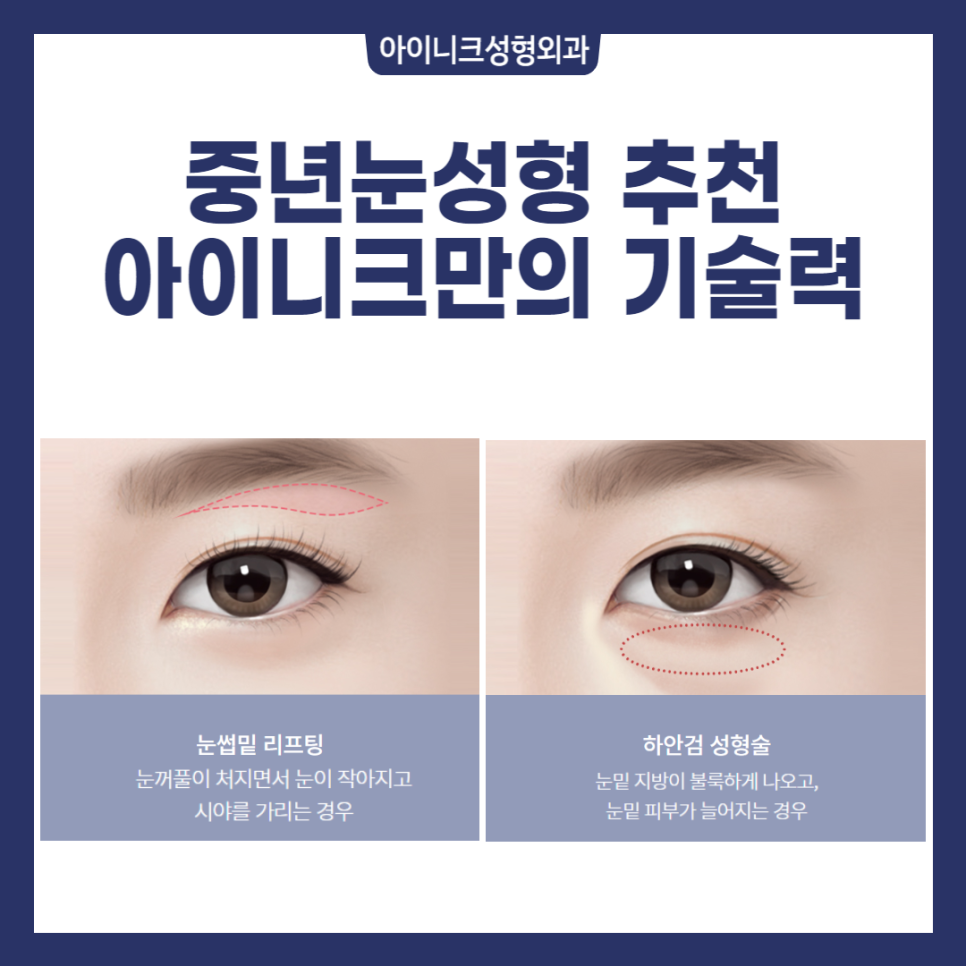
The representative procedures for eye surgery in your 40s
can be broadly divided into two types.
- Lower blepharoplasty
Recommended when the under-eye fat bulges out
and the skin under the eyes has loosened.
- Brow lift
Recommended when sagging eyelids make the eyes look smaller
and obstruct your field of vision.
As the skin elasticity of the eyelids weakens and they sag,
or the area under the eyes protrudes and casts a shadow,
it can look like dark circles, make you look tired,
or make your eyes appear smaller.
Lower blepharoplasty and brow lift surgery
can improve these symptoms,
creating a clear change that can help the eyes in your 40s
look as youthful as those in your 20s.

When under-eye fat bulges out prominently,
its distinct contour draws attention,
and the shadow can make it look like dark circles.
At this point, what can improve the uneven under-eye area
is fat repositioning or lower blepharoplasty.
Fat repositioning smooths the area by redistributing
the protruding fat on the inside of the weakened ligaments
under the eyes.
At this time, because the skin surrounding the muscles
is also stretched,
if the excess skin is additionally removed during fat repositioning,
this is called lower blepharoplasty.
The reason under-eye fat bulges out unevenly
is that the elasticity of the ligaments surrounding the fat weakens
and it extends forward.
This can also happen in people in their 20s and 30s,
which is why many undergo fat repositioning surgery.
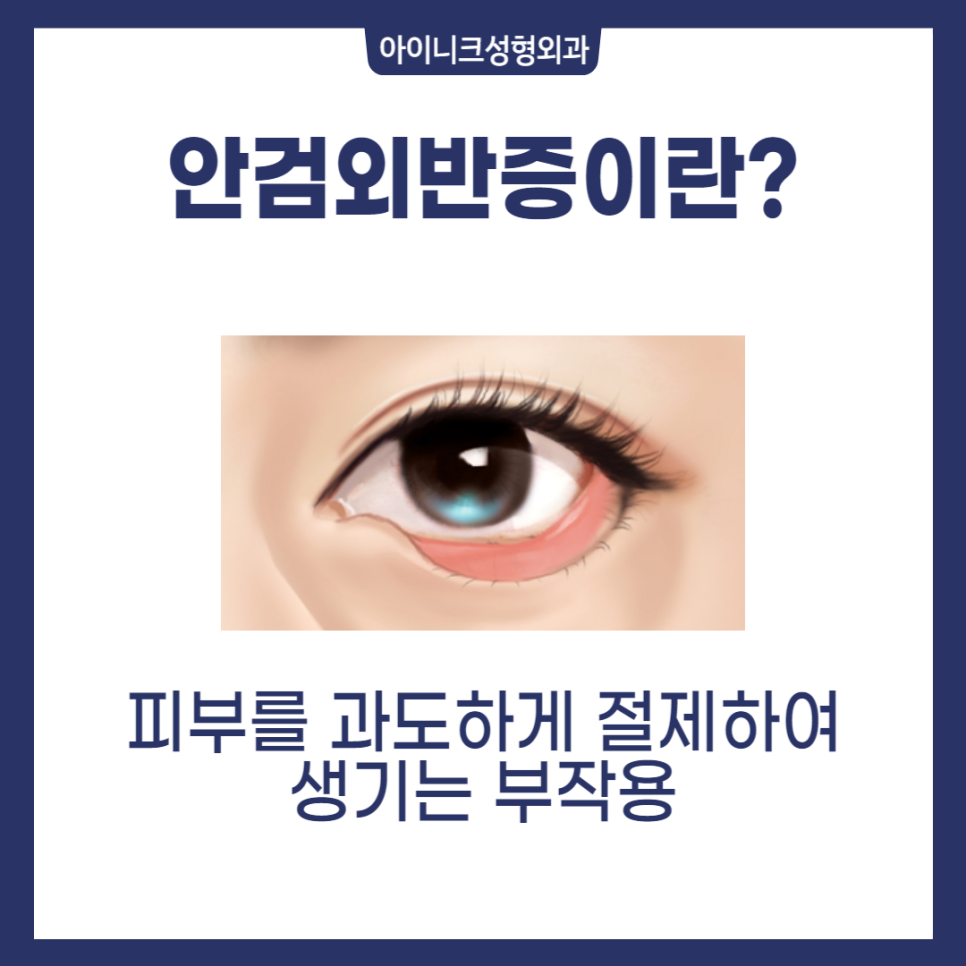
However, when performing lower blepharoplasty,
you should be careful about a side effect called ectropion.
Ectropion is a symptom in which the skin under the eyes turns outward,
causing the inner red tissue to be visible.
It is a side effect that can affect appearance greatly,
as it can also pose hygiene and health risks
and make the eyes look unnaturally white around the iris,
so it must be carefully avoided.
However, if too much of the excessively stretched skin
is removed during lower blepharoplasty,
ectropion may occur.
At Inique Plastic Surgery, to make sure this side effect never happens,
we remove only about 80% of the stretched skin
and perform the surgery in a way that preserves the muscle as much as possible,
bringing the risk of ectropion down to near zero.
If surgery is performed with excessive desire,
the result may be completely different from what you wanted,
and side effects may also occur,
so please choose a clinic that performs surgery carefully
based on extensive experience.
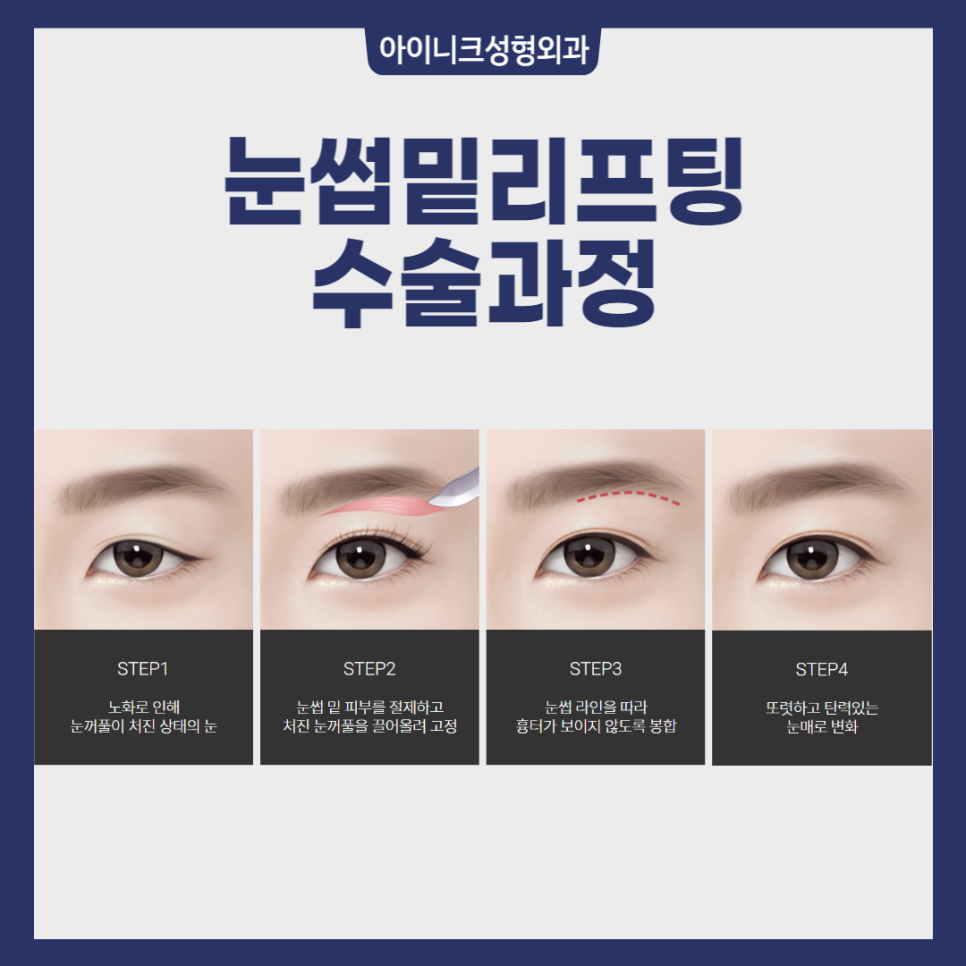
Brow lift is a procedure among eye surgeries for people in their 40s
done to improve sagging eyelids.
When the eyelids have sagged because their elasticity has weakened,
a lift is performed by removing the skin under the brow
and pulling up and fixing the drooping eyelid.
At this time, the incision is sutured along the brow line,
which has the advantage of making the scar barely visible.
Another procedure often mentioned to achieve the same effect
as a brow lift is upper blepharoplasty,
but Inique Plastic Surgery does not recommend upper blepharoplasty.
This is because the result looks unnatural and changes the impression.
The skin of the eyelid is thicker closer to the upper brow,
and becomes thinner toward the lower part.
However, upper blepharoplasty removes the thin part of the eyelid
right above the double eyelid line,
so after surgery, the thicker upper skin comes down to the incision site
under its own weight and creates an unnatural shape.
Compared with upper blepharoplasty, Inique recommends brow lift,
which is more natural and can improve sagging eyelids
with a similar principle.
 If you are considering eye surgery in your 40s,
based on the procedures explained today,
please also consult with a specialist
to receive a more accurate diagnosis.
This is because a direct examination can assess
individual differences in skin condition, recovery ability,
and more.
In the case of eye surgery in your 40s, the procedures needed
can be more diverse and more delicate for each person,
so a clinic capable of performing more precise surgery is necessary.
As a clinic specializing in eye surgery,
Inique Plastic Surgery focuses on providing natural results
through the safest surgical plan,
and helps prevent side effects and minimize patient discomfort
through thorough aftercare.
With experience from more than 5,000 eye surgeries and revision surgeries,
we will restore the beautiful eye shape of your 20s
based on the know-how we have built over time.
As if you had always been beautiful,
that was Inique.
Thank you.