Hello,
This is Inique Plastic Surgery.
When you first meet a stranger,
it is said that a first impression is formed within 7 to 30 seconds,
so an image is created very quickly.
Among these, the eyes have such a major role in determining one’s image
that research has shown they have a significant impact.
For that reason, many people choose eye surgery
in pursuit of a more positive impression.
However, after epicanthoplasty,
if the surgical result is not natural,
and the impression still seems cramped,
or if the red tissue at the inner corner of the eye is exposed,
not only can eye health be at risk,
but you may also experience discomfort in daily life.
In such cases, revision epicanthoplasty becomes necessary.
Because it is a revision surgery, it is important to choose carefully
and receive a clear, reliable result.
Revision eye surgery
Today at Inique,
we will take some time to look at the types of revision surgery
and the process by which reconstruction surgery is performed.
Types of revision epicanthoplasty
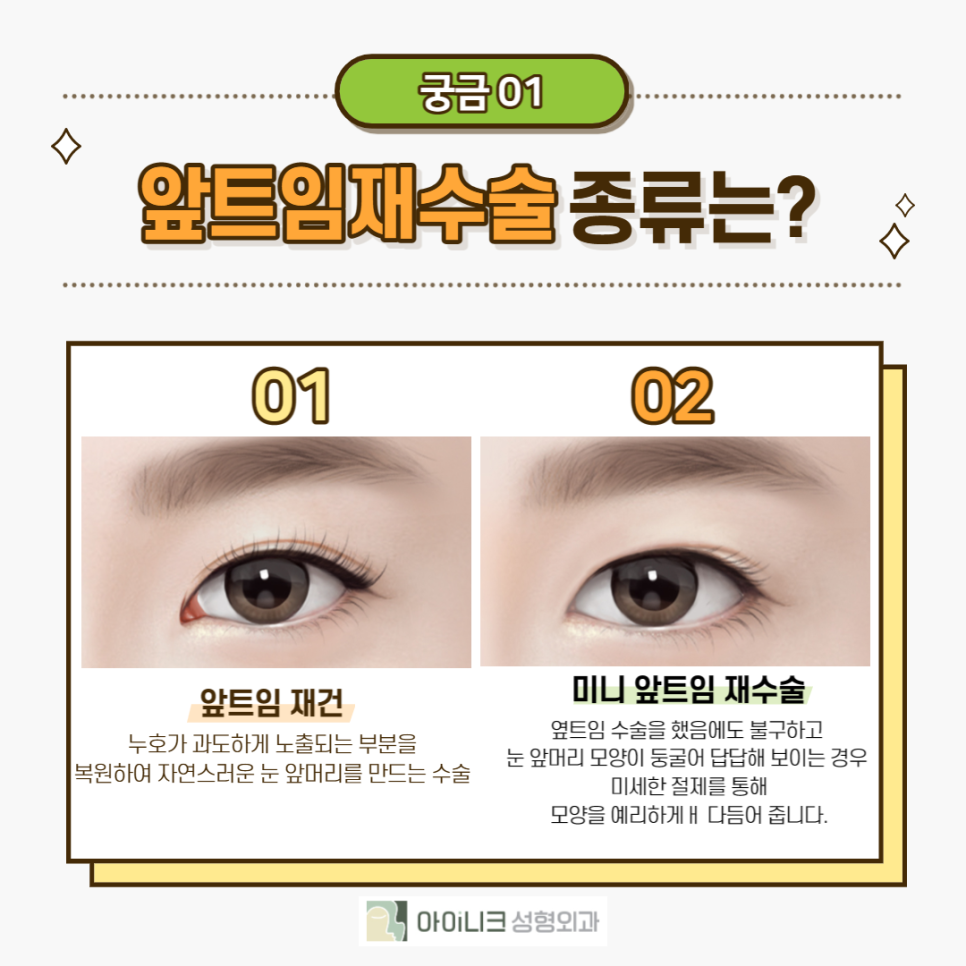
Cases of side effects after epicanthoplasty are
broadly divided into two categories:
when the amount of opening is too much or too little.
First, when the amount of opening is excessive,
the lacrimal caruncle at the inner corner of the eye may be overexposed,
and the eye may appear unnatural.
In addition, because the red tissue inside the eye is exposed,
it may also be harmful to eye health,
and in such cases, reconstructive epicanthoplasty is needed.
On the other hand, when the amount of opening is too small,
even after epicanthoplasty,
those who still have a round, closed-in, and cramped appearance
at the inner corner of the eye are recommended
for a "mini epicanthoplasty" rather than reconstruction.
Inique’s mini epicanthoplasty
improves the shape through a subtle incision,
allowing it to be refined into the look originally desired.
Inique epicanthoplasty restoration surgery

First, in cases of reconstructive surgery due to excessive epicanthoplasty,
the red area visible at the inner corner of the eye is called the lacrimal caruncle.
The ideal amount of exposure of this lacrimal caruncle is about 1/3 to 2/3.
When 2/3 of the lacrimal caruncle is exposed,
the eye may appear unnatural and sharp,
so if too much is exposed,
"epicanthoplasty restoration surgery" should be performed.
At this time, the procedure is performed using "V-Y ADVANCEMENT."
This method involves making an incision along the epicanthoplasty scar, dissecting the skin so it can be moved,
and then closing it with sutures in a "closing a zipper" pattern.
Usually, closing about 1/3 is appropriate,
and if too much is closed, it can instead give a cramped impression,
so delicate surgical skill is required.
Mini epicanthoplasty revision eye surgery

Conversely, in cases where the amount of opening is too small and revision is needed,
"mini epicanthoplasty" is performed to change the shape of the inner corner of the eye
in order to make the eyes look more open.
Mini epicanthoplasty is a procedure that sharpens the inner shape
without changing the amount of lacrimal caruncle exposure,
and by making the rounded inner corner more pointed,
it gives a brighter impression.
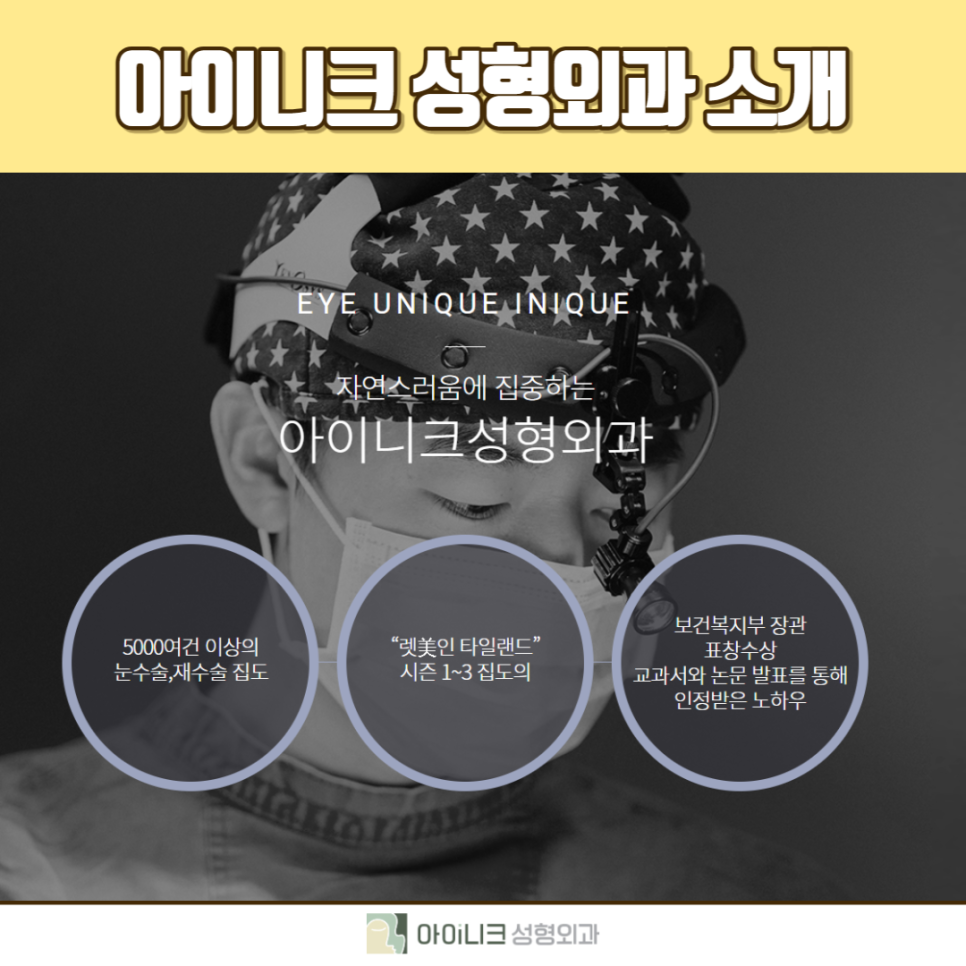
Mini epicanthoplasty is a procedure that requires delicate technique,
and Inique has completed a trademark application with the Korean Intellectual Property Office,
making it a revision eye surgery method available only at Inique Plastic Surgery.
Inique Plastic Surgery, specializing in revision eye surgery,
uses extensive surgical experience and know-how,
along with thorough consultations, analysis, and customized design,
to help recreate the eye shape you originally wanted through revision surgery.
If you would like a more detailed consultation,
click the banner below to receive one.
Until now, this has been Inique,
as if your eyes had been beautiful from the very beginning.
Thank you.