Hello, this is Inique.
The face has the greatest influence on a person’s impression,
and among its features, the eyes play a very large role in that impression.
Clear, bright eyes give a trustworthy feeling,
but eyes that look sleepy due to drooping eyelids
or give off a tired impression
cannot leave a positive image on others.
If this is something you are concerned about,
you may want to suspect ptosis.
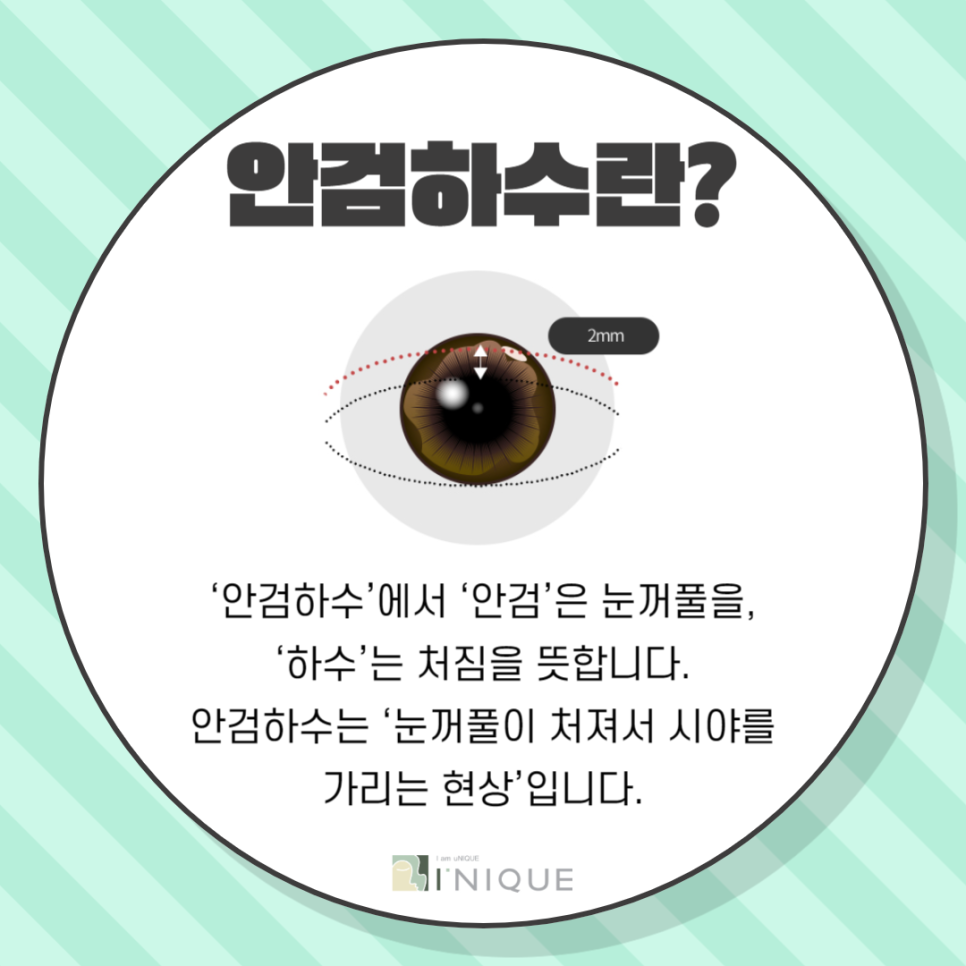
Ptosis is commonly called “sleepy eyes” or “drooping eyelids.”
In general, it refers to a condition in which the eyelid covers the eyeball more than usual,
and medically, if the eyelid covers the eyeball by 2 mm or more,
it is diagnosed as ptosis.
Today, we will take a closer look at the causes of ptosis and eyelid drooping procedures.

First, let’s take some time to check whether I have ptosis.
If people around you often say you look sleepy or dazed,
if your field of vision does not feel fully open and you feel blocked when looking straight ahead,
if you tense your forehead when opening your eyes,
or if your eyelashes keep poking your eyes,
if you have any of these four symptoms,
you may have ptosis,
and ptosis can be addressed through eyelid correction.
Then, let’s take a look at eyelid drooping procedures from here.
To put it simply, the cause of ptosis is that the strength used to open the eyes is weak,
and ptosis can be corrected by strengthening that opening force through an eyelid drooping procedure.
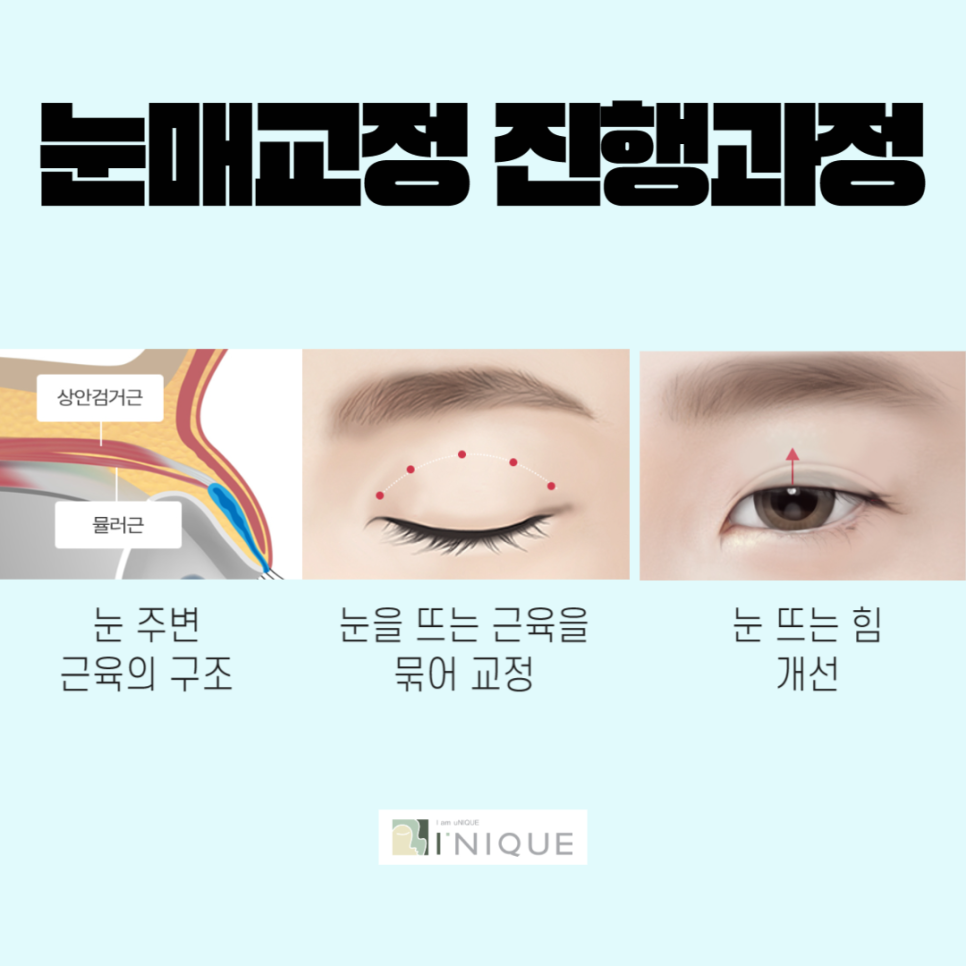
Shall we look at how the eyes open?
The muscles that play the most important role when opening the eyes are the levator palpebrae superioris and the Müller muscle.
When the strength of these two muscles weakens,
the force needed to open the eyes decreases,
and the eyelids end up covering the eyeball more.
Ptosis correction is a method that improves the force used to open the eyes by tightening and shortening the two muscles involved in opening the eyes, the levator palpebrae superioris and the Müller muscle, or by tying the tendon.
Eyelid drooping procedures are divided into non-incisional eyelid correction
and incisional eyelid correction depending on the surgical method,
and from here, let’s look at the differences and the pros and cons of each.
At Inique, we use the non-incisional method rather than the incisional method.
The non-incisional method corrects the muscles through only a few points on the eyelid,
without making a skin incision.
Because no incision is made,
a scar is hardly left,
and recovery is faster,
which is an advantage.
The incisional method lasts longer than the non-incisional method,
but it may leave scars,
and recovery takes longer than with the non-incisional method.
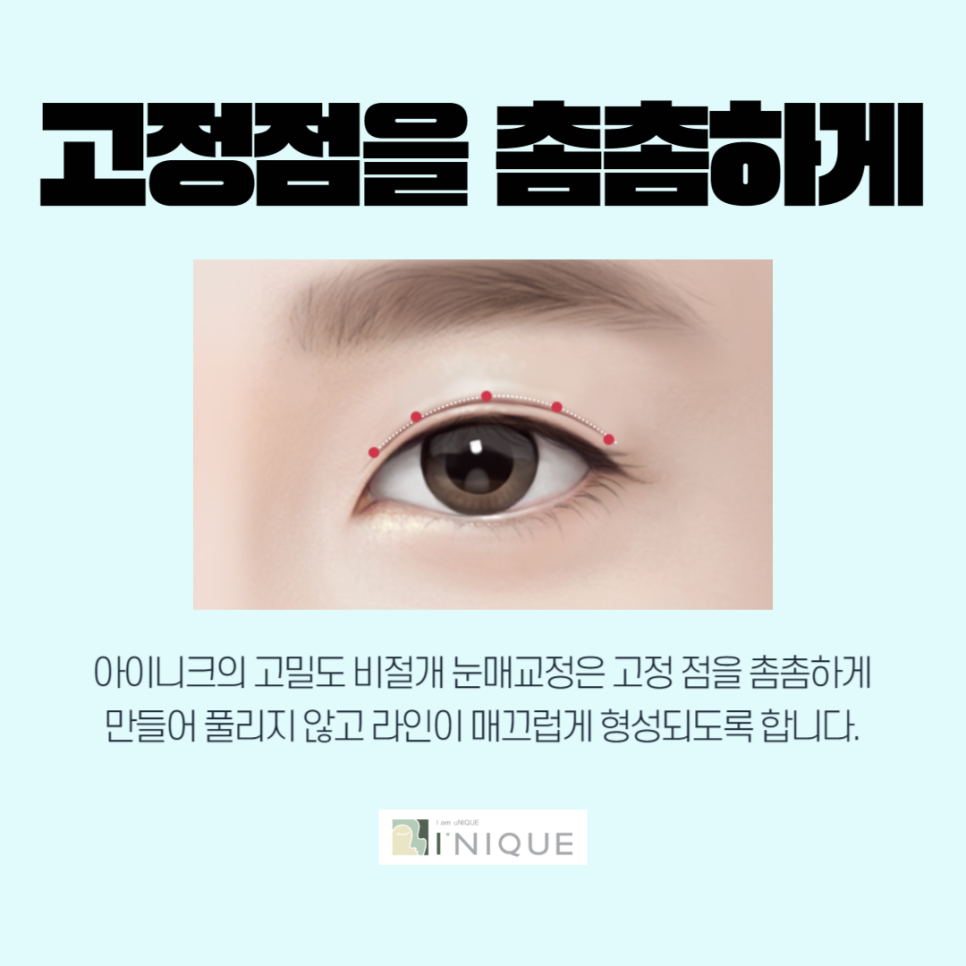
At Inique, along with this non-incisional method,
we also use a high-density correction technique,
which creates correction points densely so that they do not loosen while still forming a smooth line.
By placing fixation points at appropriate locations for each area of the eyes,
overcorrection can also be prevented.
If you are considering treatment for ptosis, also called “sleepy eyes,”
it is important to find a trustworthy hospital.

Inique Plastic Surgery is a specialized plastic surgery clinic for eye surgery,
with more than 5,000 eye surgery cases performed.
It has been recognized for its unique technology and know-how through a patent application to the Korean Intellectual Property Office,
receiving a commendation from the Minister of Health and Welfare, and more.
In particular, Representative Director and Surgeon Hae-won Yang has been recognized for his skill through extensive surgical experience,
receiving a commendation from the Minister of Health and Welfare,
and an award for excellence in medical records from Samsung Medical Center’s Kangbuk Samsung Hospital, among other honors.
If you are worried about eyes that look sleepy, now is the time to come together with trustworthy Inique.
We will do our best to deliver the most satisfying results through minimizing patient discomfort,
providing customized consultation and surgery,
and thorough aftercare.
Then, from the beginning to make it look as if it had always been beautiful,
this was Inique.
Thank you.