Hello, this is Ainique.
Although plastic surgery has become more mainstream than in the past,
because it still involves the process of incision and suturing,
it remains a “surgery”
and requires a certain recovery period,
so it is only natural to be cautious
and to worry about possible side effects or results.
If you underwent eye surgery with high hopes
for the look you wanted,
but the results were less satisfying than expected
or side effects occurred
and are affecting daily life,
you may have no choice but to consider
Apgujeong epicanthoplasty revision surgery.
However, because the first surgery already ended in failure,
you have no choice but to be even more careful
when choosing a plastic surgery clinic for revision surgery
to prevent another bad outcome.

Today, together with Ainique,
let’s take a look at cases where Apgujeong epicanthoplasty revision surgery is needed
and the methods currently being used.
You may want to receive Apgujeong epicanthoplasty revision surgery
as soon as possible,
but because the skin has already been damaged
due to the first surgery,
it is better to proceed after the wound has healed to some extent.
At Ainique, we generally recommend
performing epicanthoplasty revision surgery after 6 months,
as this is also the stage when the hardened scar tissue begins to soften.
However, if the condition is severe enough,
Apgujeong epicanthoplasty revision surgery can be performed immediately.

In most cases, Apgujeong epicanthoplasty revision surgery is decided on
when the initial surgery has resulted in either overcorrection or undercorrection.
The purpose of the incision is to properly refine the inner epicanthal fold
so that eyes that look cramped and small
can appear more open.
However, if the lacrimal caruncle is exposed too much
and the red area becomes highly visible,
or if the inner corner of the eye still looks round and cramped
even after epicanthoplasty,
an appropriate method can be selected depending on the current condition.
So, in cases of excessive lacrimal caruncle exposure,
epicanthoplasty reconstruction can be performed,
and if the incision is insufficient and the eyes still look round,
a mini epicanthoplasty can be performed.

The most important point in Apgujeong epicanthoplasty revision surgery
is how much the lacrimal caruncle is exposed.
Generally, the ideal amount of lacrimal caruncle exposure
is considered to be about 1/3 to 2/3.
However, if more than 2/3 is exposed,
the eyes may look sharp
and the impression may become unnatural.
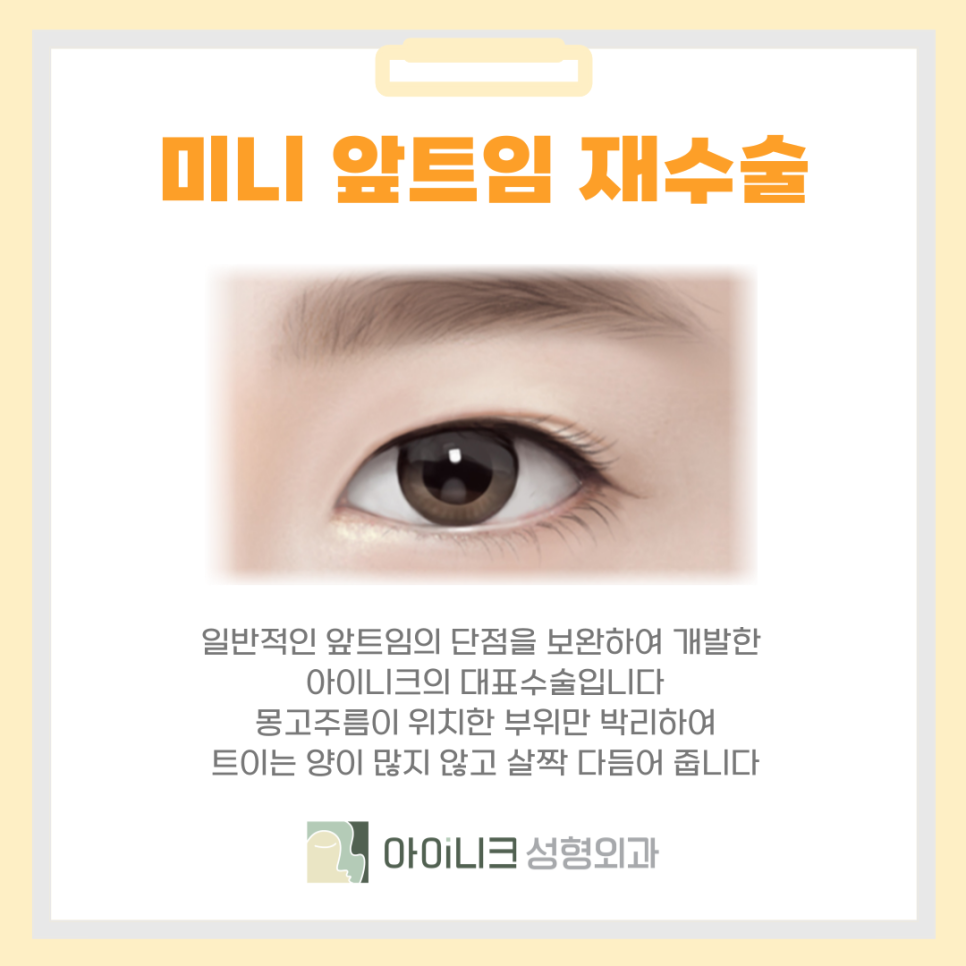
Ainique’s Apgujeong epicanthoplasty revision surgery,
mini epicanthoplasty,
is performed by improving the shortcomings of the conventional incision procedure.
In epicanthoplasty, the appropriate amount of lacrimal caruncle exposure is important,
but the shape of the inner corner of the eye is also important.
In other words, even if the amount of visible lacrimal caruncle is appropriate,
if the inner shape is round,
it can still create a cramped impression.

Mini epicanthoplasty can be a suitable method
for people who have already undergone the procedure
but still feel that their eye shape looks cramped.
It works by slightly refining only the area with the inner epicanthal fold,
so the amount of opening is relatively small.
In other words, by not excessively resecting the epicanthal fold
and removing only part of it appropriately,
it is possible to complete a more open-looking eye shape more safely
without changing the amount of lacrimal caruncle exposure.
Today, together with Ainique,
we provided a detailed explanation of when Apgujeong epicanthoplasty revision surgery is needed
and the know-how currently being used.
To always deliver satisfying results,
Ainique will continue to do its best.
If you want to overcome a first failure
and have the area reconstructed,
please feel free to contact us anytime.
Thank you.