
Hello, this is iNice.
As time goes by, the importance of appearance
is becoming greater and greater.
As the saying goes, “When choosing, the red skirt is better,”
when conditions are the same, people often
choose the better option.

Applying this saying to appearance,
when there are people with the same credentials and abilities,
the person with a more positive and appealing appearance,
even by a little, may be chosen.
For this reason, outstanding appearance
becomes a tremendous advantage in modern society,
and many people decide to undergo plastic surgery
to improve what they feel are shortcomings in their looks.
And among plastic surgeries, many people want eye surgery,
which is the most familiar and
can be expected to bring clear changes.
In general, when people think of eye plastic surgery,
the most well-known procedure is
double eyelid surgery.

Of course, double eyelid surgery
can also be a way to create attractive eyes.
However, the method introduced today by iNice is
ptosis correction surgery.

As the word “correction” suggests,
it is easy to understand this as a procedure that
improves the shape of the eyes
into a prettier and more pleasing appearance.
Many people choose ptosis correction surgery
to improve both the aesthetic and functional issues
of the eyes.
So from now on, with iNice,
we will explain in detail why ptosis correction surgery is needed,
as well as the procedure and its principles.

Ptosis correction surgery is most commonly performed
by people with ptosis who have drooping eyelids
and therefore a tired, sleepy-looking impression.
In addition, even if it is not ptosis,
those who naturally have weak eyelid-opening strength
and use their forehead every time they open their eyes
can also consider ptosis correction surgery.

People who use their forehead muscles because their eye-opening strength is weak
are highly likely to develop forehead wrinkles,
and simply using that much force
can cause significant fatigue
and may lead to a need for improvement in other areas.
In addition, if the sizes of the two eyes are asymmetrical,
or if the eyelids obstruct the field of vision too much,
those who feel discomfort
may consider ptosis correction surgery.

In simple terms, ptosis is
a condition where drooping eyelids obstruct the field of vision.
In other words, it is a term related to the amount of exposure of the black pupil,
and the ideal degree we generally consider is when, upon opening the eyes,
only about 1 to 2 mm of the area above the black pupil is covered,
and the rest is fully visible.
However, if more than 2 mm of the black pupil is covered,
it can give a sleepy appearance and suggest weak eye-opening strength,
and this is diagnosed as ptosis that requires ptosis correction surgery.
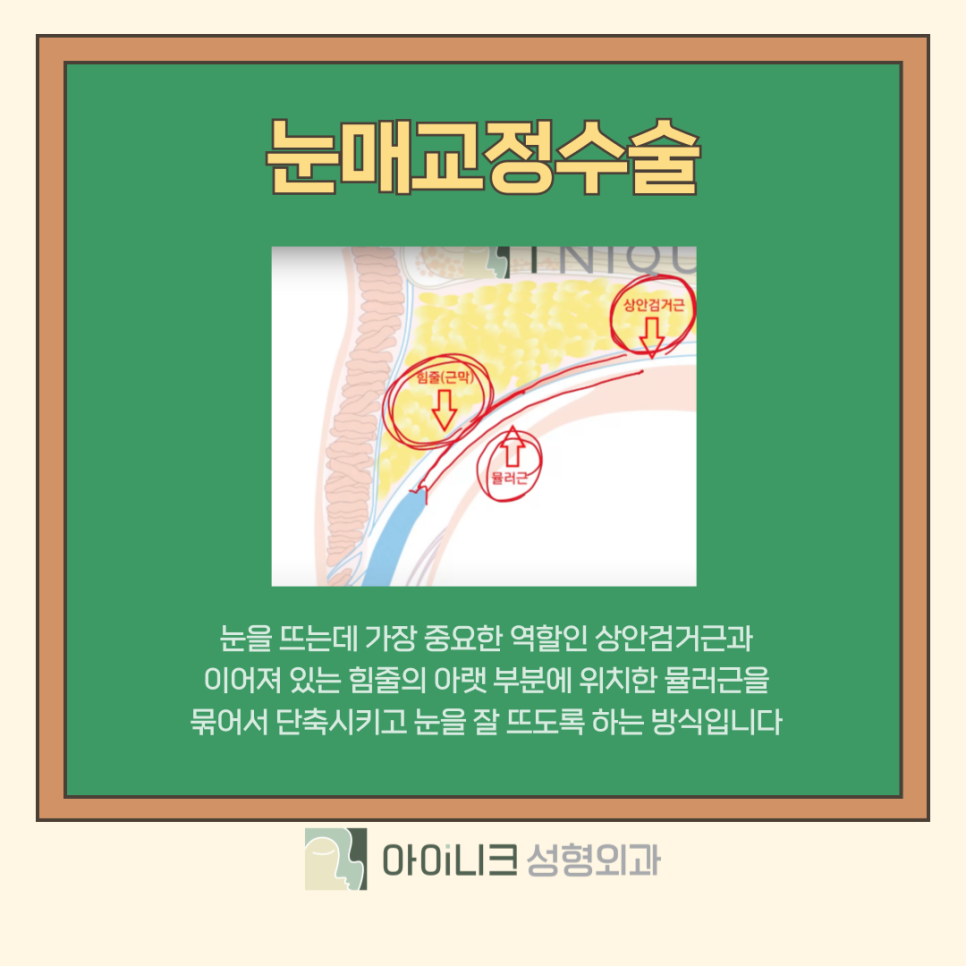
Looking closely at the structure of the eye,
there is a muscle called the levator palpebrae superioris,
which plays the most important role in opening the eyes.
This muscle is connected by a tendon
that attaches to the eyelid.
Also, a very thin muscle called the Müller muscle
works together beneath this tendon,
so ptosis correction surgery is a procedure that binds and shortens
the tendon fascia and Müller muscle
to help the eyes open more easily.
Ptosis correction surgery includes both non-incision and incision methods,
and first, let’s take a closer look at the non-incision method.

Non-incision ptosis correction surgery means
correcting the eye shape without making an incision.
This can be understood as being similar to
buried-suture double eyelid surgery.
Because no incision is made,
the surgery time is relatively short
and the recovery period is also relatively brief,
making it a highly preferred method.
At iNice, when performing ptosis correction,
we sufficiently increase the number of fixation points
to help the eyes open well
and reduce the likelihood of the correction coming loose,
thereby increasing durability.

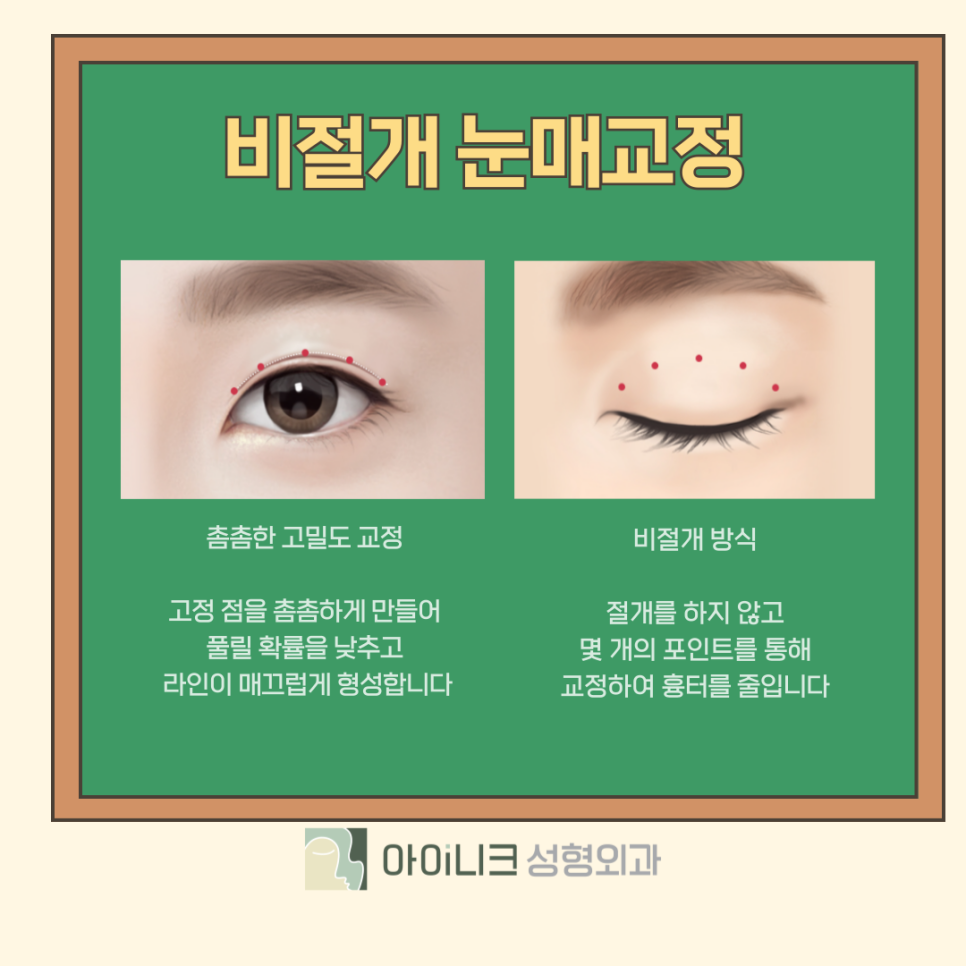
The methods used for ptosis correction at iNice
include dense high-density correction
and the non-incision method.
First, dense high-density correction
creates closely spaced fixation points
to produce a smooth line,
and by fixing at an appropriate position
taking the eye area into account,
it can help prevent overcorrection.
Second, the non-incision method
uses a few points without an incision
to correct the muscle.
It leaves almost no scar
and allows for quick recovery.

Director Yang Hae-won of iNice’s
non-incision ptosis correction know-how has been published in the U.S. text
AESTHETIC PLASTIC SURGERY OF THE EAST ASIAN FACE,
which shows the level of skill and expertise involved.
In addition, with the know-how accumulated through extensive experience
performing eye surgery and revision surgeries,
as well as an aesthetic eye for pursuing results that become naturally beautiful,
iNice always aims for natural beauty.

Today, we looked in detail at the methods of ptosis correction surgery
and the cases of people who need it.
Since each person has different facial features, eye shape, and skin condition,
it is important to proceed with the method that suits you best
through sufficient consultation when it comes to eye plastic surgery.
If you have questions about ptosis correction or eye plastic surgery,
or if you would like a consultation,
please contact iNice.
This has been iNice, as if you were pretty from the start.
Thank you.