
Hello, this is iNique.
The desire to become more beautiful
is a wish that everyone has,
regardless of age or gender.

That is why these days, regardless of gender or age,
many people seek plastic surgery
to improve areas of their appearance they feel are lacking.

Because of this, perceptions of plastic surgery
have become much more mainstream than in the past.
In the past, plastic surgery was sometimes seen as
a burdensome or uncomfortable subject,
but today it is viewed as a means of
changing one’s less satisfying appearance
in a positive direction.

The areas people feel are lacking differ from person to person,
so procedures can be performed on various areas
such as the jaw, eyes, or nose.
But one of the most popular and familiar
and well-known procedures is double eyelid surgery.

There are also various methods, including the buried suture method and the incision method,
and different shapes such as in-line, in-out line, and out-line,
so the procedure can be planned according to each person’s desired design and what suits them well.
However, although many people undergo double eyelid surgery
to achieve larger, more striking eyes,
it does not always lead to satisfactory results.
In particular, the double eyelids may loosen
or multiple folds may form,
which can create a situation where revision surgery is needed.

Depending on the person, if the condition is severe,
some people may have such difficulty that it becomes hard to go out
or carry out social activities.
In such cases, because the skin and tissue have been damaged,
there are people who worry about what to do next.

For those people, today at iNique,
we will explain not only the method and know-how for reconstructing failed double eyelid results,
but also the appropriate timing for double eyelid revision surgery.

The generally recommended timing for double eyelid revision surgery
is after 6 months have passed since the operation.
The reason is that after a surgery has already been performed once,
damaged skin and tissue need enough time to recover well,
the swelling needs to subside,
and the tissue needs time to stabilize.
However, if the result is so severe that daily life is difficult,
or in the case of those who had the buried suture method,
because swelling is relatively less and recovery tends to be faster,
it may be worth considering moving the timing forward
without waiting the full 6 months.

The reasons revision double eyelid surgery may be needed
can be broadly classified into three categories.
First, when the double eyelid crease has loosened and the eyelid has become layered.
Second, when there is a lack of soft tissue above the eyes.
Third, when adhesion has occurred as a result of surgery.
Because the appropriate revision method differs depending on each condition,
it is important to accurately diagnose your own condition
and, along with the timing of double eyelid revision surgery,
carry out thorough planning, consultation, and design.

The first type is when the double eyelid fixation has loosened,
or the holding strength has weakened,
resulting in a layered double eyelid shape.
In this case, the loosened double eyelid needs to be firmly fixed.

A method that can be good to try at this time
is iNique’s Smooth Incision Method.
The key to this method is adjusting the depth of fixation
while maintaining a natural and not awkward appearance.
By making about 7 to 9 point fixations generously,
and keeping the line spacing narrow,
you can expect a smooth result without irregularities.
In particular, the inner part of the eye,
which is considered an area where loosening can easily occur,
is finished firmly with deep fixation.
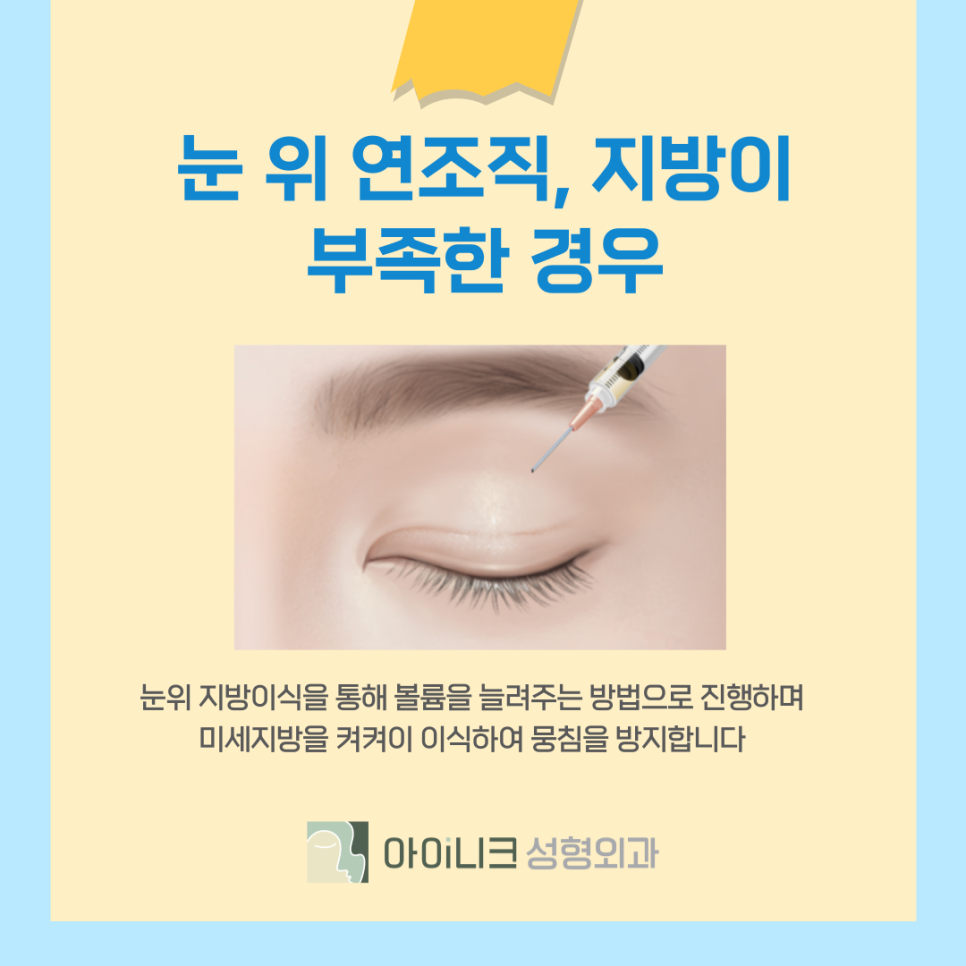
Looking closely at the shape of the eyelid,
it is made up in the following order:
skin, muscle, soft tissue, and fat.
In types with a lack of soft tissue and fat,
the skin above the double eyelid may appear sunken,
which can cause a crease above it (a triple fold).

When there is insufficient fat and soft tissue like this,
a process to restore missing volume is needed.
A microfat grafting method can be attempted,
and it should be performed by adjusting the amount appropriately
so that it does not clump or become uneven.
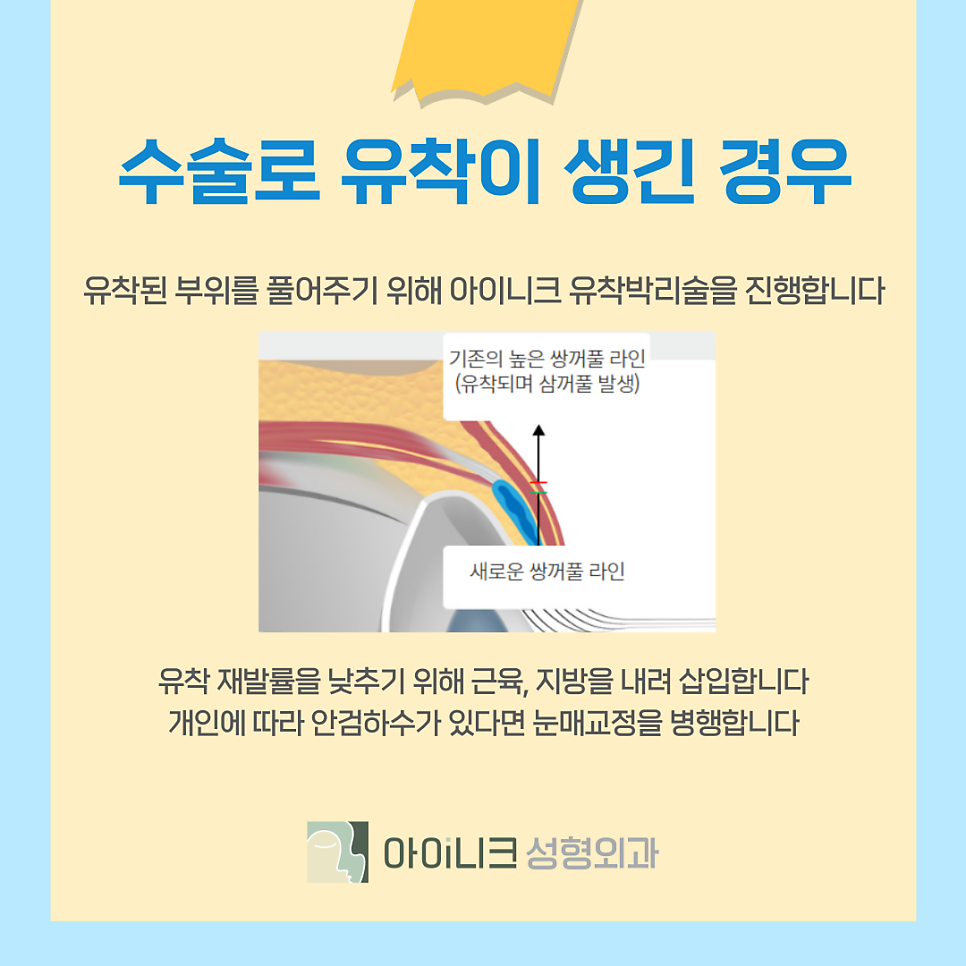
When adhesions occur due to the first double eyelid surgery,
adhesion may develop along the original double eyelid line,
causing multiple folds in the eyelid.
In such cases, the adhered area is released,
and iNique’s adhesion release procedure is performed as a preventive method
to reduce the chance of recurrence.
This method releases the adhered area,
and to lower the recurrence rate,
muscle and fat are lowered and inserted.
Depending on the person’s condition,
if they also have ptosis and their eyes look sleepy and heavy,
eye correction may be performed together.

Today, together with iNique,
we explained the timing for double eyelid revision surgery
and reconstruction know-how.

If you would like a detailed consultation,
please click the button below.
As if you had been beautiful from the start,
this was iNique.