
Hello, this is iNick.
The human body has no part that is unimportant,
but among them, the eyes are more than just organs that brighten our vision;
they play a key role in protecting our daily lives.
Through the eyes, we recognize the colors and shapes of the world
and feel moved by them, and we can also detect subtle movements
and changes to avoid dangerous situations.

In addition, because the eyes are the first to detect
a person’s expression, an approaching object,
or even a brief flash of light and send us signals,
even a small abnormality can have a major impact on daily life.
The eyes are not only important functionally
but also carry significant weight in medical appearance.

Among the factors that determine a first impression,
the eyes are where attention lands first,
and depending on the size, line, and expression,
they can create anything from a soft and friendly impression
to a refined and clear atmosphere.
However, if there are symptoms such as ptosis,
where drooping eyelids cause functional and temporal discomfort
with the eyes,
you may feel frustrated yourself, and from an aesthetic standpoint,
they can give off a tired and sleepy impression,
which can become a complex in social life.

One way to improve these ptosis symptoms
is eye contouring surgery.
However, given that the eyes are a very sensitive
and critical area,
the procedure must be done at a place that is careful and highly skilled.
Today, iNick will take a detailed look
at how eye contouring surgery is performed
for those struggling with ptosis.
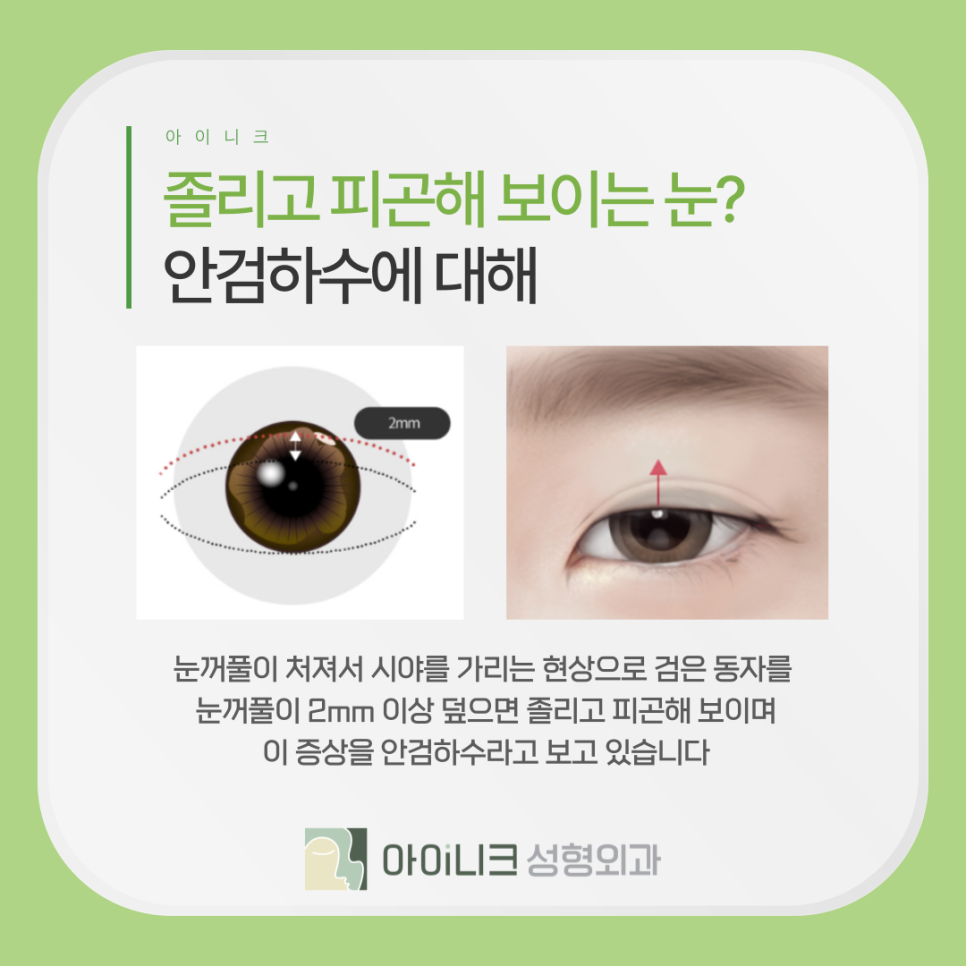
To briefly explain ptosis that requires eye contouring surgery,
it refers to a condition in which the drooping eyelids
block the field of vision.
If the eyelid covers more than 2 mm of the iris,
it can make the eyes look sleepy
and be considered ptosis.

Even if you understand what symptoms ptosis shows,
when you try to check your own condition,
you may still be unsure whether it is really ptosis
that needs eye contouring surgery or not.
For people like this, iNick has prepared
a self-diagnosis test for ptosis and eye contouring surgery.
First, you often hear that you look dazed and sleepy.
Second, when looking ahead with your eyes,
you feel a stuffy or cramped field of vision.
Third, you strain your forehead every time you open your eyes.
Fourth, your eyelashes keep poking your eyes.
If these characteristics apply,
ptosis may be suspected.
iNick’s eye contouring method to improve this
uses eye-correction surgery.

iNick’s eye-correction method
analyzes the structure of the muscles around the eyes
and shortens them by tying together
the muscles used to open the eyes:
the Müller muscle and the levator palpebrae superioris.
Through this, the drooping eyes are corrected,
and improvement in the strength used to open the eyes
can also be expected.
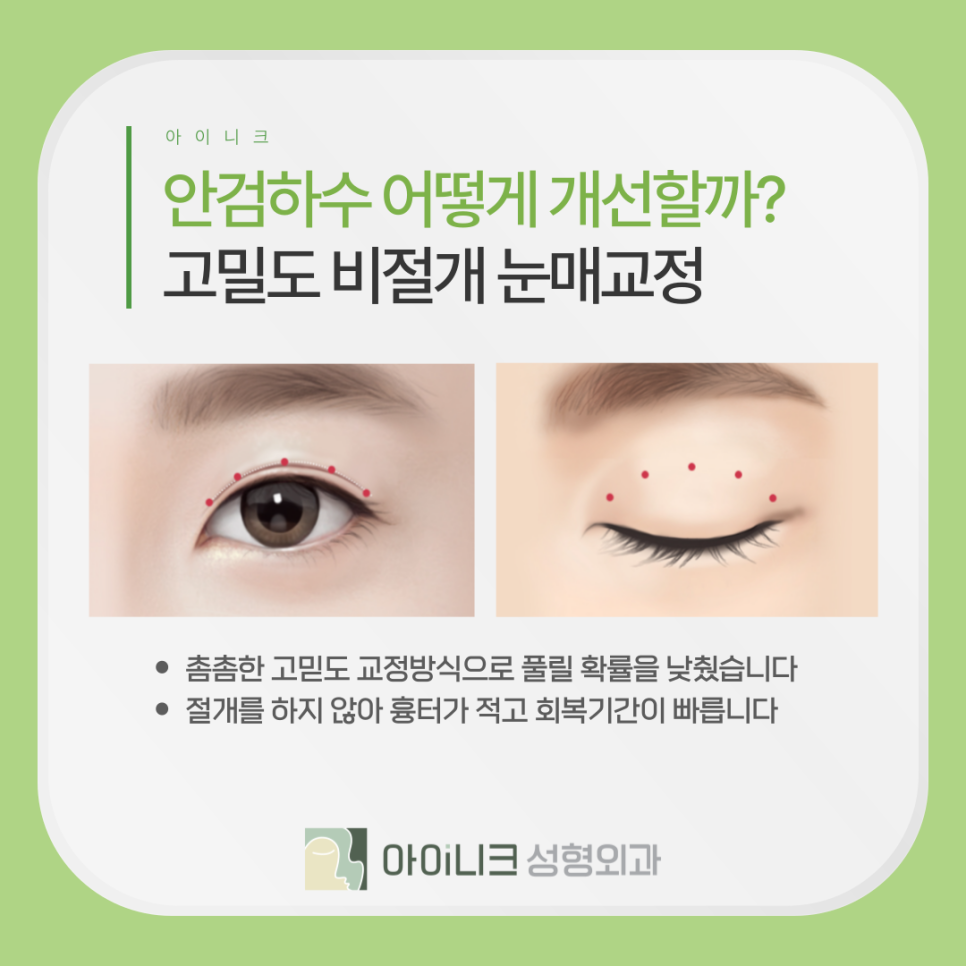
We are performing eye contouring surgery
through high-density non-incisional eye correction.
As the name suggests, this method corrects the muscle
by using the buried-suture method without making an incision.
By creating points without an incision
and correcting the muscle densely,
there is less scarring and the recovery period
after surgery can be shortened.

With diverse know-how and skill in eye surgery,
and recognized through various activities,
iNick has extensive experience in many eye surgeries and revision surgeries,
and Director Yang Hae-won of iNick
had content about non-incisional eye correction and the buried-suture method
published in an American textbook.

So far, we have provided detailed information
about ptosis symptoms, self-diagnosis,
and how to correct ptosis through eye contouring surgery.
If you have any questions or would like a consultation,
please click the channel link below.
Thank you.