
Hello, this is Ainic, an under-eye clinic.
Every time you look in the mirror,
your under-eye area looks dark and has dark circles,
appears bulged,
and the dark circles are so severe that
eye makeup alone cannot fully cover them.

Today, for those who are concerned about under-eye dark circles
or under-eye hollows and bulging,
let’s look at what causes them
and what solutions are available.

There are various reasons why dark circles appear,
but the main factors that cause them
can be broadly divided into two types.
First, a problem with the skin itself.
This is when there is pigmentation under the eyes
or blood vessels are visible through the skin.
In such cases,
they can be improved through melanin-targeting lasers or
vascular lasers.

In particular, excessive melanin production or
capillary dilation is more noticeable around the eyes,
where the skin is thin, and dermal pigmentation accumulation
and blood flow stagnation act together.

Second, a structural problem with the fat.
This is when there is a structural issue with the under-eye fat.
In such cases,
under-eye fat repositioning is needed.
This refers to the shadow being formed due to
protrusion of orbital fat and weakening of the orbital septum,
which is an anatomical cause rather than a simple pigmentation issue.
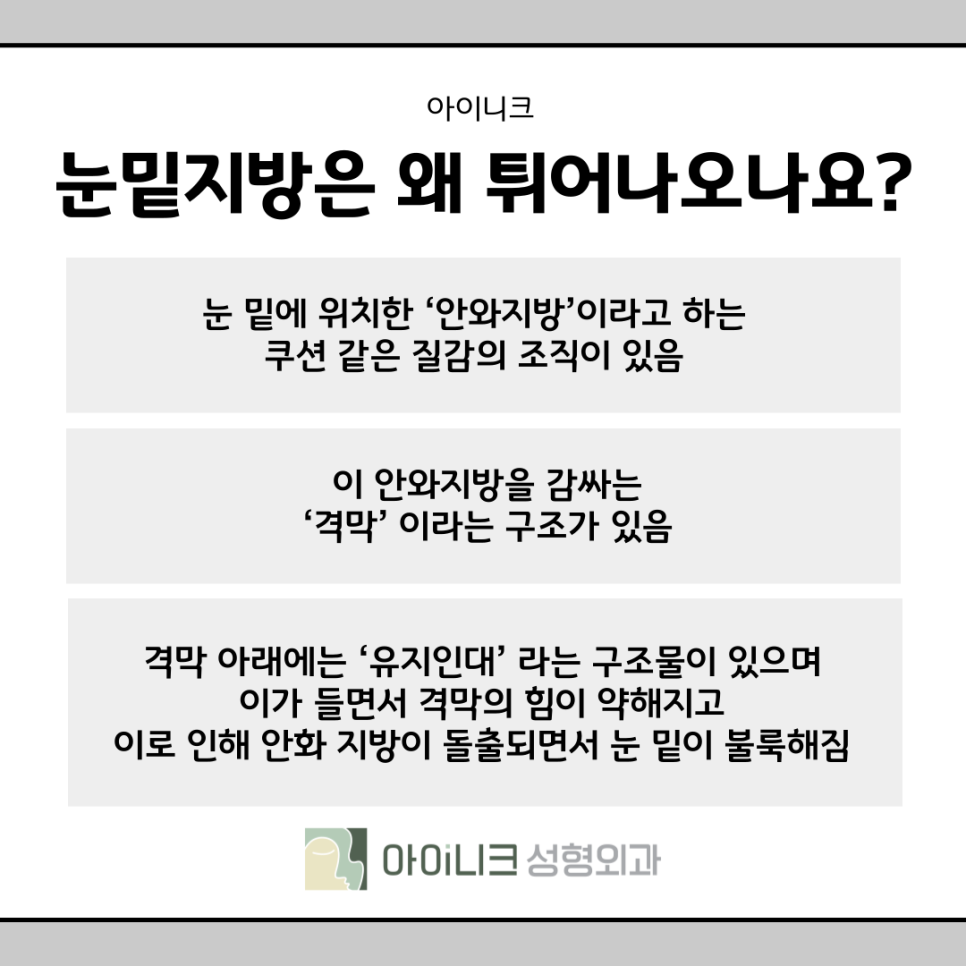
Many people wonder why under-eye fat bulges out.
Looking at the reason from an anatomical perspective,
there is a cushion-like tissue under the eyes called
"orbital fat."

And there is a structure called the "septum" that surrounds
this orbital fat.
Beneath the septum is a structure called the "retaining ligament,"
which connects the bone and skin.
However, as we age, the strength of the septum weakens,
and as a result, the orbital fat protrudes,
causing the under-eye area to bulge.

In addition, because the retaining ligament is relatively
firmly attached to the bone,
this area can become a hollow groove.
As a result, that bulging and hollow groove forms a shadow
under the eyes and can contribute to dark circles.
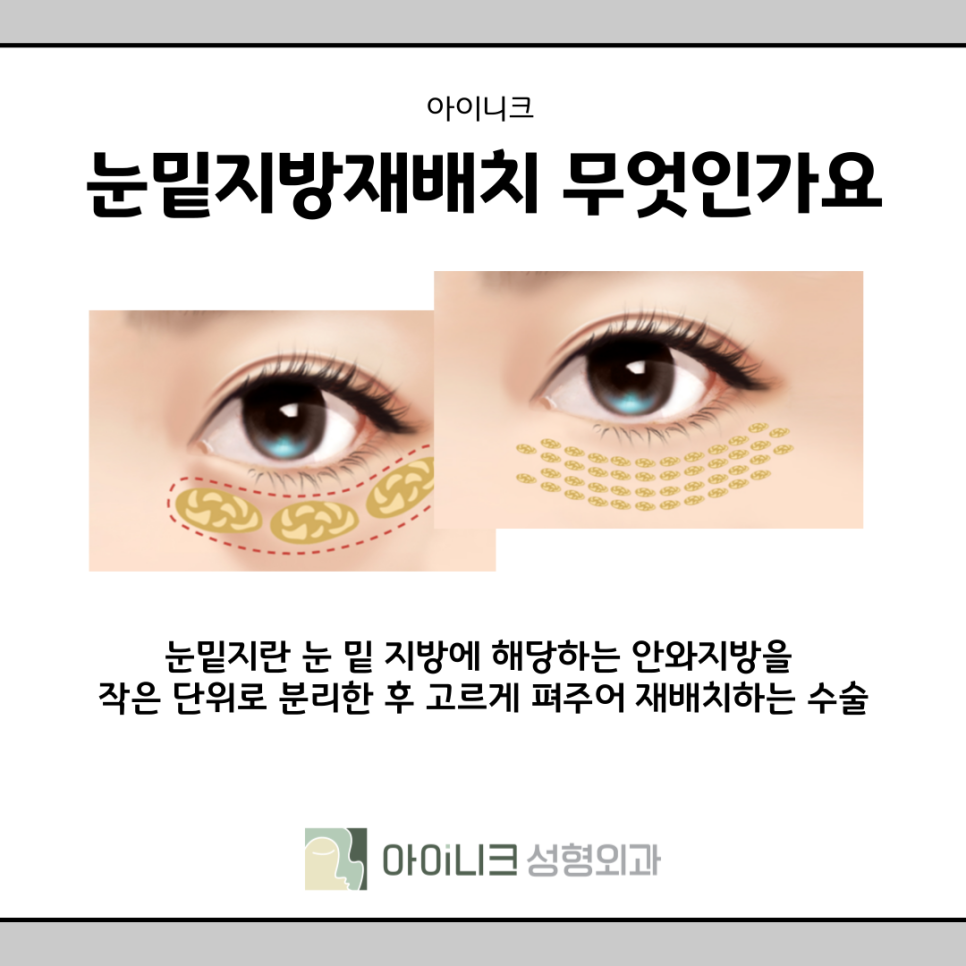
What is under-eye fat repositioning? It is a procedure that
divides the orbital fat under the eyes into small units
and then spreads it evenly to reposition it.
A notable feature of this procedure is that
the surgery can be performed through an incision inside the eyelid
without making an external incision on the skin.

In particular, by accessing through the conjunctiva,
skin damage is minimized and recovery is relatively fast.
Because of these features, there is almost no visible scar
from the outside.
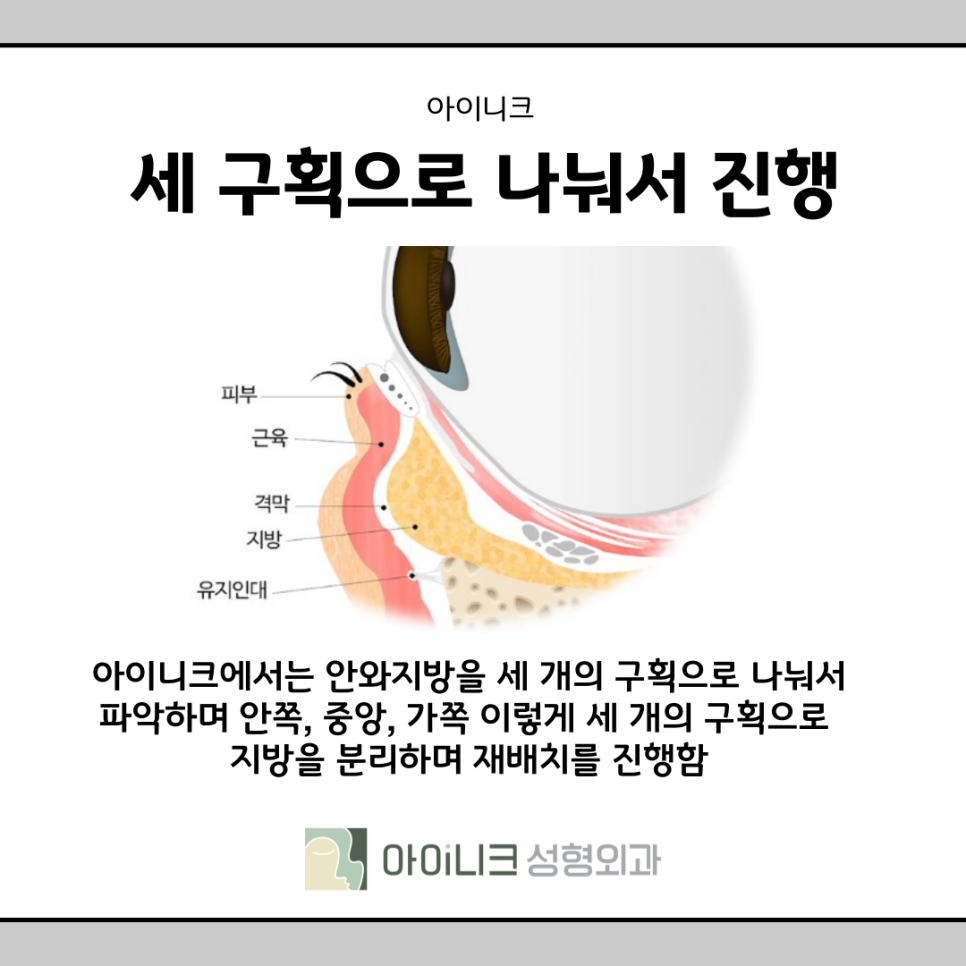
At Ainic, an under-eye clinic,
we identify the orbital fat in three compartments.
The fat is divided into three compartments:
the inner, center, and outer areas.
By checking it this way, we precisely remove the parts that need
to be removed appropriately
and then proceed with repositioning.
At this stage, it is important to analyze the degree of protrusion
and hollowness in each compartment together,
avoid excessive removal,
and maintain natural volume.

Temporary improvement with fillers is also possible.
However, orbital fat caused by weakening of the septum
is difficult to improve with fillers.
In addition, grooves fixed by the retaining ligament
cannot be improved with fillers either.

In particular, the tear trough area is structurally fixed
by the retaining ligament,
so it is difficult to fundamentally solve the problem
with simple volume replacement alone.
After under-eye fat repositioning,
the bulging areas naturally settle in,
and the sunken areas can be smoothed into a more even surface,
helping the face appear more lively.

In addition, by repositioning the fat and reducing shadows,
the overall impression can look brighter,
and it may help improve a tired appearance.

Today, together with Ainic, an under-eye clinic,
we took a detailed look at how under-eye fat repositioning
is performed.
If you need additional help beyond the information provided today,
click the banner below for quick guidance.
Thank you.