
Hello, this is Iniq, a best place for under-eye fat repositioning.
Today, together with the director, we will look at the methods that can be useful depending on each person’s cause and condition when under-eye concerns arise.

Is it true that the eye pouch disappears after under-eye fat repositioning or lower blepharoplasty?
Can the eye pouch be created during surgery?
Many people have these questions.
First, let’s take a look at the eye pouch.
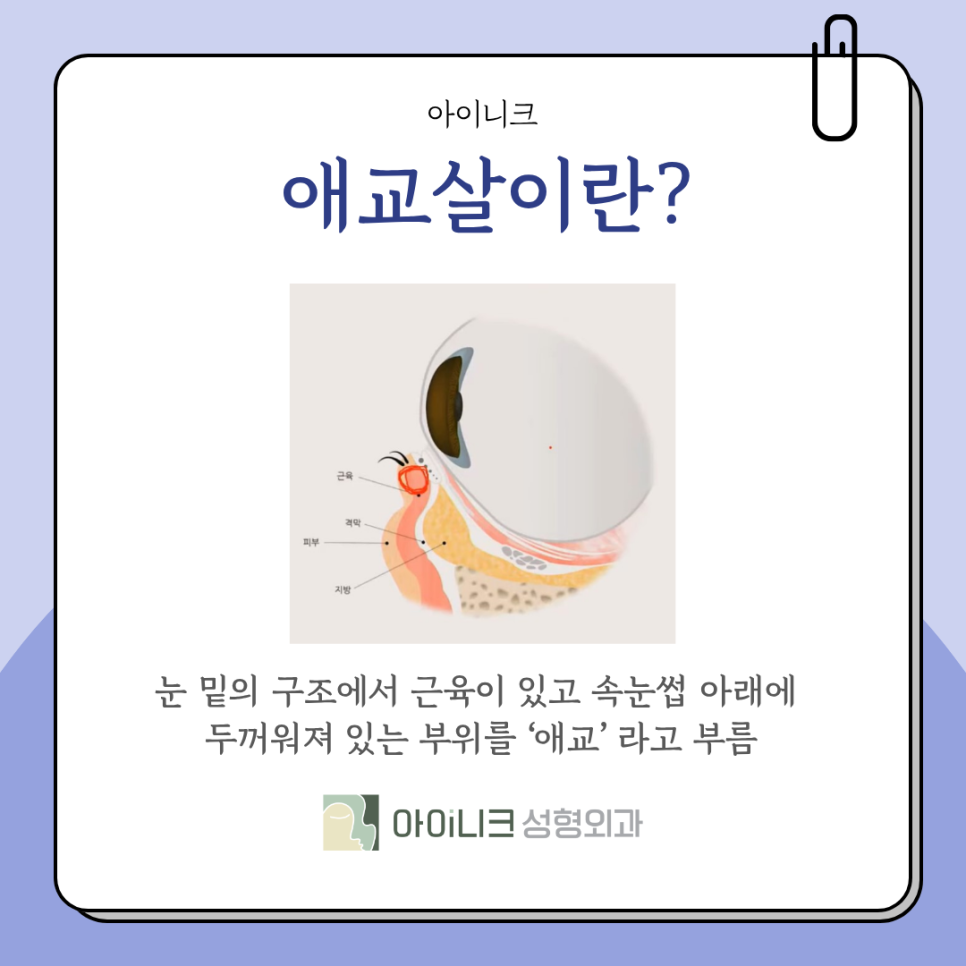
The eye pouch refers to the thickened area below the eyelashes when looking at the structure under the eye, where there is muscle.
In simple terms, the eye pouch is not skin, but muscle.
So if this muscle is removed, it can become flat, which is why under-eye fat repositioning does not make the eye pouch area disappear.

However, when lower blepharoplasty is performed, if the excision includes skin and muscle,
there is a chance that the eye pouch will be reduced.
Therefore, when performing lower eyelid surgery, it should be done in a way that minimizes disturbance to the muscle as much as possible.

At Iniq, a best place for under-eye fat repositioning, the repositioning is performed from the conjunctival side,
and the skin is separately incised from the outside.
The reason for doing it this way is to prevent damage to the eye pouch area.

As explained earlier,
because the eye pouch is muscle rather than skin, if you are still and do not make an expression,
it may look flatter, and when smiling, the muscle gathers and contracts,
making the eye pouch more noticeable.
That is why, in some cases, the eye pouch is created during surgery,
and it can be made by folding or inserting it.

Can people with a keloid tendency also undergo surgery?
To give the conclusion first:
Yes, people with a keloid tendency can undergo surgery.
In the case of under-eye fat repositioning, there is no skin incision,
so it is not related to keloids.
Procedures such as lower blepharoplasty, double eyelid surgery,
and incision methods under the eyebrow are also possible.

The reason is that, due to the nature of keloids,
there are areas where they are more likely to form.
First, thick skin
Second, areas with a lot of tension (pulling)
For example, they are more likely to occur in places with a lot of movement,
such as the earlobe, arms, and legs.

This time, at Iniq, a best place for under-eye fat repositioning,
we will explain misconceptions and facts about under-eye fat repositioning.
- An incision method is more effective than under-eye fat repositioning?
If there is sagging skin,
it is more efficient to undergo lower blepharoplasty, which is an incision method,
and if there is no sagging, the effect may be the same.

- Even after under-eye fat repositioning, it goes back to the original state?
Rather than saying it returns, as time passes,
aging progresses and the bulging may become more noticeable,
and having the procedure once more may improve the condition.
- Does under-eye fat repositioning increase wrinkles under the eyes?
When repositioning is performed, the volume under the eyes decreases,
and depending on the situation, much like a deflated balloon,
wrinkles under the eyes may become more noticeable.

- If you are going to do it anyway, is it better to do it as young as possible?
It may be more efficient to do it when you are younger,
because of skin elasticity.
If sagging and puffiness continue for a long time,
the skin has already stretched a lot,
so it may not be easy to return to its original state.

Today, at Iniq, a best place for under-eye fat repositioning,
we took a more detailed look at improving under-eye fat.
If you have questions or would like a consultation,
please click Iniq’s channel link!
Thank you.