
Under-Eye Procedures in Your 40s at a Glance
-
Your 40s are when under-eye fat bulging, hollowness, fine lines, and decreased skin elasticity may begin to appear together, making it important to choose a corrective method suited to your current under-eye condition.
-
If skin sagging is not severe and fat bulging or tear trough hollowness is the main concern, under-eye fat repositioning may be considered. If sagging of the skin and muscle is pronounced, lower blepharoplasty may be more suitable.
-
Rather than simply removing a large amount of protruding fat, it is important to preserve and reposition the necessary fat while also considering the structures that support skin elasticity and the fat. Even among people in their 40s, under-eye conditions vary from person to person. Therefore, instead of deciding on a surgical method based solely on age, the method should be selected after comprehensively assessing the amount and location of fat, the degree of hollowness, and the degree of skin sagging and elasticity.
-
Even among people in their 40s, under-eye conditions vary from person to person. Therefore, instead of deciding on a surgical method based solely on age, the method should be selected after comprehensively assessing the amount and location of fat, the degree of hollowness, and the degree of skin sagging and elasticity.

Are Your 40s the Right Time for Under-Eye Surgery?
The reasons why people in their 40s may be suitable candidates for under-eye surgery are as follows. One major advantage is that more positive results than expected may be possible.
-
Dark circles gradually begin to appear, a tired appearance becomes more noticeable, and fat starts to bulge.
-
In many cases, sagging is not yet severe, and excision may not be necessary.
-
Recovery is relatively quick.
-
With proper care, a longer-lasting result may be expected.
-
Noticeable surgical results may be expected.

Surgical Methods Suitable for Your 40s
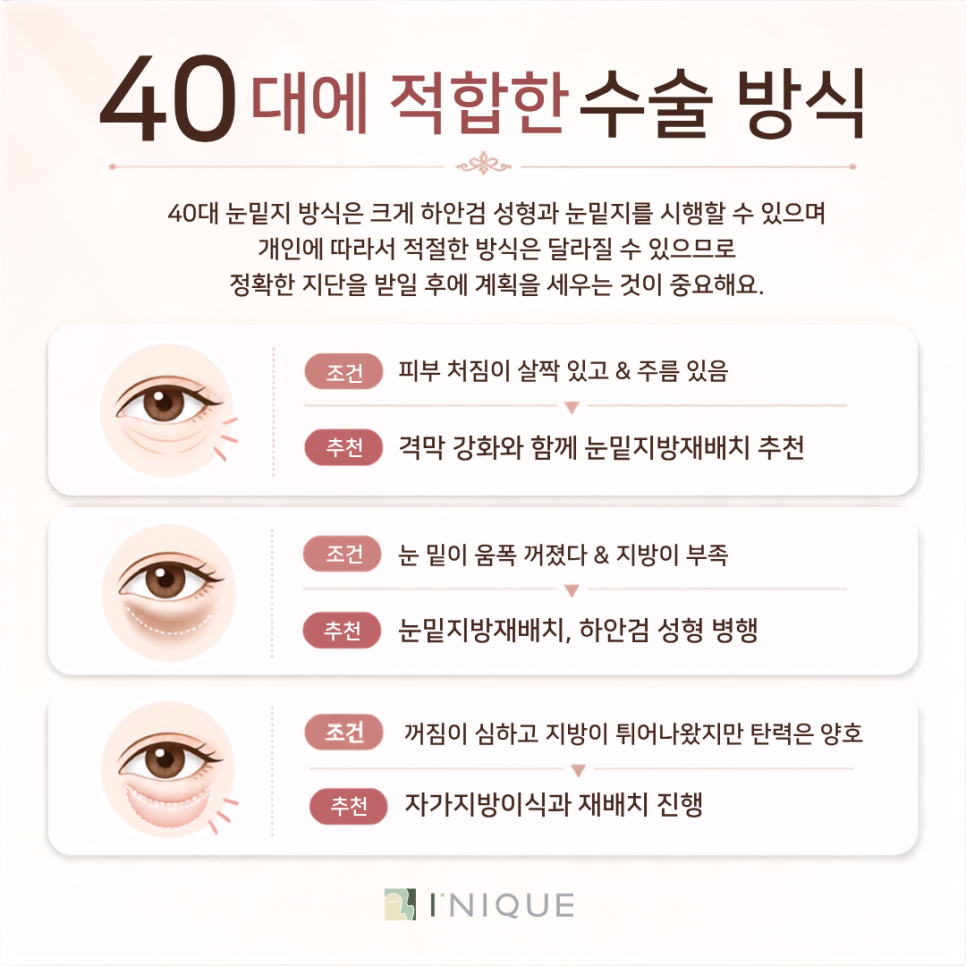
Under-eye procedures for people in their 40s can generally be divided into two types: lower blepharoplasty and under-eye fat repositioning. Since the appropriate method may vary from person to person, it is important to receive an accurate diagnosis, compare the procedures, and then make a decision and plan.
-
Slight skin sagging and wrinkles: Under-eye fat repositioning with septum reinforcement is recommended.
-
Hollow under-eyes and insufficient fat: Under-eye fat repositioning combined with lower blepharoplasty.
-
Severe hollowness and protruding fat, with adequate elasticity: Autologous fat grafting and fat repositioning.

Under-Eye Procedure for Your 40s: Fat Repositioning
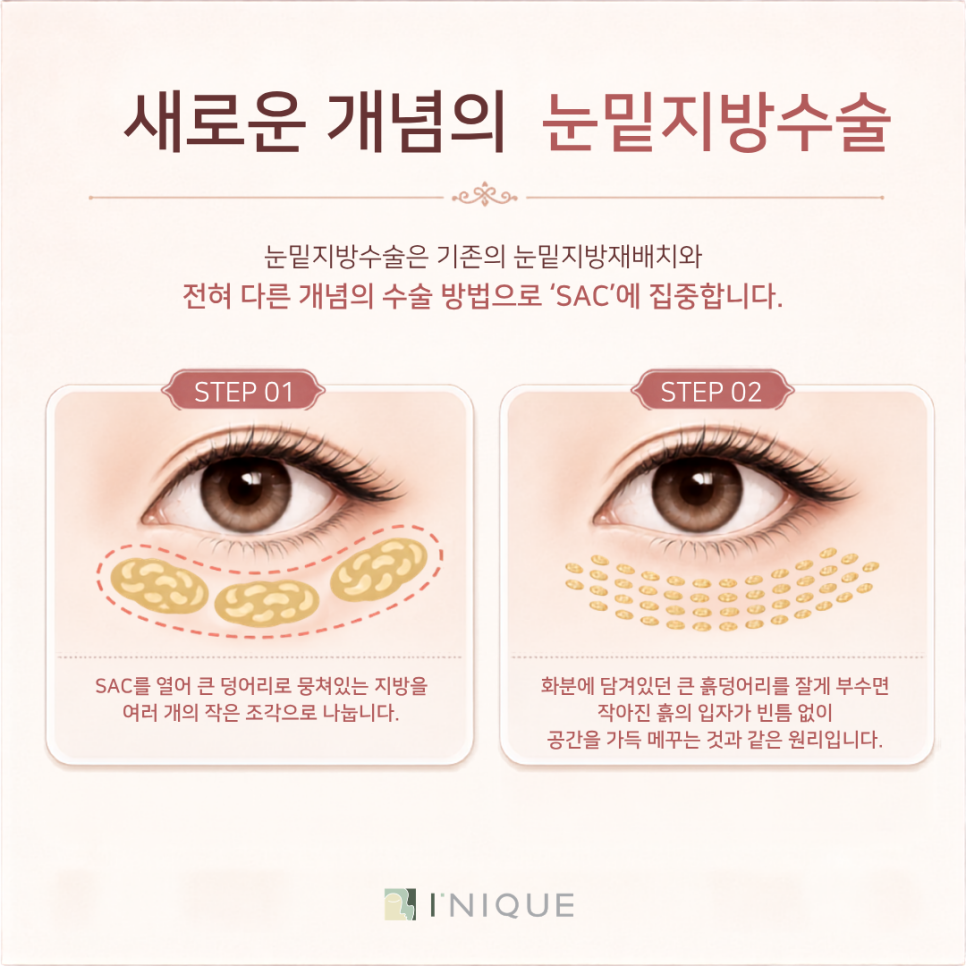
Many people wonder which is better: under-eye fat repositioning or lower blepharoplasty. To put it simply, the key is to choose the method appropriate for you. Under-eye fat repositioning is an essential procedure to consider when comparing under-eye procedures in your 40s. It can be described as being performed according to a somewhat different, newer principle than conventional methods. It does not involve excessive skin excision. Instead, it focuses on the thin, transparent membrane surrounding the under-eye fat, the fat pocket, and the SAC.
-
- The SAC is opened, and the large mass of fat is divided into smaller pieces.
-
- These small pieces of fat are moved to the hollow areas.
-
- Unnecessary fat can be removed slightly during the procedure, but the key is to preserve and use the fat rather than remove too much. This may help improve under-eye sagging and wrinkles more stably while reducing tissue damage.
Less Damage with the Encore Ultra Laser
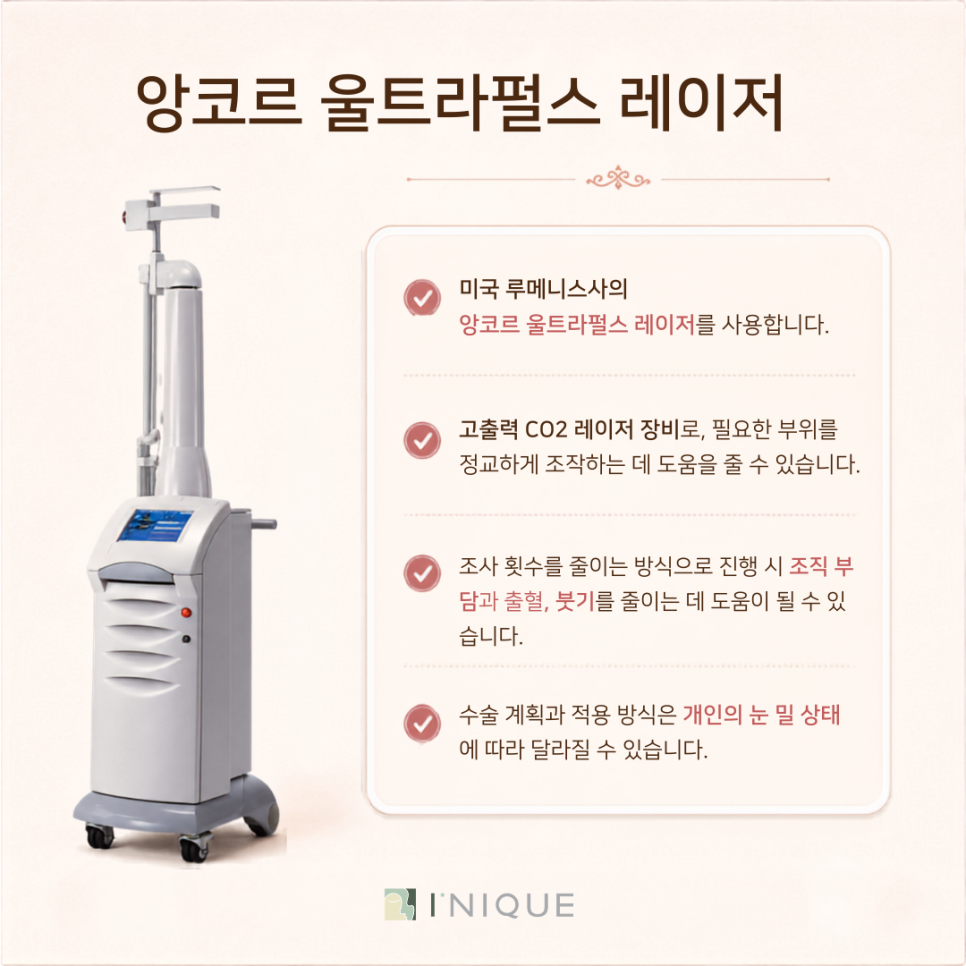
One reason under-eye fat repositioning stands out is that it is performed using the Encore Ultra Pulse Laser. This laser is a device made by the US company Lumenis and is considered a high-priced CO2 laser among the lasers currently introduced in Korea. Because the device can deliver high-output energy, it can separate the necessary amount of fat with just one application. Due to this feature, it may reduce issues such as damage, bleeding, and swelling that can occur when the skin and tissue are treated multiple times with a conventional laser.

Under-Eye Procedure for Your 40s, Method 2: Lower Blepharoplasty
Lower blepharoplasty may be considered for people with insufficient fat or severe sagging under the eyes. Therefore, for people in their 40s with more severe symptoms, or for those in their 50s or 60s, lower blepharoplasty may offer more favorable results than fat repositioning.
If aging has caused sagging fat and bulging under the eyes, creating shadows and a dark appearance along with dark circles, an incision can be made in the skin below the eyelashes, followed by appropriate fat removal and repositioning. If there is excess skin, the procedure may include appropriate excision and muscle fixation. If necessary, fat grafting can also be performed when there is insufficient fat. Lower blepharoplasty can improve elasticity by lifting sagging skin, tissue, and muscle. It may also provide strong skin lifting and improve wrinkles.

What People in Their 40s Should Pay Attention To
Since the aging process becomes more pronounced in your 40s, you should choose a provider that strengthens the septum from the outset to help slow its progression. We also recommend avoiding providers that remove excessive amounts of fat during surgery, as removing too much fat may worsen hollowness. After under-eye surgery, you should also take care to prevent sunlight from reaching the skin and avoid smoking and alcohol. It is important to maintain the results consistently over the long term by receiving treatments that support elasticity and regeneration once or twice a year.