
Let me first summarize the key points.
The reason the area under the eyes can look swollen and protruding is not simply because there is too much fat. As the orbital septum supporting the orbital fat weakens, the fat can be pushed forward. At the same time, the tear trough ligament can pull the skin firmly, creating a hollow groove alongside the protrusion. The difference in height between these two areas can create shadows, resulting in a tired or aged appearance.
The Encore under-eye fat repositioning procedure takes this structure into account. Rather than automatically removing the protruding fat, it moves and repositions it to the areas where it is needed, reducing the height difference between the protruding and hollow areas. However, the most important point is not to choose a surgical method based only on age or the appearance of the under-eye area. The current under-eye structure must first be accurately examined, after which an individualized plan can be made.

When you are young, this supporting structure is relatively firm. However, as elasticity decreases over time and the tissues become looser, the orbital fat can gradually move forward. As a result, the area under the eyes may appear swollen and protruding. In contrast, the tear trough ligament, which firmly connects the skin and bone beneath the inner under-eye area, remains relatively fixed even when the surrounding tissues protrude forward. This can make the boundary appear more pronounced as a line-like depression.
Therefore, when the under-eye area is protruding and the groove is deep, it is important to examine not only the amount of fat but also the strength of the orbital septum, the degree of fat protrusion, and the depth of the tear trough. When these structural changes overlap, they can make you look tired even after getting enough sleep or make you appear more mature than your actual age.
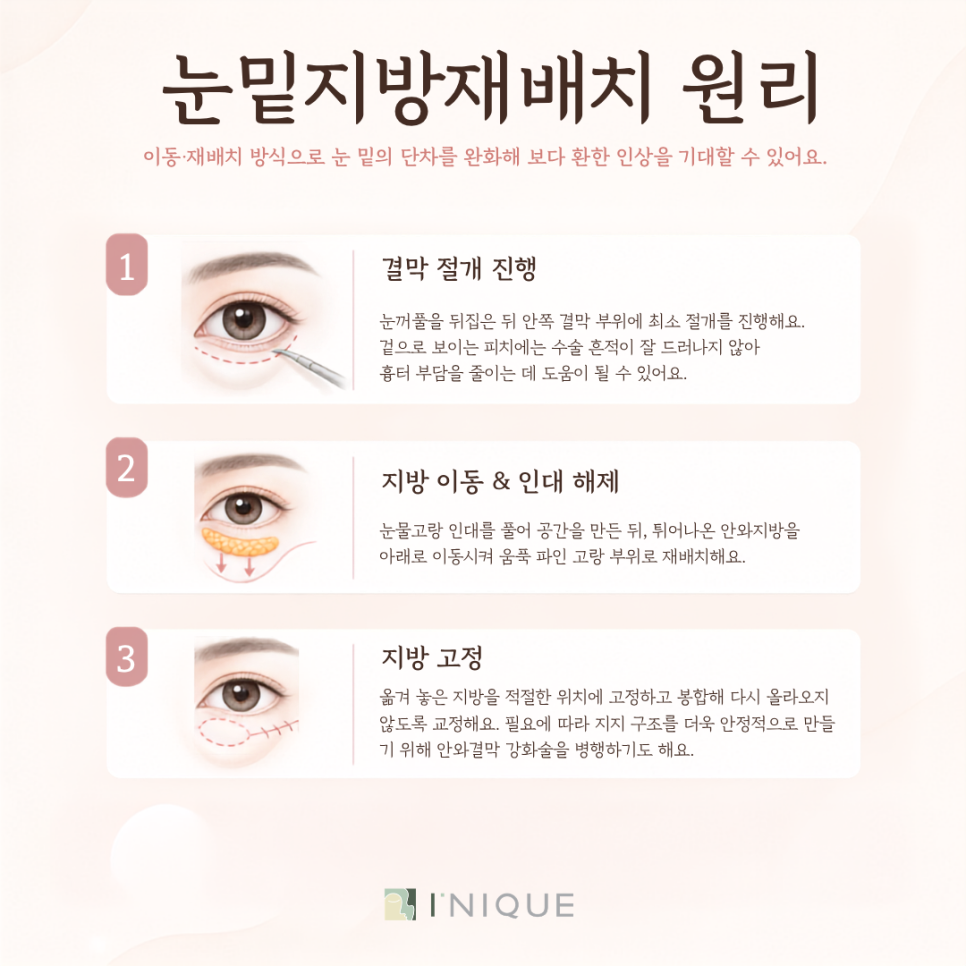
Accordingly, the important point in the Encore under-eye fat repositioning principle is that using the individual’s existing fat, including in hollow areas, may be a more effective option than simply removing protruding or sagging fat. To explain it simply, the procedure naturally reduces the height difference by moving and repositioning the fat, helping the under-eye area look brighter. The surgical process is carried out as follows.
After turning the eyelid outward, a minimal incision is made in the inner conjunctival area.
- Moving the fat and releasing the ligament
The tear trough ligament, commonly referred to as the retaining ligament, is released to create space. The protruding orbital fat is then lowered and moved into the hollow groove.
The fat moved in the previous step is fixed above the periosteum or on the lower plane and integrated to prevent it from moving back upward. Orbital septum reinforcement may also be performed to further stabilize the supporting structure.

During this process, 아이니크 may use a conjunctival approach with an UltraPulse laser. Because the procedure is performed through the conjunctiva on the inner side of the eyelid, it can reduce the burden of a visible skin incision. The laser may also help make the necessary incisions and perform dissection more precisely.

Earlier under-eye procedures generally involved simply removing sagging fat. Although this method could improve the protrusion itself, it could also make the under-eye area look more sunken after surgery or leave an appearance suggestive of aging. In addition, it carried a relatively high risk of disrupting the existing structure, which could increase the likelihood that bruising and swelling would persist for a long time. The possibility of recurrence was also relatively high.
The Encore under-eye fat repositioning principle was developed to address these limitations and reduce the risk of side effects. Rather than eliminating the fat, it focuses on “moving” it. The goal of the procedure is to maintain the result for a longer period while creating a natural, more youthful-looking appearance and an anti-aging effect.

Of course, a predetermined surgical method should not be used simply because someone is young or old. Since the pace of aging and the condition of the skin and tissues vary from person to person, these factors must be taken into account. For example, some people may have skin elasticity that has not decreased significantly for their age, while others may be relatively young but have considerable skin aging. Therefore, the most important step before surgery is to receive an accurate assessment of your current condition and then find and decide on the appropriate method.
-
Since the condition of the ligaments, bone structure, and amount of fat vary from person to person, the procedure should be performed on a one-to-one, customized basis.
-
If there is a significant lack of fat, microfat grafting may be performed at the same time.
-
For those with significant under-eye sagging, lower blepharoplasty combining fat repositioning and an incision may also be possible.
Rather than trying to assess and predict your under-eye concerns on your own, remember that you should choose a clinic with skilled techniques and extensive experience in eye plastic surgery, have a thorough consultation with the surgeon, and then find a safe and suitable approach.