
Recently in the field of dermatology, treatment approaches that stably control the skin’s immune response
are becoming increasingly important.
In particular, chronic conditions such as atopic dermatitis and vitiligo,
which are strongly influenced by the living environment,
are often difficult to manage with simple moisturizing or temporary soothing alone.
At times like this, the device that is recognized as enabling consistent treatment is excimer light therapy.
By using a specific wavelength range (308nm short-wave UVB, NB-UVB),
it can selectively irradiate only the affected skin area,
making it one of the treatment options that can help with various inflammatory and immune-related conditions.
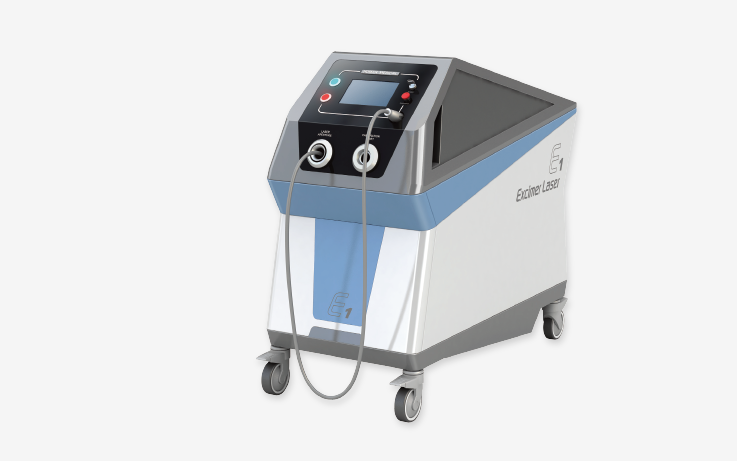 The key to treating atopic dermatitis and vitiligo: “precise target treatment”
Atopic dermatitis and vitiligo
The key to treating atopic dermatitis and vitiligo: “precise target treatment”
Atopic dermatitis and vitiligo
both share the characteristic that disruption of the skin’s immune system leads to symptoms.
The symptoms differ, but the core is the restoration of immune balance.
● In the case of atopic dermatitis
– Weakened skin barrier
– Chronic inflammatory response
– Repeated itching and redness
Because these factors repeat like a vicious cycle,
it is important to consistently create an environment where inflammation can calm down and the skin barrier can be reorganized.
● In the case of vitiligo
– Reduced function of pigment cells (melanocytes) in specific areas
– Symptoms caused when the immune system attacks pigment cells
At this point, the key is to help melanocytes recover
and reduce abnormal immune responses.
For both conditions, excimer is being steadily used because it can ease the skin’s immune response using a specific wavelength
and treat only the necessary area selectively.
 The main mechanism of excimer light therapy
Among various light therapies, excimer is considered advantageous because
The main mechanism of excimer light therapy
Among various light therapies, excimer is considered advantageous because
it can be applied intensively to a specific area.
● How it works
– Uses 308nm short-wave UVB and NB-UVB
– Regulates excessive immune and inflammatory responses
– Allows lesion-focused treatment, minimizing stimulation to normal skin
– Can be used on both localized and widespread areas
Based on these characteristics,
it is a method that is consistently chosen for immune- and inflammation-related conditions such as
vitiligo, atopic dermatitis, and psoriasis.

How often should it be received?
The basic recommended schedule for excimer is regular treatment 1–2 times per week.
The reasons are as follows.
– The skin’s immune system is more stably regulated by repeated, regular adjustment than by a single stimulus
– Maintaining a consistent irradiation interval allows the effect of reducing inflammatory signals to accumulate
– The skin condition can recover gradually without over-stimulation
Because this consistency determines the direction of treatment,
it is a treatment structure in which maintaining regular intervals is important.
 Pregnant women and nursing mothers can also undergo repeated procedures
Excimer is a treatment method that stimulates only with light, without systemic medication,
Pregnant women and nursing mothers can also undergo repeated procedures
Excimer is a treatment method that stimulates only with light, without systemic medication,
so it can be used in certain situations as well.
In particular, because excimer uses a local irradiation method,
it may be considered as an option even for pregnant women or nursing mothers depending on the situation.
(As each person’s skin condition and living environment are different, it is basic to have sufficient consultation with a specialist before the procedure.)
 Precautions after the procedure
After light therapy, it is good to keep the following points in mind.
Precautions after the procedure
After light therapy, it is good to keep the following points in mind.
● Possible reactions after the procedure
– Slight redness of the skin
– Warm feeling
– Increased dryness
These are reactions that can occur when a special wavelength is applied to the skin,
and in most cases they naturally settle down over time.
● Care method
– Use moisturizer frequently to help restore the skin barrier
– Avoid strong UV exposure
– It is safer to avoid excessive friction and scrubbing
– Avoid very hot environments such as saunas on the treated area
Consistent moisturizing is also very helpful in maintaining the effects of light therapy.
 Positive changes excimer can bring to daily life
Rather than discussing dramatic short-term changes,
Positive changes excimer can bring to daily life
Rather than discussing dramatic short-term changes,
light therapy follows this flow:
consistent immune regulation → recovery of the skin environment → symptom relief → increased convenience in daily life
Atopic dermatitis and vitiligo are closely influenced by lifestyle and environmental factors,
so more stable changes can be expected when treatment and care are carried out consistently.
 Regular and consistent treatment
The excimer treatment used at Mapo Dermatology Clinic is
Regular and consistent treatment
The excimer treatment used at Mapo Dermatology Clinic is
a selective light therapy method that controls the skin’s immune response and inflammation with a specific wavelength,
and it is used for various chronic skin conditions such as atopic dermatitis, vitiligo, and psoriasis.
Regular and consistent treatment is the basic principle,
and because it is applied according to each person’s skin characteristics,
it has a structure that allows long-term management alongside daily life.











 Previous image
Next image
Previous image
Next image









 Previous image
Next image
Previous image
Next image