Among people considering lifting procedures,
there are quite a few who already know about Thermage
or have had it once before.
In consultations at Gongdeok Station Dermatology,
many people begin the conversation by saying,
“I’m wondering whether I should do Thermage again this time.”
That is how Thermage is
recognized as a standard for elastic lifting.
However, as the consultation continues,
the explanation often comes back to one common point.
That is that the face is not a single unit.
The face responds differently by area
At a glance, the face looks like one surface,
but in reality, skin thickness, elasticity structure, and the direction of sagging differ by area.
-
Jawline / lower face → relatively thick skin and structural sagging
-
Central cheeks → an area where reduced elasticity is mixed with volume changes
-
Around the eyes / above the cheekbones → an area where the skin is thin and fine lines and reduced elasticity appear first
Because of these differences,
“applying the same lifting treatment to the entire face”
may not always be the best approach.
The areas where Thermage works well
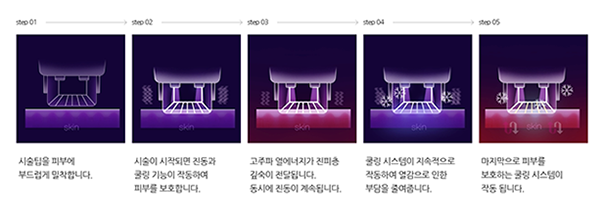
Thermage is
a lifting procedure that delivers heat stimulation to the deep layer of the dermis
to induce collagen remodeling.
So Thermage
✔ is strong in rebuilding the skin’s overall elasticity foundation
✔ and plays a role in organizing the central axis of sagging.
However, these changes are
often felt gradually over time rather than immediately after the procedure.
That is because the collagen rearrangement process takes time.
So Thermage is
closer to a treatment that changes how your face looks a month or two later than right away.
Parts where Sofwave responds more quickly
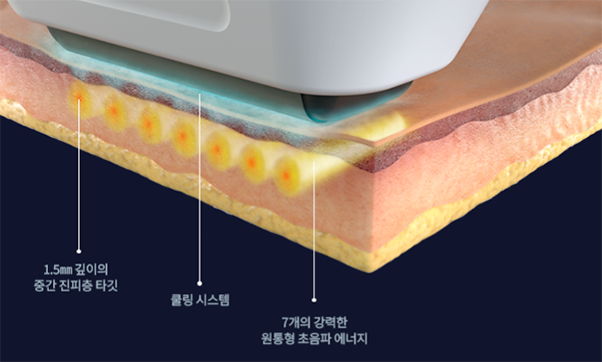
Sofwave is
a method that delivers more uniform and more superficial stimulation to the dermal layer of the skin.
So
✔ the skin feels more refined relatively quickly after the procedure
✔ fine lines and skin texture changes may appear
✔ elasticity may be felt immediately
in many cases.
In particular,
in areas such as around the eyes, above the cheekbones, and along the facial contour,
where the skin is thin and responds quickly,
the characteristics of Sofwave tend to stand out more.
That is why the word “complement” comes up
The reason Gongdeok Station Dermatology explains Thermage and Sofwave together
is not because either one is lacking.
✔ Thermage organizes the deep structure
✔ Sofwave quickly complements the surface and the immediate feel.
As these two overlap,
they create both
a sense that “I had a lifting procedure”
and
elasticity that is maintained over time.
Do you really have to do both?
Of course, not everyone
needs both procedures at the same time.
-
If reduced elasticity is the main concern, Thermage alone may be enough
-
If the focus is skin texture and fine lines, Sofwave alone may be satisfying
However,
✔ if you had Thermage before but the initial effect felt lacking
✔ if your concerns differ by facial area
✔ if you want the most balanced change possible from a single treatment
then designing the treatment by dividing the roles and areas of the two procedures
can be a practical option.
Lifting is about “how you divide it,” not just “what you do”
What matters in lifting procedures
is the design, not the name.
Even with the same Thermage,
how it feels can differ depending on where and for what purpose it is used,
and even with the same Sofwave,
the result can differ depending on the skin condition to which it is applied.
The reason Gongdeok Station Dermatology talks about Thermage and Sofwave together
is not to tell you to choose one of the two,
but rather to suggest looking at
which area of your current face
✔ needs what role
and dividing it that way.
If you are considering lifting,
rather than “which treatment is famous,”
a more accurate starting point may be to first sort out
“what part of my face I want to change, and how.”









 Previous image
Next image
Previous image
Next image










Previous image
Next image










Previous image
Next image