
Some people have tried treating melasma or blemishes
but did not feel much change.
In such cases, instead of a simple pigmentation issue,
it is better to first consider the possibility of a “refractory pigmentation disorder.”
Even if it looks similar on the surface,
because the location and nature of the pigmentation are different,
→ the approach itself must also be different.
Why refractory pigmentation should be viewed differently
Typical blemishes or melasma are
mainly located in the epidermis or in relatively shallow layers.
In contrast, refractory pigmentation
→ often settles deeply into the dermis, or
→ occurs due to structural abnormalities in the pigment cells themselves.
Because of this difference,
even repeated treatment with the same laser may produce only a weak response,
or may even lead to darker discoloration.
That is why what matters is
→ not treatment that is done often,
→ but treatment that is precisely matched.

Representative refractory pigmentation disorders
Milk spots (café-au-lait spots)
These appear as uniform light-brown spots,
but because the depth of pigmentation is not consistent,
the treatment response tends to vary.
→ Even if it looks simple on the surface,
it is a type of pigmentation for which laser response is difficult to predict.
Clustered lentigines
Small pigment spots appear in clusters,
showing a pattern with a higher possibility of recurrence than ordinary blemishes.
→ More than simple removal,
a sustained management strategy is important for this condition.
Becker’s nevus
This is a condition that can involve not only pigmentation,
but also hair and changes in skin thickness.
→ Rather than simple pigmentation treatment,
a dermatologic approach that also considers skin structure is needed.
Nevus spilus
This appears as small pigment spots scattered over a broad, light-colored patch.
→ Rather than treating it strongly in one session,
a step-by-step approach is important in this case.

Why is treatment not easy?
Refractory pigmentation is not simply a matter of color,
but is influenced by a combination of
→ the depth of the pigment
→ the size of the pigment particles
→ the reactivity of the surrounding skin
So,
strong laser = not necessarily good treatment.
If approached incorrectly,
→ post-inflammatory hyperpigmentation (PIH)
→ worsening of pigmentation
can result,
which is why precise energy control is the key.
Devices used for Mapo refractory pigmentation treatment
Mapo refractory pigmentation treatment is not solved with a single device;
it is approached selectively depending on the characteristics of the pigmentation.
The representative devices used are as follows.
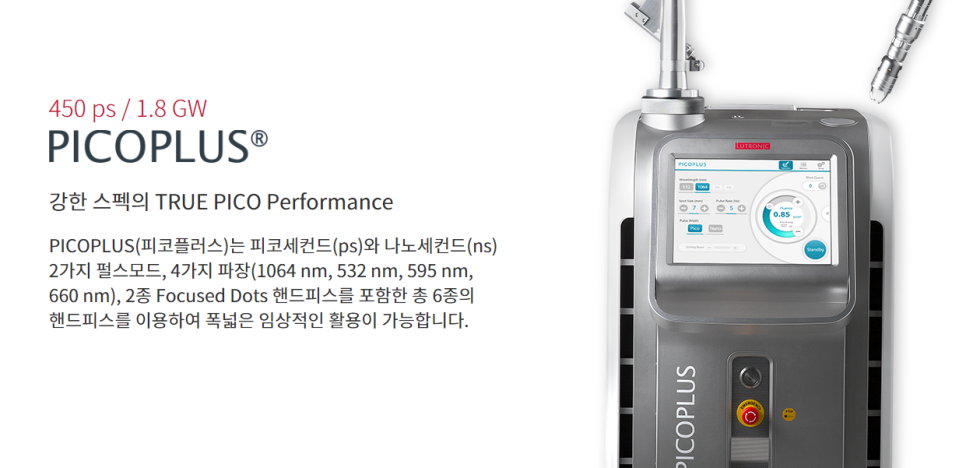
PicoPlus (PicoPlus)
→ Delivers energy over an extremely short time (in picoseconds)
and breaks down pigment into fine particles.
Features
✔ Minimizes damage to surrounding tissue
✔ Effective for fine, deep pigmentation
✔ A highly useful device for refractory pigmentation

Fotona QX-MAX
→ Uses a Q-switched method
to deliver energy to pigment in a stable way.
Features
✔ Can reach deep pigmentation
✔ Addresses a wide range of pigmentation disorders
✔ Gradual improvement through repeated treatment
One thing that matters more than the device
Even with the same PicoPlus or the same QX-MAX,
→ at what depth
→ at what intensity
→ at what intervals
treatment is performed will completely change the outcome.
In particular, refractory pigmentation
can become darker if overtreated,
so experience-based adjustment is important.

Refractory pigmentation should be approached like this
Rather than simple removal,
a process is needed that
→ analyzes the depth of the pigmentation
→ sets up a step-by-step treatment plan
→ adjusts while observing the skin’s response
That is why
the overall treatment design is more important than the result of a single procedure.
What type of pigmentation do I have?
Even if they look like similar brown spots on the surface,
→ whether they are simple blemishes
→ refractory pigmentation
→ or mixed pigmentation
the treatment direction changes completely.
An incorrect start
can lengthen the treatment period.
If you are considering Mapo refractory pigmentation treatment,
→ rather than simply choosing which laser to use,
→ it is best to first confirm an accurate diagnosis of your pigmentation.
A change that is not excessive but is clearly noticeable,
ultimately begins with diagnosis and planning.











Previous image
Next image










Previous image
Next image