When the facial line starts to look less defined, the time spent in front of the mirror gradually gets longer.
When the jawline that used to fall sharply has somehow become blurred, and your face in photos feels unfamiliar, that change tends to linger in your mind longer than you might expect.
These changes go beyond simple appearance concerns; they can lead to the realization that you are “changing,” and sometimes even become a source of a complex.
Fortunately, there is a clear answer to this change.
It is not just a lifting procedure that tightens the skin, but the SMAS Mini Lift, which corrects the core structure of elasticity itself.
Rather than simply pulling at the outer layer, it is a lifting procedure that precisely elevates the superficial musculo-aponeurotic system (SMAS) beneath the skin to rebuild the facial structure itself.
It is a highly advanced procedure that restores a three-dimensional, defined contour line by filling hollow areas with fat grafting and refining overly protruding areas with liposuction.
That is why where you get this procedure is truly important.
This is also why simply choosing it because a clinic is well known, or because the price is low, does not necessarily lead to the results you want.
From here, let’s take a step-by-step look at what the SMAS Mini Lift is and who it is best suited for.
 SMAS Mini Lift
How is it different from simple lifting?
SMAS Mini Lift
How is it different from simple lifting?

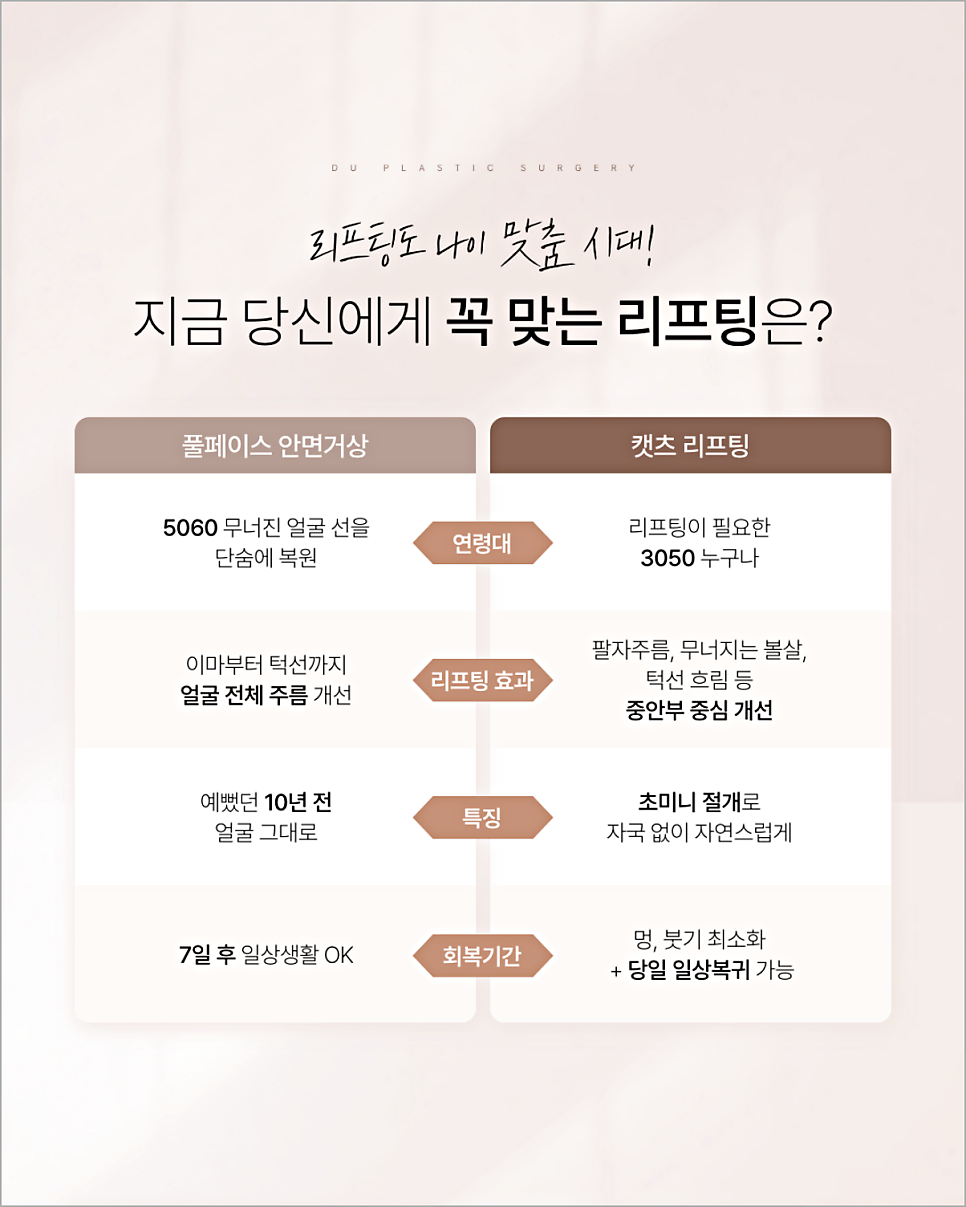
The SMAS Mini Lift is fundamentally different from procedures that simply pull the skin to create a temporary lifting effect.
The SMAS layer is the “Superficial Musculo-Aponeurotic System,” located about 4.5 mm beneath the skin, and is an elastic structure connected to the facial expression muscles.
The changes we commonly feel as “sagging” are mostly caused by weakened elasticity in this SMAS layer.
Unlike a lift that creates an artificial “pulled” face by tightening only the outer skin,
it directly addresses the structural cause of facial sagging, so you can expect much more natural and long-lasting results.
In addition, when the deep plane facelift technique is applied to the SMAS Mini Lift, it becomes possible to access the deeper deep plane layer.
This allows for combined improvement of cheek sagging, nasolabial folds, and marionette lines.
If performed together with a forehead lift or lower blepharoplasty during this process, a more complete overall anti-aging effect can be achieved.
Sagging after contour surgery,
The SMAS Mini Lift is the solution
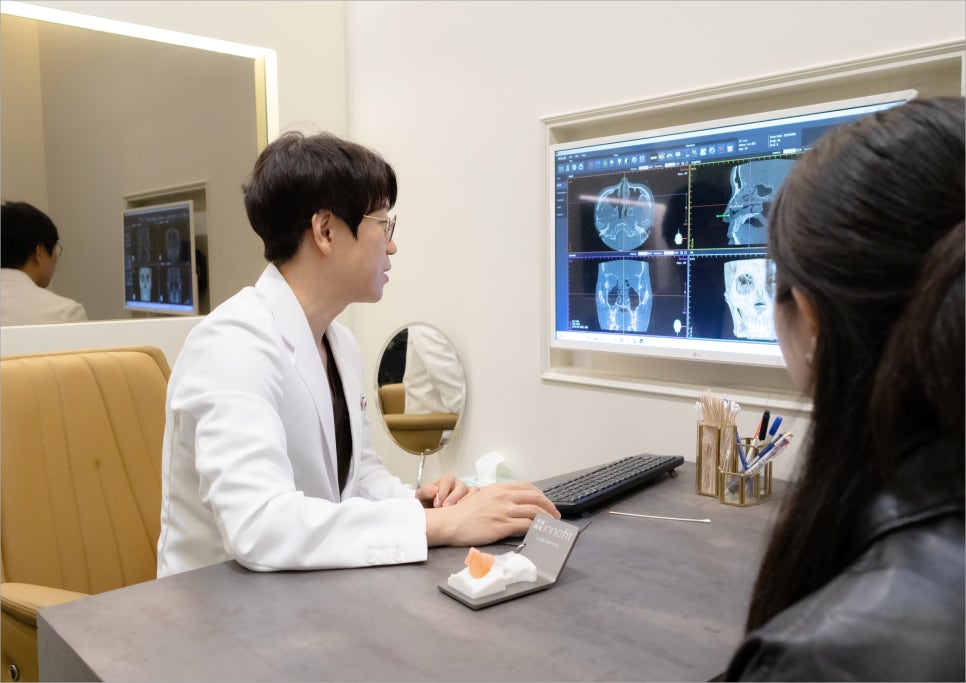
Recently, many patients in their 20s and 30s have been concerned about facial sagging after contour surgery.
Although the face shape has become slimmer after reducing the cheekbones or chin, the skin cannot keep up with the change, leading to looseness,
and in many cases the face ends up looking older than before surgery, or the V-line feels as though it has collapsed.
Especially in younger age groups, the skin is often thinner and there is less fat,
so even slight sagging can significantly change the impression because the tissues respond sensitively to changes in volume.
The SMAS Mini Lift is a practical solution that addresses this kind of “residual elasticity issue.”
Rather than simply pulling the skin, it pulls the SMAS layer, the fundamental structure of elasticity, and precisely adjusts the loosened skin around the jawline and cheeks after contour surgery to help restore a clear contour line.
Also, because it is performed using the deep plane method, you can expect results that are much more natural and three-dimensional than a method that lifts only superficial layers.
These fine adjustments make a significant difference in balancing the overall impression of the face.
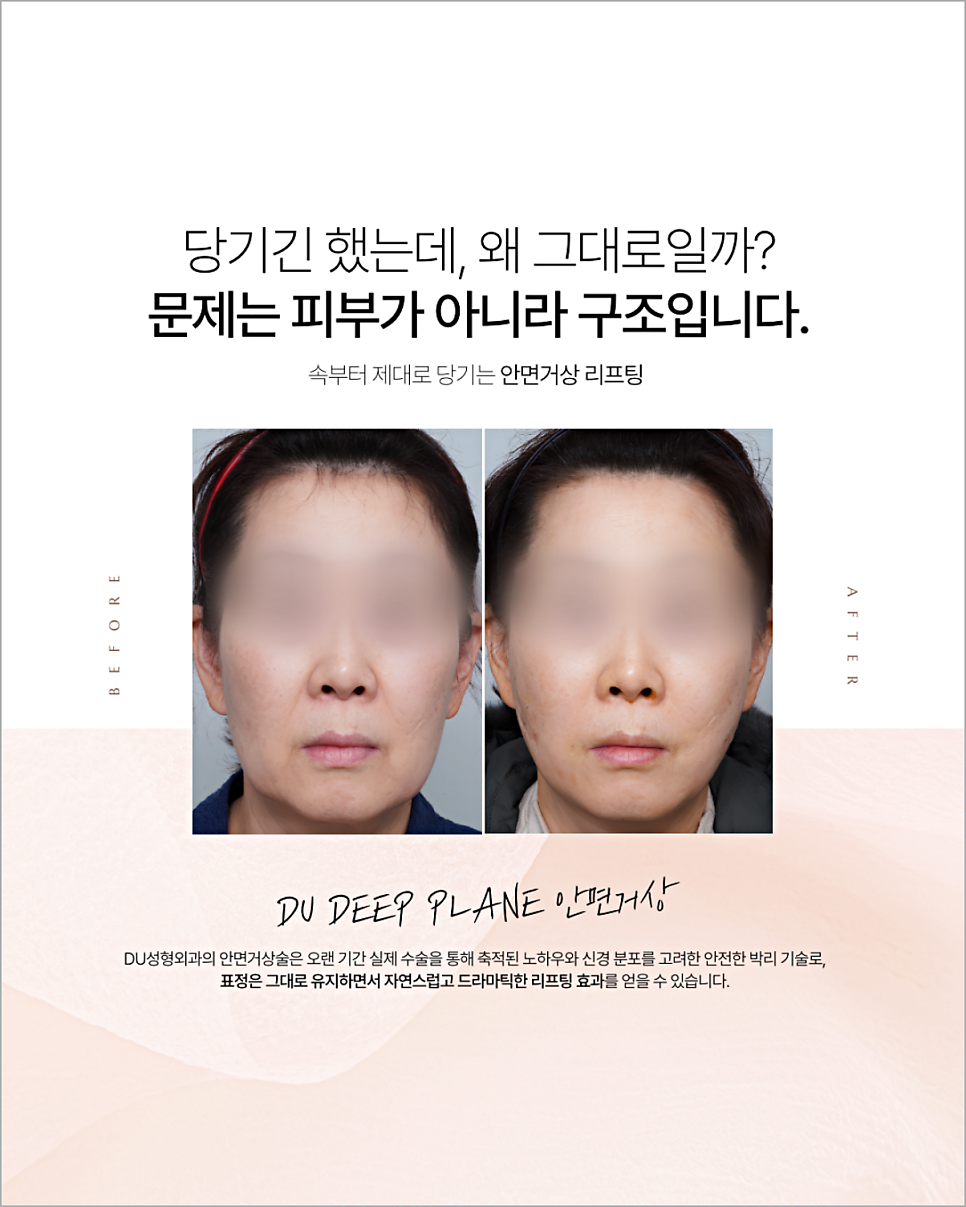
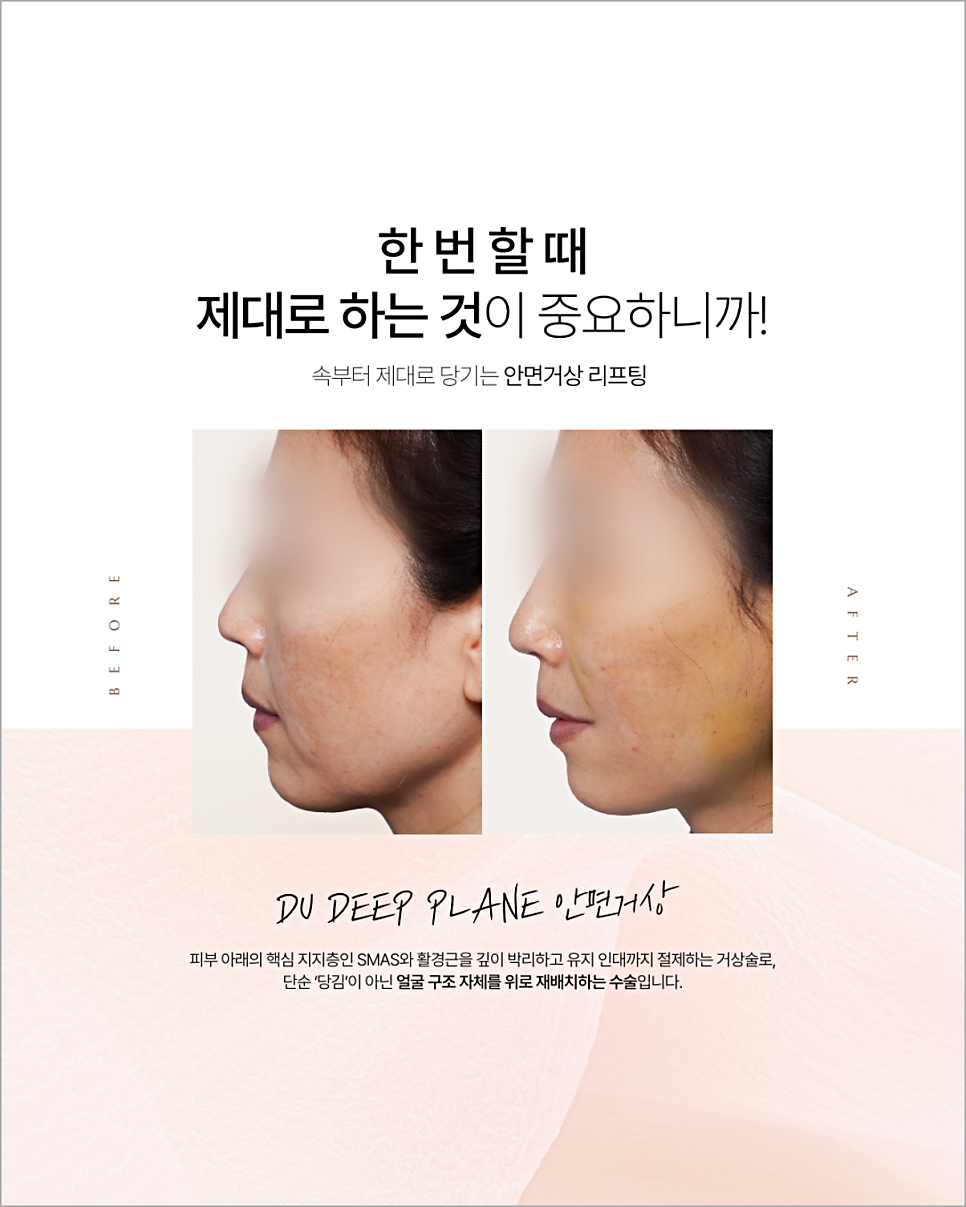
Recovery is fast,
and scars are delicately concealed

Many people worry about a long recovery period and noticeable scars when they think of a facelift.
However, Deus Plastic Surgery designs the incision line and suturing precisely to match the patient’s natural wrinkle directions.
Although the incision is made along the area in front of the ear, the incision line is designed to naturally overlap with the wrinkle line, so it is hardly visible in daily life and recovery is relatively quick.
In addition, because the neck area is not treated, if only the face has sagged, the procedure can be performed without unnecessary burden.

The SMAS Mini Lift is not a simple facelift.
It is closer to a precise surgery that redesigns the very structure of a collapsed face rather than just a procedure that tightens the skin.
It is a process that restores the balance and three-dimensionality of the entire face by considering the essential contours—not just the surface—such as volume and lines, wrinkles and elasticity structure.
In particular, by directly pulling and fixing the SMAS layer, reducing unnecessary fat, and repositioning what is needed, it can create results that are not merely a “younger-looking face,” but a “natural lift that still looks like you.”
However, because it is a highly advanced procedure that requires a detailed understanding of facial anatomy and careful planning of the direction and tension of the fascial layer, thorough consultation before the procedure and a customized design suited to each individual are more important than anything else.
| 1) Those concerned about facial sagging that developed over time after contour surgery2) Women in their 30s and older whose jawline appears to have collapsed and whose overall impression has become blurred3) Those who want a natural and noticeable change within a short recovery period |
For people like this, the SMAS Mini Lift can be not a return to your old appearance, but a new beginning.
Deus Plastic Surgery considers with you not a simple lift, but the answer to change that suits your face best.
We will always be sincerely waiting at the very first step. Thank you.