When you look in the mirror, there are times when you suddenly notice a silhouette that seems to hang beneath the jawline, as if an extra layer has been added.
From any angle, a sharp contour doesn't appear, and every time you smile or look at your side profile, the "double chin" is what catches your eye first.
Many people simply think of it as a problem caused by weight gain and move on easily, but
in actual consultations, I hear much more often from people who say that their double chin does not improve even when they diet.
Some of these people may have a "muscular double chin."
In other words, this is a case where the platysma muscle under the chin becomes weak and can no longer support the skin and fat, so it loosens and spreads downward in the direction of gravity, causing the double chin to become fixed in place.
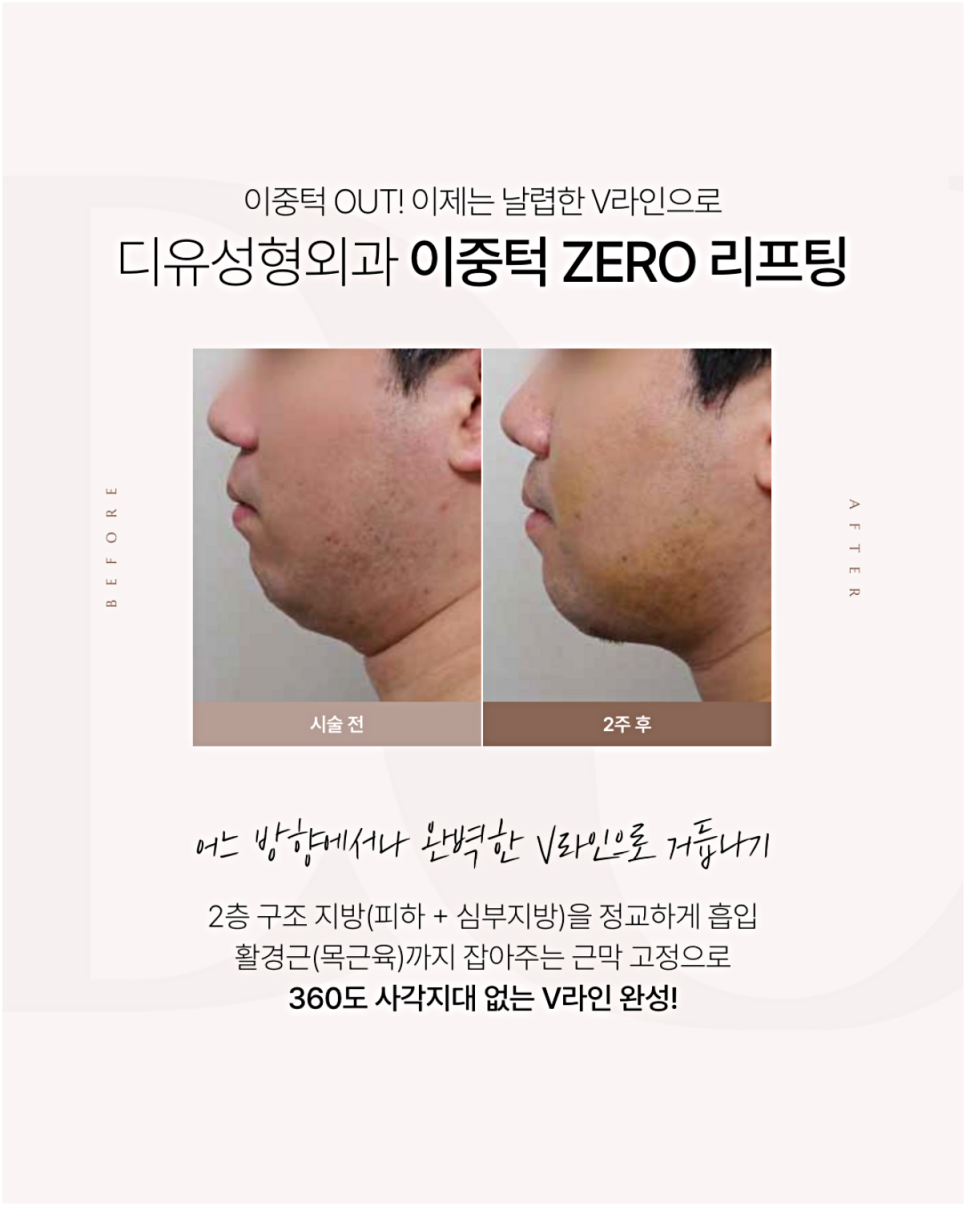 If you're worried about swelling after double chin muscle tightening, read this
In this case, the procedure you can choose is "double chin muscle tightening."
It is a method that firmly ties the sagging chin muscle at the midline to tighten and refine the jawline, allowing for a fundamental structural improvement rather than a temporary lift.
However, when people search for double chin muscle tightening, many become concerned about "swelling."
Will it be noticeable?
What if the swelling lasts a long time and I have to go to work?
To put it simply: there is swelling, but it does not swell in a noticeable way.
From here, I will explain the reason in more detail.
- Why does swelling occur after double chin muscle tightening?
 Reason for swelling after double chin muscle tightening
Double chin muscle tightening surgery is a minor procedure in which, after a skin incision, the platysma muscle is sutured and realigned at the midline.
In this process, the incision is made along the wrinkle line under the chin, within about 1 to 1.5 cm,
and because the process of delicately securing the muscle internally is involved, temporary tissue reaction can cause swelling.
However, this swelling is different in nature from that seen after liposuction or contour surgery.
Because only minimal manipulation is performed at the muscle layer rather than scraping away a wide layer under the skin or suctioning out fat, tissue damage is small and bleeding is minimal, so recovery tends to be faster than expected.
In general, swelling is concentrated for about 3 to 5 days immediately after surgery, then noticeably subsides around 7 days, and after 2 weeks, recovery is to the point where it is hardly noticeable to others in daily life.
According to actual patient reviews, many say, "The swelling was less than I expected, and because I could hide it with a mask, it didn't interfere much with work life."
This is the result of multiple factors working together, such as the anesthesia method, surgical method, and suturing skill, which help promote natural recovery.
- Will tying the muscle refine the jawline?
 Will the jawline be refined after double chin muscle tightening swelling?
Many people think only of liposuction when they hear about improving a double chin.
However, removing fat alone does not make the jawline look sharp.
In particular, from the mid-to-late 30s onward, the strength of the fascia and muscles often weakens, causing the jawline to collapse.
Double chin muscle tightening surgery addresses exactly this area.
By pulling and tying the weakened platysma muscle at the center, it firmly holds the sagging tissue in place and lifts the lower area beneath the drooping jawline.
Especially when combined with liposuction, laser lifting, and similar procedures to create a more dimensional jawline, it can produce a more dramatic change than any single procedure alone.
Most importantly, the biggest advantage of this surgery is that once the muscle is tied, it does not easily loosen again.
In other words, you can expect a jawline that can be maintained long term rather than just a temporary lifting effect.
If you have hesitated because you were worried about swelling, it may be worth reconsidering this option, which can address years of concern with just a week of recovery.
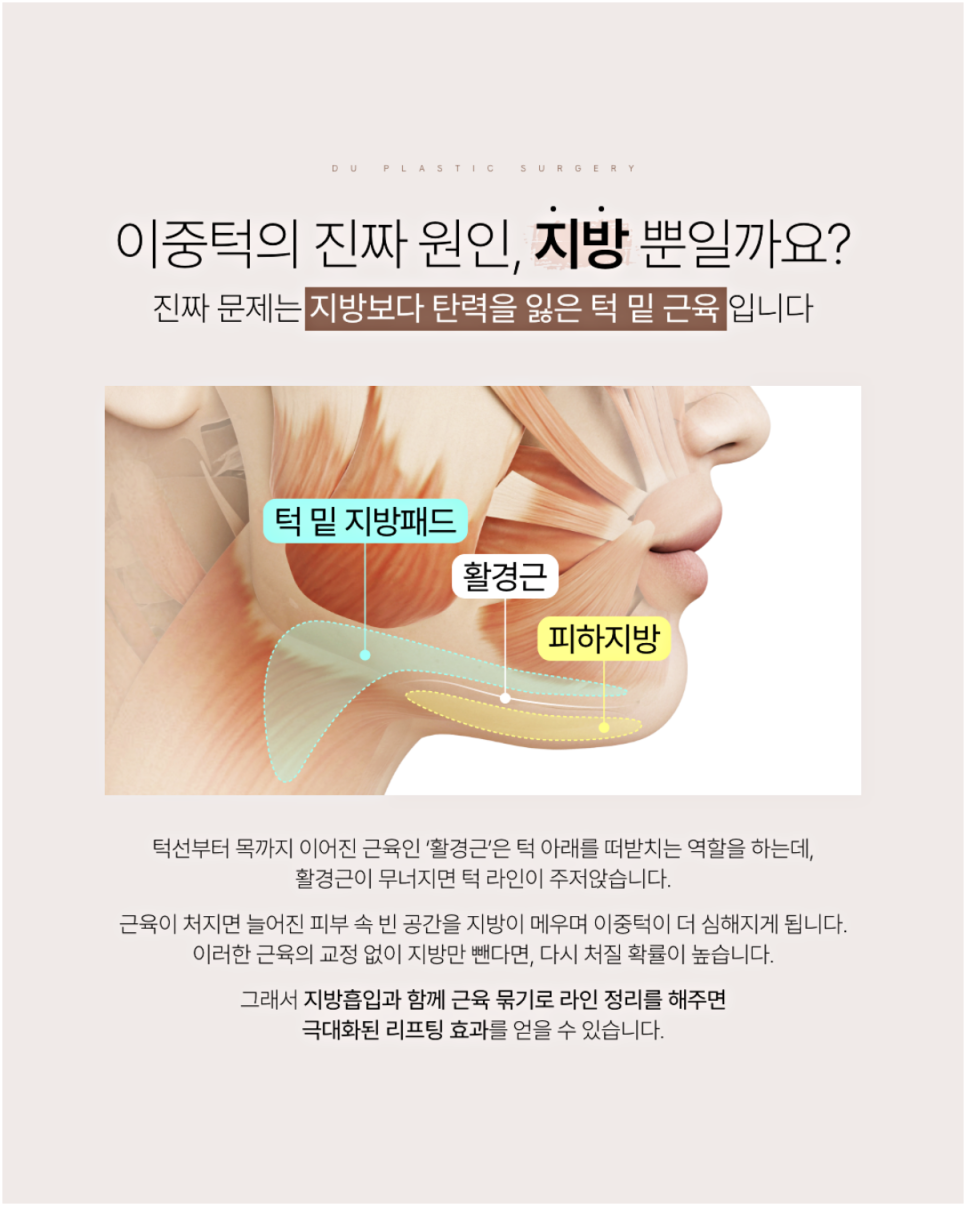 What lifting is right for me after double chin muscle tightening swelling?

Double chin muscle tightening surgery may appear to be a simple procedure on the surface, but in reality it requires a deep understanding of the anatomical structures under the chin and refined surgical technique.
Unlike a simple fat-removal method, it must take into account both sagging soft tissue and the weakened muscle layer, so accurate diagnosis and planning are essential.
Concerns about swelling are something anyone can have, but in reality the recovery course can vary depending on many factors such as the incision range, surgery time, and degree of tissue damage.
In particular, if a customized surgical plan is carried out by an experienced medical team, it is possible to reduce unnecessary tissue damage to some extent and minimize swelling.
Therefore, rather than postponing surgery simply because of concerns about swelling, it is important to consult thoroughly with the medical team about whether the surgery is appropriate for your facial structure and condition, and which method is suitable.
Thank you for reading this long post today. If you have any more questions, please leave a reply.