
Mini thread lifting
Every time you look in the mirror, your jawline seems less defined than before,
and your cheeks feel like they are sagging downward, making the nasolabial folds deepen when you smile…
If these subtle changes have started to bother you more and more, it may be a sign that facial aging is beginning in earnest.
Especially when you look at photos of yourself and find yourself thinking, “Huh? Have I really gotten this old?” more often, it is natural to start considering lifting procedures.
At this point, many people first think of “mini thread lifting.”
That is because there is a common perception that it requires no incision, has a quick recovery, and can be tried with relatively little burden.
However, whether a method that simply pulls with threads is truly suitable for your facial structure is something worth checking at least once.

Especially if facial elasticity has already declined, thread lifting alone has clear limitations, and may instead cause uneven volume or an asymmetrical jawline.
In cases like this, rather than simply inserting threads, a “mini facelift” that structurally lifts all the way to the SMAS layer can be a much more precise and effective alternative.
Today, I will explain in detail why a mini facelift is suitable for faces that need a true lift rather than just pulling, focusing on how it differs from mini thread lifting.
Mini thread lifting and mini facelift,
the biggest difference is the “area of action”



Previous image
Next image
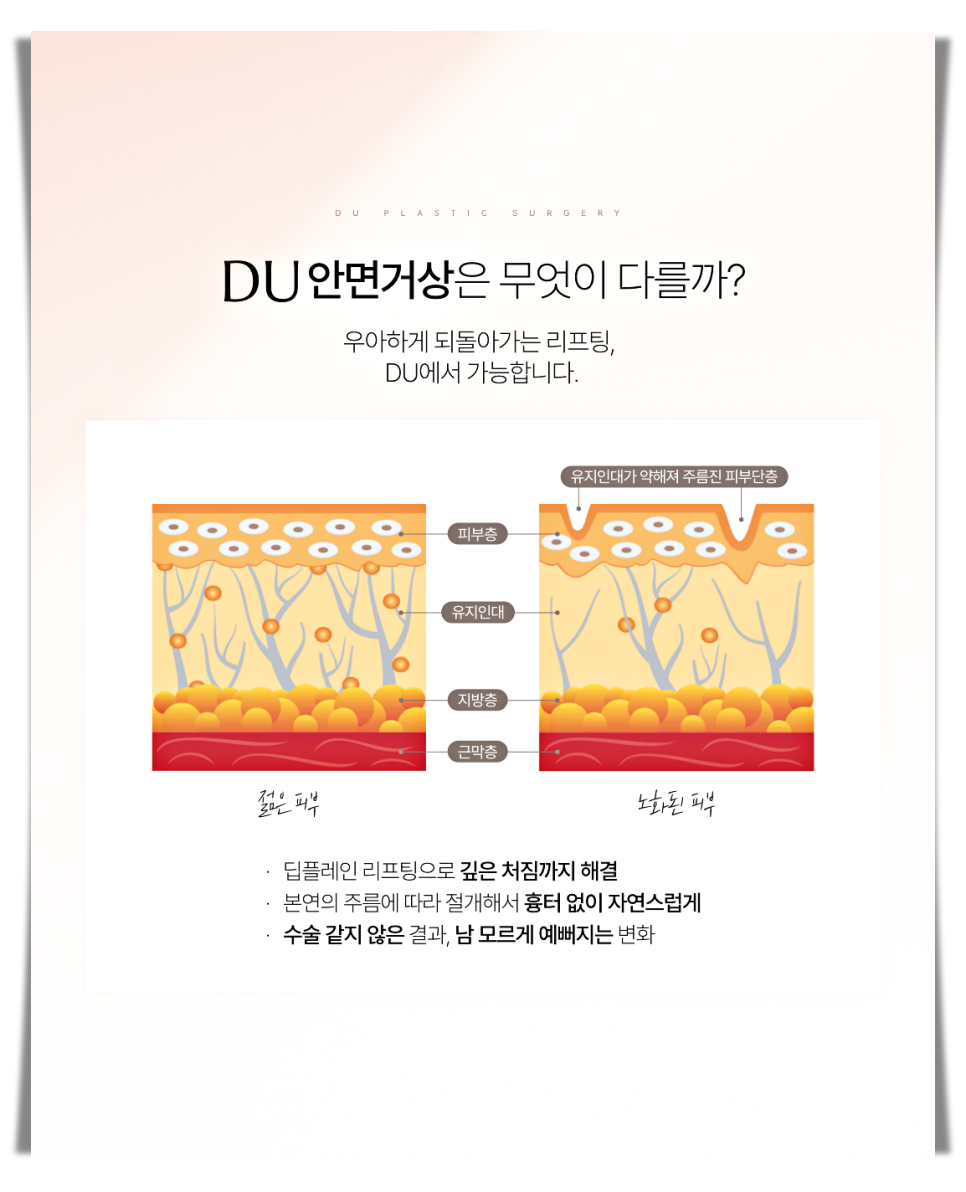
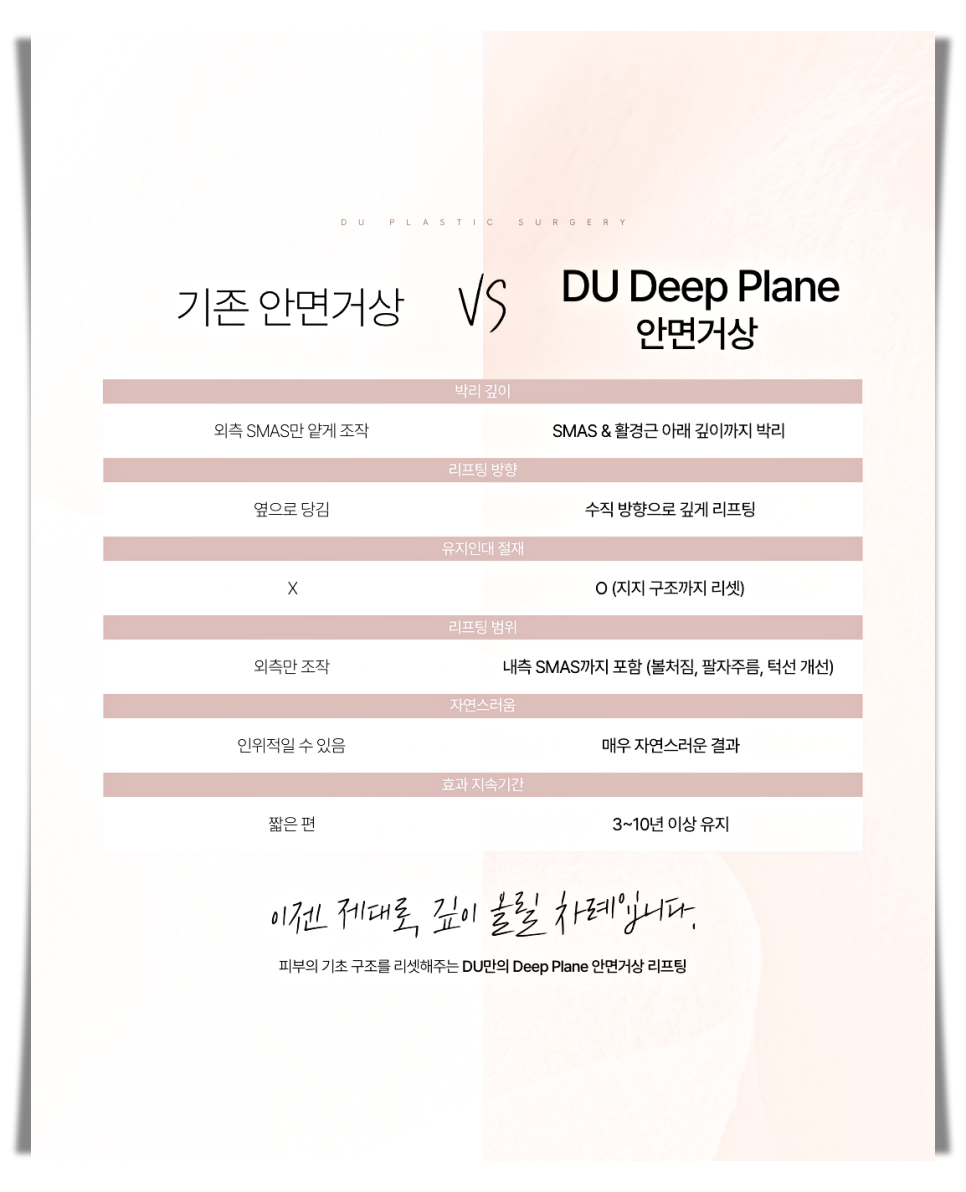
Mini thread lifting works by inserting threads under the skin and pulling upward, and it mainly affects only the dermis and subcutaneous fat layer.
In other words, it does not reach the SMAS layer (the superficial musculoaponeurotic system), which is the fundamental cause of sagging.
The SMAS layer is the core structure that determines facial elasticity and contours.
Therefore, once true sagging begins, how this SMAS layer is lifted becomes the deciding factor in how long the lifting effect lasts and how natural it looks.
Previous image
Next image
By contrast, a mini facelift is a surgery that directly dissects the SMAS layer, lifts it in the desired direction, and fixes it in place.
Although the incision is small, the area treated from the inside is much deeper and more precise.
Threads dissolve within a year and may return things to how they were before after that, but a mini facelift physically repositions the support structure, so the durability and stability are completely different.
For faces where sagging has progressed,
fascial fixation is more important than threads

Mini thread lifting
Usually, in your 20s and 30s, thread lifting can improve things to some extent.
But once you reach your mid-40s and beyond, the story changes.
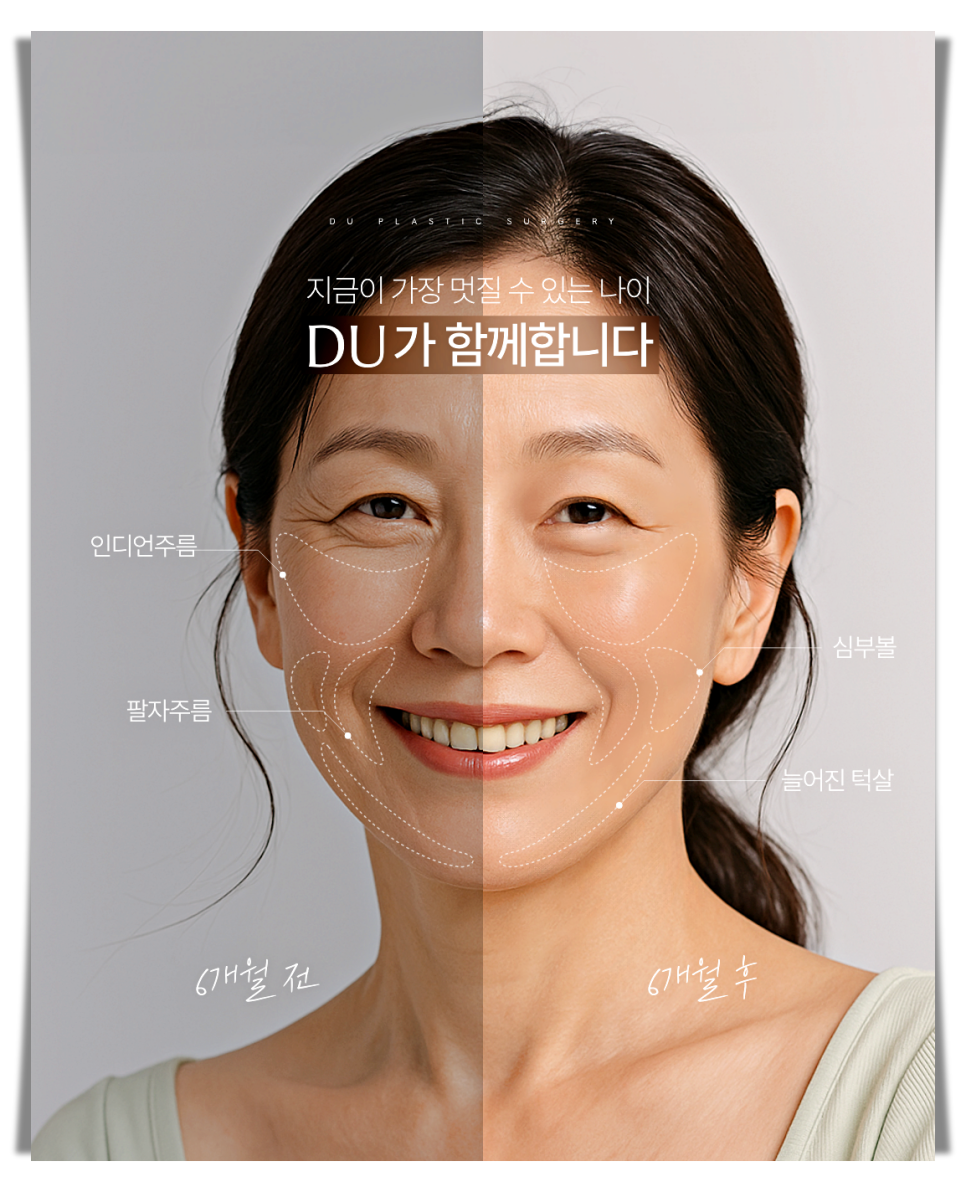
From this stage, it is not only the skin that sags; structural aging begins, in which the cheeks move downward and facial contours start to collapse.
In particular, as the nasolabial area hollows out, the cheeks gather around the mouth, and a double chin or sagging under the jaw is added on top, making the entire facial line appear blurred.

Previous image
Next image
These changes are not simply a loss of skin elasticity, but a problem caused by loosening and shifting in the middle layers of the face (the fascia and fat layer).
When you try to pull only the surface skin with threads in such cases, the skin surface may become uneven, or side effects may occur where the threads bunch up and protrude.
If pulled too forcefully, the expression may also become unnaturally altered.
On the other hand, a mini facelift is a surgery that resets this collapsed structure from below.
Because it corrects heavy cheeks, a sagging jawline, and hollow nasolabial folds through a fundamental fixation method, it can create a much more refined appearance.
Mini thread lifting has a quick recovery,
but a mini lift lasts longer in its results



Previous image
Next image
When many people consider lifting, the first question they ask is, “How long will recovery take?”
Thread lifting has almost no swelling immediately after the procedure and allows a quick return to daily life, so short-term satisfaction is fairly high.
However, the drawback is that the effect is short-lived and repeated procedures are needed.
One or two times may be fine, but with repetition, the possibility of tissue damage increases, and asymmetry problems can occur, such as one side being pulled more than the other or the threads loosening.

By contrast, a mini facelift involves an incision, but because it is a tiny incision designed to match the hairline in front of the ear, concerns about scarring are minimal.
Recovery is also much faster than with a standard facelift, and most people can return to daily life in 2 to 3 days.
And the most important difference is that you can expect a clear change that can last for years after just one surgery.



Previous image
Next image
So far, we have looked at lifting strategies by stage of facial elasticity decline, focusing on the differences between mini thread lifting and mini facelift.
In the end, what matters is not “which procedure is more famous,” but which method is most suitable for your current facial condition.
A method that only pulls the surface may provide temporary change, but for a facial line that has structurally collapsed, it may instead leave only unnaturalness or the burden of repeated procedures.
If you need surgery that accurately understands not only the surface of the skin but also the structure beneath it, and resets the elasticity structure based on the SMAS layer, a mini facelift may be a much safer and more effective choice.
✔ When you want a surgery that is more certain than a procedure
✔ When you feel the limitations of repeated thread lifting
✔ When you want to restore a facial line that has structurally collapsed
The answer may not be mini thread lifting, but a precisely designed mini facelift.
If you are thinking about not just pulling things tighter, but about a change that truly fits your own face, now may be the most important moment to choose.
In the following post, I cover mini facelift in more detail, so it may be helpful to refer to that.
Thank you for reading this long post.