Philtrum reduction surgery,
The method you choose determines the outcome
Hello.
As a board-certified plastic surgeon,
Glovi Plastic Surgery Clinic sees patients every day with the mindset
of carefully examining each person’s results to the very end,
even for small procedures.

Philtrum reduction surgery
| A clinic that follows the principles of plastic surgery, Glovi Plastic Surgery Clinic |
|---|
| In plastic surgery, it is most important to follow the basics. Plastic surgery must be designed with the patient’s entire life in mind. Both the process and the results must be safe. Glovi always puts the patient first. |
| Consultation is an important step that leads to surgery. To help you be satisfied with your surgical results, we promise personalized consultations with medical staff who have extensive clinical experience. |
| Aftercare can also be considered an extension of surgery. To help patients recover quickly, we provide customized care programs. |
If you searched for philtrum reduction surgery,
you were probably thinking something like this.
I definitely want to shorten my philtrum,
but I don’t know which method I should choose.
In fact, philtrum reduction surgery is divided into different methods depending on
where and how the incision is made,
and the effect and scar location vary according to that method.
Especially when corner-of-the-mouth correction is performed at the same time,
the combination and order of the two procedures
affect how complete the result is.
But I often feel in the clinic that there are fewer places than expected
that explain these points properly during consultation.
Even if you search a lot,
most of the explanations about the methods are vague,
so you may have felt even more confused.
That is why in this post, I want to honestly explain the differences between
the methods of philtrum reduction surgery
and the points you should know when considering corner-of-the-mouth correction.
If you read to the end, it will become much clearer
which direction is right for you.
Philtrum reduction surgery,
Which method is right: lateral, medial, or combined?
Philtrum reduction surgery
The question people ask most often when first learning about philtrum reduction surgery is:
Lateral? Medial?
Which one should I choose?
Because each method has different characteristics,
it is difficult to say for certain which method is right for a person
without checking them in person.
Still, it will be helpful to know the basic concept in advance
before coming in for a consultation.

Philtrum reduction surgery
The lateral incision method reduces the length of the area
that runs from the side of the nostril to the corner of the mouth.
Because the incision follows the anatomical boundary line between the nostril and the cheek,
the scar can be hidden behind the line,
which has the advantage of being relatively less noticeable.
Beyond simply shortening the length,
it can also help support the drooping corners of the lips,
while simultaneously refining the contour of the outer face line.

The medial incision method makes an incision attached to the base of the nose
and lifts the philtrum upward.
It can help balance the overall face and lift the upper lip to create a fuller look,
so it may be considered for those who want both a shorter philtrum
and improved lip volume.
However, compared to the lateral method,
the shortening effect of the medial method may be more limited in some cases,
and there is also a tendency for some of the effect to lessen
as tissue tension relaxes after suturing.
That is why, when choosing the medial method,
it is important to properly align expectations in advance,
and I recommend checking during consultation
whether the clinic brings this up first.
During consultations, cases like this come up often.
For someone with a fairly long philtrum and thin lip volume,
it may feel insufficient to recommend only the medial method,
and if only the lateral method is used,
the available skin may not be sufficient.
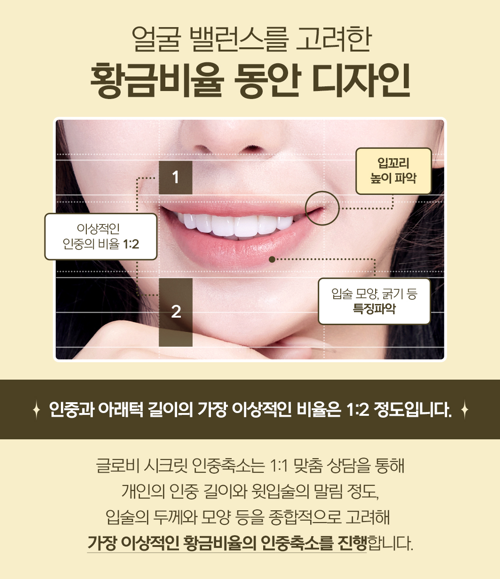
In such cases, we consider a combined approach as an alternative.
However, if both methods are applied at the same time,
the tension placed on the tissue around the lips increases,
so rather than overreaching, we prioritize creating results within the tissue’s tolerance range.
It is wiser to achieve results within a safe range
than to try to correct too much at once and end up with a longer recovery.
I’m not saying you must come to us.
But if you understand the differences among these three methods
before your consultation, I think you will be able to have a much more specific discussion.
Corner-of-the-mouth correction,
What you must know when combined with philtrum reduction
Philtrum reduction surgery
As you look into philtrum reduction,
many people naturally begin to think:
If I’m already working on the area around the mouth,
what about lifting the drooping corners of the mouth too?
I completely understand this concern.
In fact, there are cases where a long-looking philtrum
and drooping corners of the mouth appear together,
so correcting both can make the overall change feel more natural.
On the other hand, some people say that after shortening only the philtrum,
leaving the corners of the mouth unchanged feels somewhat awkward,
so it is important to discuss in depth during consultation
whether both procedures should be planned from the start.

Corner-of-the-mouth correction is a surgery that lifts the corners of the mouth
by removing a small amount of skin from the drooping area
or adjusting the direction of the underlying muscles.
Because the incision range is not large, the recovery burden is relatively light,
but since the corners of the mouth are an area with concentrated facial muscles,
the amount removed and the direction of suturing can affect
the natural appearance of everyday expressions.
When deciding how much to lift in this area,
we always approach it with naturalness first rather than excess.
There is nothing more uncomfortable in daily life than a post-surgical expression that looks awkward.

There is one more thing I would like to mention.
When consulting with people who want to undergo both surgeries at the same time,
I often find that many of them underestimate the burden of simultaneous procedures.
Because both surgeries involve the tissue around the lips,
when performed together, it is necessary to consider the tension on each area
and the blood flow condition at the same time.
If the tissue is pushed beyond what it can handle,
recovery may take longer or lead to unwanted results,
so in some cases, it is much safer to proceed in stages.
I understand the desire to solve everything at once,
but I believe it is right to be honest about this point.
Philtrum reduction surgery may look like a minor procedure,
but the results can differ significantly depending on the method chosen
and the surgeon’s experience.
You may have many concerns, including scars, expected effect,
and whether to address the corners of the mouth as well.
It is worth checking whether the clinic can properly discuss these concerns during consultation,
and whether it explains the reason for choosing a particular method first.
That one step can change your level of satisfaction with the outcome.
If you are interested in Glovi Plastic Surgery Clinic,
please feel free to contact us.
It is okay if you are still not sure which method is right for you.
We will speak honestly and without exaggeration.
< Other posts you may want to read >
Glovi Plastic Surgery Clinic is located
1 minute on foot from Exit 4 of Apgujeong Station on Subway Line 3,
at 5F and 6F, EGI Building, 843 Nonhyeon-ro, Gangnam-gu, Seoul.
Consultation appointments are available on both weekdays and weekends.
All consultations are conducted privately, one-on-one.
For detailed inquiries and reservations, please leave a message through the channel below.



Philtrum reduction surgery