How to Improve a Long Philtrum,
Things East Asians Should Know
Hello,
This is Glovi Plastic Surgery Clinic.

How to Improve a Long Philtrum
| A clinic that follows the principles of plastic surgery, Glovi Plastic Surgery Clinic |
|---|
| The most important thing in plastic surgery is to follow the basics.Plastic surgery should be planned with the client’s entire life in mind.Both the process and the results of plastic surgery must be safe.Glovi always puts the client first. |
| Consultation is an important step that leads to surgery.We promise customized consultations with medical staff rich in clinical experience so that you can be satisfied with your surgical results. |
| Aftercare can also be said to be an extension of surgery.To help patients recover quickly,we provide customized care programs. |
Whenever a long philtrum starts to bother you, a thought comes to mind.
“Am I the only one whose philtrum is unusually long?”
“Can it be shortened with surgery?” and similar questions
keep piling up,
and eventually lead to vague resignation.
But this concern
actually has a variety of options for improvement.
Today, I’ll explain how to improve a long philtrum,
and also how it relates to nose surgery.
I think what once felt vague will become much more concrete.
Why Philtrum Surgery for East Asians Needs a Different Approach
How to Improve a Long Philtrum
When you look into philtrum reduction surgery,
you often first come across overseas cases or paper-based information.
But the surgical methods introduced there
need to be considered carefully before being applied directly to East Asians.

Philtrum reduction surgery is a procedure that removes part of the skin
from under the nose to the space between the lips,
shortening the overall length.
In the past, the mainstream methods were direct incisions under the nose
or incisions above the lip line.
While these methods can clearly improve length,
they came with a major issue for East Asians: scars.
For Westerners, especially white patients, skin characteristics tend to make scars less noticeable,
and they usually fade naturally over time,
so the burden of this type of surgery is relatively lower.
By contrast, East Asians often have skin tissue density and melanin distribution characteristics that cause scars to remain darker and longer-lasting,
even with the same incision.
If surgery is performed without accounting for these differences,
you may end up with a shorter philtrum but a scar that is even more noticeable.
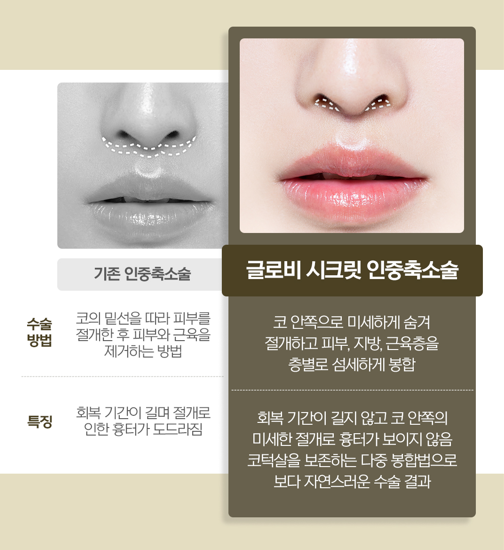
Therefore, for scar-sensitive East Asians,
the surgical approach itself should be differentiated by placing the incision inside the nostril
and, if necessary, extending it toward the alar side
so that the scar is not visible from the outside.
In addition, if the procedure goes beyond simple skin removal and also secures the internal tissue upward with sutures,
you can reduce the scar burden while still expecting sufficient improvement.
At our clinic as well, we perform this type of combined correction
that hides scars and firmly secures the internal tissue.
Even if you do not visit Glovi,
if you are considering philtrum reduction, we recommend checking the incision location and scar management method first during consultation.
If You’re Considering Nose Surgery,
You Should Also Look at the Philtrum
How to Improve a Long Philtrum
There is one more point that is often overlooked as much as the scar issue.
That is the ratio between the nose and the philtrum.

How to Improve a Long Philtrum
During consultations, some people often say this.
They had surgery to raise the tip of the nose,
but it seems like the philtrum looks longer instead.
Some worry that the surgery may have gone wrong,
but in most cases, that is not the case.
If you look at the principle,
when the nasal tip is raised, the eye is naturally drawn upward across the face,
so the space below the nose—the philtrum—can appear more prominent by comparison.
This is not a surgical failure.
It is a natural change in proportion caused by a shift in the face’s visual center of gravity.

The nose and philtrum may feel separate,
but in reality they share the same midface space and divide the proportions within it.
So as the nasal tip gets higher,
the philtrum can appear to take up a larger visual share,
and if this is not considered in advance,
you may feel unexpected disappointment after surgery.
Structurally, the two surgeries also connect naturally.
The method of making an incision inside the nostril during philtrum reduction overlaps significantly with the area handled in nose surgery,
so if the two procedures are performed together,
they can share the incision path and reduce the burden of additional cuts.
Another advantage of combining them is that the overall midface proportions can be adjusted in a single surgery.

Of course, there are also people who feel enough change with philtrum reduction alone,
without nose surgery, and this does not mean the two procedures must always be done together.
However, if you are already planning nose surgery,
I think it is a good idea to check the ratio with philtrum length during the consultation stage
so that you do not end up regretting it later.
If you have been worrying about your philtrum for a long time,
I hope today’s post helps you find some direction.
If you want to understand things thoroughly before deciding on surgery,
or if you want to check the ratio between your nose and philtrum,
please feel free to contact the Glovi channel.
※ After surgery, side effects such as bleeding, inflammation, and infection may occur depending on the individual,
and sufficient consultation with a specialist is necessary.
< Related posts you may also find helpful >
Glovi Plastic Surgery Clinic is located at EGI Building, 5th and 6th floors, 843 Nonhyeon-ro, Gangnam-gu, Seoul,
a 1-minute walk from Exit 4 of Apgujeong Station on Subway Line 3.
Consultation reservations are available on both weekdays and weekends.
All consultations are conducted privately, one-on-one.
For detailed inquiries and reservations, please leave a message through the channel below.



How to Improve a Long Philtrum