Feeling the thread after a thread lift,
read this if you’re worried
Hello,
This is Globi Plastic Surgery Clinic.

Feeling the thread after a thread lift
| A hospital that follows the principles of plastic surgery, Globi Plastic Surgery Clinic |
|---|
| Plastic surgery is most important when the basics are followed. Plastic surgery should be designed with the patient’s entire life in mind. Both the process and the results of plastic surgery must be safe. Globi always puts the patient first. |
| Consultation is an important step that leads to surgery. To help you be satisfied with your surgical results, we promise personalized consultations with medical staff who have extensive clinical experience. |
| Aftercare can also be seen as an extension of surgery. To help patients recover quickly, we provide customized care programs. |
A few days after a thread lift procedure,
have you ever felt something under the skin?
When you gently press the area in front of the mirror,
have you ever worried, 'Could this be the thread poking out?'
Many people have had that fear,
more than you might think.
In this post, I’ll honestly explain why the thread can be felt,
and what criteria can help you tell whether it is a normal reaction or not.
If you read just for 3 minutes, this will help you check for yourself
whether you should visit the clinic
or whether it is okay to observe a little longer.
Feeling the thread, how long is normal?
Feeling the thread after a thread lift
Many people experience the symptom of feeling the thread
after a thread lift procedure.
And at that moment, most people think the same thing.
Is this supposed to happen,
or is something wrong?
To put it simply,
feeling the thread for a certain period after the procedure
is not abnormal in itself.
The reason is that the threads used in thread lifting
are inserted near the boundary between the dermis and subcutaneous fat,
that is, quite close to the skin surface.
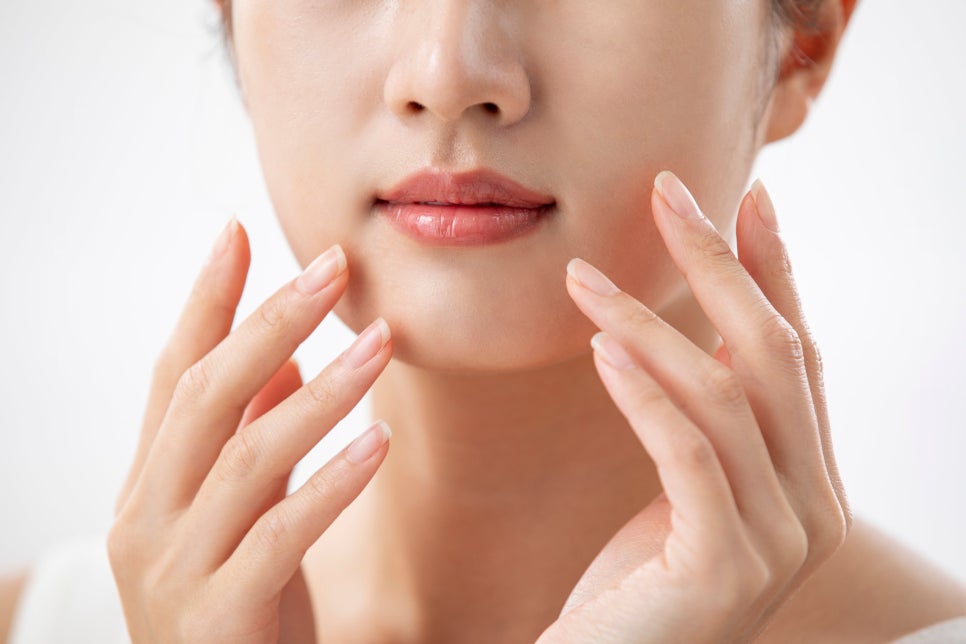
Because of that, when you gently press with your hand,
feeling the presence of the thread
is a structurally natural response.
In particular, areas with a thin fat layer, such as the inner cheeks or jawline,
tend to make the sensation more noticeable,
and that is due to the skin structure of the area
rather than a problem with the insertion itself.
Right after the procedure, the tissue has not yet fully settled around the thread,
so the sensation can feel stronger.
As swelling goes down and the tissue stabilizes, it often naturally eases
around 4 weeks later.
That said, there is one important point I want to emphasize.
Even if you can feel the thread,
the key factor is whether it is improving over time.
If the skin surface is noticeably raised
or the hard, lumpy feeling does not improve even after 2 to 3 weeks,
it is a good idea to visit the clinic where you had the procedure
and have the condition checked.
If you understand in advance the reactions that may appear depending on your individual skin characteristics,
you can respond much more safely and with less anxiety.
Above all, if anything feels even slightly off,
it is safest to have it checked by a specialist
rather than worrying about it alone.
The degree of feeling the thread depends on the procedure design
Feeling the thread after a thread lift
The threads used in thread lifting are broadly divided into cog threads,
which have barbed structures and are specialized for lifting,
and mono threads,
which have a smooth surface and promote collagen regeneration.
Choosing the right thread is important,
but the more crucial point is at what depth
and how many threads are inserted.
During consultations,
many people ask, "Doesn’t using more threads make the effect better?"
That is a reasonable thought,
but in reality, the opposite is often true.
If too many threads are inserted, tissue tension increases,
and the feeling of the threads and pulling may actually last longer,
and if thick threads are inserted close to the surface in someone with thin skin,
unevenness may appear before the lifting effect does.

Feeling the thread after a thread lift
Therefore, in the consultation process,
checking skin thickness, degree of sagging, and fat distribution first
is by no means a simple step.
The more precise this assessment is,
the more unnecessary foreign-body sensation can be reduced,
and the more the lifting effect can be maximized.
Using the right thread for the right area,
at the proper depth, may sound simple,
but this design is the key factor that determines the difference in results.
It is only natural to be this concerned about feeling even one thread.
There is the cost, of course,
but because this is a procedure that directly affects your face,
it is natural to become sensitive to even small changes.
It is Globi’s principle to transparently disclose the precautions and possible side effects
that patients need to know.
If you are wondering whether the symptoms you are feeling are within the normal range,
or what kind of design would suit your skin condition,
please feel free to leave an inquiry for consultation.
※ As all procedures may cause side effects such as inflammation, bleeding, or asymmetry depending on the individual,
an adequate consultation with a specialist is necessary.
< Posts that may be helpful to read together >
Globi Plastic Surgery Clinic is
located 1 minute on foot from Exit 4 of Apgujeong Station on Subway Line 3,
on the 5th and 6th floors of EGI Building, 843 Nonhyeon-ro, Gangnam-gu, Seoul.
Consultation reservations are available on both weekdays and weekends.
All consultations are conducted privately, one-on-one.
For detailed inquiries and reservations, please contact us through the channel below.


Feeling the thread after a thread lift