Hello,
This is Globi Plastic Surgery Clinic.

Middle-aged eye surgery
| A clinic that follows the principles of plastic surgery, Globi Plastic Surgery Clinic |
|---|
| The most important thing in plastic surgery is to keep to the basics.Plastic surgery should be designed with the customer’s lifetime in mind.Both the process and the results of plastic surgery must be safe.Globi always puts customers first. |
| Consultation is an important step that leads to surgery.We promise personalized consultations with medical staff who have extensive clinical experience so that you can be satisfied with the surgical results. |
| Aftercare can be said to be an extension of surgery.To help patients recover quickly, we provide customized care programs. |
When speaking with people in their 40s and 50s,
there is a common concern they often bring up.
Their eyes seem smaller,
and why are the areas under the eyes so saggy...?
They do not know where to start.
The changes in which the area above the eyes sags and the area below the eyes becomes puffy
are natural phenomena that come with aging.
But in the moment, many people find it difficult to judge
which correction is right for them,
or even whether they need both.
Upper blepharoplasty and lower blepharoplasty—
even if you have heard the names, understanding what is different and when each is needed
is the first step to reducing trial and error.
From here, we will clearly explain the 기준.
If the upper eye area has become heavy,
you need to first check whether it is a skin issue or a muscle issue
Middle-aged eye surgery
There is a question we often hear in consultations.
I do not know if my eyelids are heavy,
or if my eyes were just small to begin with.
Every time we hear this,
we look first for the underlying cause of the sagging.
Middle-aged eye surgery
In other words, whether it is simply loose skin,
or whether the muscle that opens the eyes has weakened itself.
Although they may look similar on the surface,
these two cases require completely different correction plans.
As people age, if the strength of the muscle that lifts the eyes (the levator palpebrae superioris)
itself weakens, the eyelid begins to cover the eyeball,
causing symptoms of ptosis.
From that point on, the impression changes to one that looks tired and heavy.
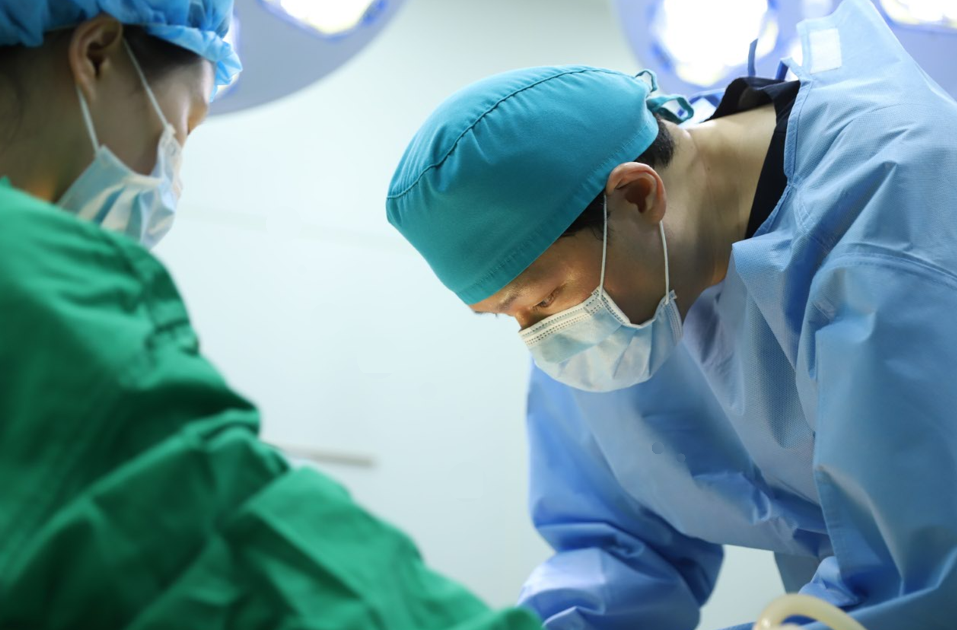
Upper blepharoplasty removes sagging skin,
and when necessary, it is performed together with muscle correction
to address the issue.
Its purpose is fundamentally different from simply creating a double eyelid.
The key factor that determines the result is the amount removed.
If too much is cut away, the eyes may not close fully,
or an unnatural impression may remain.
On the other hand, if too little is removed, the effect will be minimal.
This is why the design must take into account
a combination of factors such as skin thickness, the degree of sagging, and the distance from the eyebrows.
One more thing to add:
if weakened muscle function is the main cause rather than sagging skin,
that is, if ptosis is also present, upper blepharoplasty alone may not provide sufficient improvement.
In such cases, we may design eye correction together with it,
or depending on the situation, recommend a different approach first
before upper blepharoplasty.
Why simply removing under-eye fat is not the answer
Middle-aged eye surgery
If sagging in the upper eye area is the domain of upper blepharoplasty,
the problems under the eyes are addressed by lower blepharoplasty.
However, in middle age, it is actually more common for these two issues to occur at the same time.
Will the scar under my eye be very noticeable after surgery?
Honestly, that is what I am most afraid of.
This is the question most often asked before lower blepharoplasty.
Concerns about scarring are understandable,
but in fact, the point that truly determines the outcome of lower blepharoplasty
is not the scar, but how the fat is handled.
As people age, the orbital septum that supports the area under the eyes
weakens, and the fat inside it
is pushed forward.
This is the direct cause of the under-eye area looking puffy.
In the past, this fat was simply removed.
But if you only remove the fat,
the puffiness may disappear, yet the hollow under-eye groove can become deeply sunken,
which may make you look even more tired.
That is why, today, the priority is a repositioning method that moves the protruding fat
to the sunken tear trough area and smooths it out.

There is one more important step for middle-aged patients:
the removal of sagging skin.
In people in their 20s and 30s, even if only the fat is repositioned,
the skin can still contract on its own to some extent,
but skin that has lost elasticity does not do that.
Only when fat repositioning and skin removal are performed together
can a natural improvement in the under-eye area be expected.
However, if too much is removed,
the eyelid can turn outward,
causing ectropion,
so
we go through a process in which the patient is briefly awakened during the correction
and asked to open their eyes directly.
It is also good to know the recovery process in advance.
The major swelling goes down within a week,
and bruising usually disappears within 1 to 2 weeks.
Washing your face is possible after the stitches are removed,
but for up to 3 weeks, you should gently rub the wound area sideways only very lightly.
Because the incision is made 1 mm below the eyelashes,
after about a week it naturally blends into the texture of the under-eye wrinkles.
Middle-aged eye surgery begins with the desire to simply look younger,
but in reality, deciding which correction is right for you
is more complicated than it seems.
Whether you need upper blepharoplasty, lower blepharoplasty,
or both can only be determined by directly checking the skin condition, muscle condition,
and even the distribution of fat.
If you approach it in the wrong direction,
both time and cost, and even the recovery period, will be wasted.
We recommend starting by first checking which correction is appropriate for your case,
and whether the direction you are considering is the right one.
< Related posts worth reading >
Globi Plastic Surgery Clinic is
located 1 minute on foot from Exit 4 of Apgujeong Station on Subway Line 3
at 843 Nonhyeon-ro, Gangnam-gu, Seoul, EGI Building, 5th and 6th floors.
Consultation appointments are available on both weekdays and weekends.
All consultations are conducted privately, one-on-one.
For detailed inquiries and reservations, please leave a message through the channel below.



Middle-aged eye surgery