Thread-Lifting Dimples,
Worried That Skin Indentations May Not Go Away?
Hello,
This is Globie Plastic Surgery Clinic.

Thread-Lifting Dimples
| A Clinic That Upholds the Principles of Plastic Surgery, Globie Plastic Surgery Clinic |
|---|
| The most important thing in plastic surgery is adhering to the basics. Plastic surgery should be planned with the patient's entire life in mind. Both the process and the results must be safe. Globie always puts patients first. |
| Consultation is an important step that leads to surgery. To help you be satisfied with your surgical results, we promise personalized consultations with experienced medical professionals. |
| Aftercare can also be considered an extension of surgery. To help patients recover quickly, we provide personalized care programs. |
If you look in the mirror after a thread-lifting procedure
and notice that one area of your skin is deeply indented like a dimple,
you will probably have thoughts like these first:
Isn't something wrong?
What if it hardens like this?
In fact, quite a few people feel anxious after their procedure
because of dimpling.
To give you the conclusion first,
dimpling is not a fatal or permanent side effect,
and it can improve sufficiently with early intervention.
However, it is also true that you should not simply leave it alone.
In this article, we will honestly summarize why dimpling occurs,
how to respond to it, and what can happen
if it is left untreated.
Why Do Dimples Occur?
Thread-Lifting Dimples
You said the procedure went well,
but when I got home, one area looked deeply sunken.
Is this normal?
For patients experiencing this phenomenon for the first time,
it is only natural to be surprised.
However, to be honest,
dimpling is not uncommon after thread lifting.
It is not a sign that the procedure itself was performed incorrectly;
it can also mean that the thread has properly engaged with the tissue.
The issue is that the engagement has become
excessively concentrated at a particular point.
Let us explain this in a little more detail.
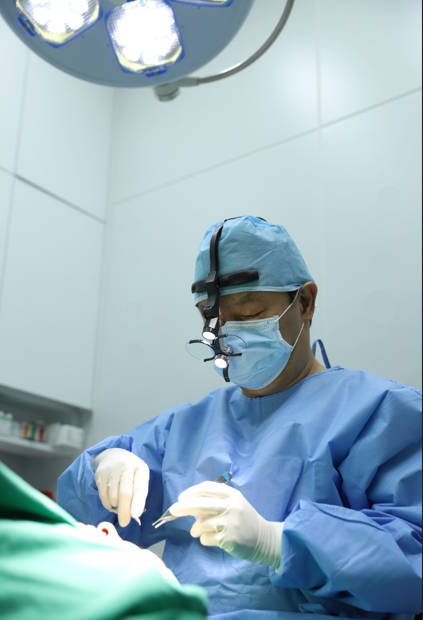
The threads used for thread lifting have small barbs,
or projections, attached to them.
These projections grip the SMAS layer beneath the skin
and pull it upward to create a lifting effect.
During this process, the thread's projections may grip
a specific point in the SMAS layer more strongly than necessary.
When only that area is pulled inward,
the surface appears sunken.
That is a dimple.
It is similar to how a section of fabric appears indented
when thread is pulled too tightly at one point while sewing.
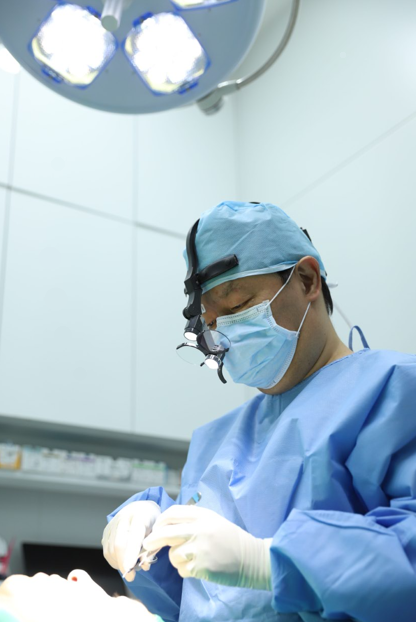
There is one point that needs to be addressed.
When the skin is excessively thin,
the projections are closer to the surface,
which relatively increases the likelihood of dimpling.
In such cases, during the consultation before the procedure,
we tend to consider other methods first
instead of thread lifting.
This is because there are certainly cases in which
the decision made before the procedure is more important
than the result afterward.
Why “Can't I Just Leave It Alone?”
Is the Most Dangerous Question
Thread-Lifting Dimples
When we talk about dimpling,
quite a few people ask in response:
Just as swelling goes down over time,
won't the dimple disappear on its own
if I simply leave it alone?
This is an entirely understandable reaction.
However, the reason this question is concerning
is that dimpling is not something that is resolved
simply by waiting.
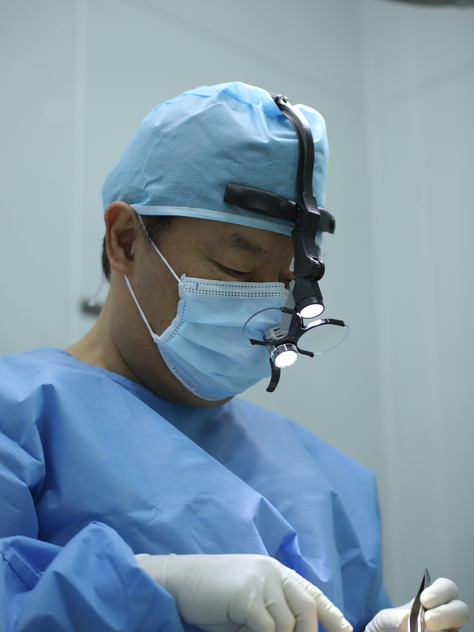
Swelling and bruising disappear
as the body naturally absorbs them.
Dimpling, on the other hand, is a physical condition
in which the projections grip the SMAS layer
and continue pulling inward.
As time passes, the tissue around the thread hardens
and adhesions develop.
It is like a knot that can be loosened now,
but becomes hardened and difficult to undo if left alone.
The period during which correction is possible is within four weeks after the procedure.
During this period, gently massaging the area with appropriate pressure
to loosen the thread entanglement often improves the skin's surface.
However, rather than doing this massage on your own,
it is safer to have the treatment provider examine the area directly
before proceeding.
Only a medical professional who has examined the condition directly
can determine which area should be loosened and with how much pressure.
Thread-Lifting Dimples
There was one patient who visited us
because a dimple had become bothersome only two months after the procedure.
Tissue adhesion had already progressed considerably,
and additional treatment was necessary
because improvement through massage alone was difficult.
It was an unfortunate case in which correction
could have been carried out relatively smoothly
if the patient had visited us earlier.
Based on this experience,
our clinic has placed greater emphasis on checking the condition
the day after the procedure and monitoring progress at one month.
Dimpling is one of the phenomena
that may occur after thread lifting,
but it may improve if addressed appropriately
when it is discovered.
Conversely, missing the right timing
can cause a problem that could have been resolved simply
to become unnecessarily more serious.
At Globie Plastic Surgery Clinic, it is our principle
to transparently explain in advance the phenomena
and potential side effects that may occur after a procedure.
This is because we believe that receiving treatment
with accurate information is a safe way to protect your results.
If you are wondering whether thread lifting is suitable for your case,
or are concerned about dimpling after the procedure,
please feel free to leave us a consultation inquiry.
< Other Articles You May Find Helpful >
Globie Plastic Surgery Clinic
is located a one-minute walk from Exit 4 of Apgujeong Station on Subway Line 3,
on the 5th and 6th floors of the EGI Building,
843 Nonhyeon-ro, Gangnam-gu, Seoul.
Consultation reservations are available on weekdays and weekends.
All consultations are conducted privately on a one-on-one basis.
For detailed inquiries and reservations, please contact us through the channel below.



Thread-Lifting Dimples