Alar Reduction Surgery,
A Complete Guide to
Design Methods for Different Types of Wide Noses
Hello,
This is Globie Plastic Surgery Clinic.

Alar Reduction Surgery
| A Clinic That Follows the Principles of Plastic Surgery: Globie Plastic Surgery Clinic |
|---|
| The most important principle in plastic surgery is to follow the basics. Plastic surgery should be designed with the patient's lifetime in mind. Both the process and the results must be safe. Globie always puts patients first. |
| Consultation is an important step that leads to surgery. To help you be satisfied with your surgical results, we promise personalized consultations with medical professionals who have extensive clinical experience. |
| Postoperative care can also be considered an extension of surgery. We provide personalized care programs to help our patients recover quickly. |
If you searched for alar reduction surgery,
you may have started wondering,
"Does my nose really look wide,
and do I need surgery?"
However, there is something that people
we meet in the consultation room
commonly say.
I thought my nose looked wide,
so I assumed that alar surgery alone would be enough,
but when I came in for a consultation,
they told me it was more complicated
than I had expected.
That is correct.
The causes of a nose that looks wide
differ from person to person,
and the appropriate approach differs as well.
Simply cutting away the alar tissue
does not resolve every situation.
In today's post, we will honestly summarize
what differs by type
and the criteria used to determine the design.
"Can't you just remove the alar tissue?"
Alar Reduction Surgery
During consultations,
many people ask this question.
Can't you just remove some of the alar tissue?
It is not entirely wrong, but this question contains
the most common misunderstanding about alar surgery.
The cause of a nose that looks wide
may be the size of the alae themselves,
but there are also many cases in which
the nasal tip is low and wide,
making the alae look relatively broad.
Even if they look similar on the outside,
the surgical method can be completely different
when the underlying cause differs.
If only the alar tissue is removed from someone
whose nose looks wide because the tip is low,
the result may be an awkward proportion:
the nasal tip remains low while
the width of the nostrils becomes narrower.
This is often the kind of situation
that leads to a result that feels like,
"Something seems off,"
after surgery.
In fact, among many people who are concerned
about broad alae,
a considerable number have nasal tip cartilage
that has spread apart and lacks strength,
making the entire nose look wide.
In such cases, even without touching the alae,
firmly supporting only the nasal tip structure
can create the visual effect of the previously
wide alae naturally drawing inward.
This is a way to achieve the desired contour
while reducing unnecessary incisions.
That is why, during consultations, Globie separately analyzes
the nasal tip height,
alar thickness, and nostril shape
before developing the surgical design.
In some cases, a sufficient change can be achieved
without alar excision,
while in others, excision is essential.
Designs That Differ by Type:
Why the Cause of a Wide Nose Must Be Addressed First
Alar Reduction Surgery
The causes of alae that look broad
can largely be divided into three types.
A situation in which the nasal tip cartilage has spread apart,
a situation in which the alae themselves are thick and wide,
and a situation in which both occur together.
If the nasal tip is low and wide,
the key is to correct the alar cartilages,
also called the wing cartilages.
The alar cartilages are two pieces of cartilage
that support both sides of the nasal tip.
If they do not come together toward the inside
and instead spread outward,
the nasal tip becomes wide,
making the alae look broad as well.
This type is more common than expected among East Asians,
who often have smaller and weaker cartilage in this area.
In such cases, the approach may involve
bringing the separated cartilage together with sutures,
or creating a more three-dimensional nasal tip
by grafting cartilage.
When the nasal tip is raised and defined,
the alae naturally appear narrower as a result.
Therefore, for this type, it is often unnecessary
to add alar excision.
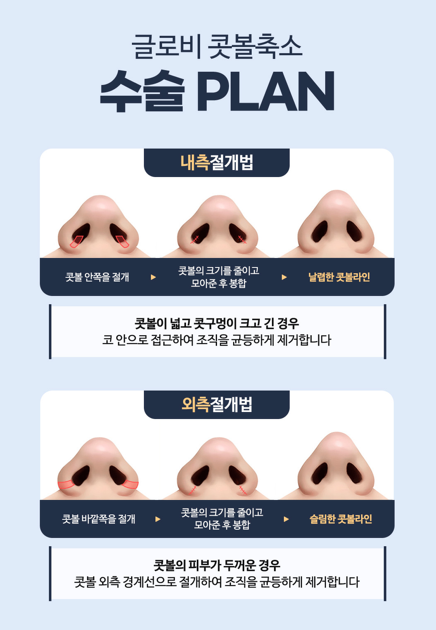
On the other hand, if the nasal tip already has
an adequate height but the alae themselves are wide
or the tissue is thick,
alar excision is necessary.
This method reduces the width by removing part
of the tissue along the boundary where the alae
meet the facial skin.
There is one point I would like to emphasize.
Many people think that removing more tissue
will produce a better result,
but once the skin around the alae is removed,
it cannot be enlarged again.
Because excessive removal at the outset
makes later correction difficult,
it is much safer to begin conservatively
and make additional adjustments if necessary.
If both the nasal tip is low and the alae are wide,
both issues must be incorporated into the design.
The most important factor in this situation
is the order of treatment.
Alar Reduction Surgery
After first raising the nasal tip,
we predict how naturally the alar width will decrease,
then adjust the amount of excision
only enough to make up the difference.
If the skin is thick or lacks elasticity,
making recovery after excision more difficult
than expected, we explain this honestly
before surgery and may suggest another approach first.
Alar surgery is not simply a matter of
"whether or not to cut away tissue."
It begins with accurately understanding
the structure of your nose.
Even when people come in with the same concern,
the design differs from case to case.
Choosing the wrong approach based on incorrect information
can take you farther from the result you want.
It is Globie's long-standing principle
to transparently disclose the possibility of complications
and the recovery process,
and to recommend surgery only when it is truly necessary.
If you would like to accurately determine
which approach is right for your case,
please feel free to contact us for a consultation.
※ Plastic surgery may cause side effects such as bleeding, inflammation, or infection depending on the individual, so caution is required.
<Recommended Related Articles>
Globie Plastic Surgery Clinic
is located at 5th and 6th floors of the EGI Building,
843 Nonhyeon-ro, Gangnam-gu, Seoul,
just a one-minute walk from Exit 4 of Apgujeong Station on Subway Line 3.
Consultation appointments are available on both weekdays and weekends.
All consultations are conducted privately on a one-on-one basis.
For detailed inquiries and appointments, please leave a message through the channel below.



Alar Reduction Surgery