Breast Fat Grafting Scars,
If You’re Worried About Marks, Be Sure to Read This
Hello,
This is Globie Plastic Surgery Clinic.

Breast Fat Grafting Scars
| A Clinic That Adheres to the Principles of Plastic Surgery: Globie Plastic Surgery Clinic |
|---|
| Adhering to the basics is the most important aspect of plastic surgery. Plastic surgery should be planned with the patient’s entire lifetime in mind. Both the process and the results must be safe. Globie always puts its patients first. |
| Consultation is an important step that leads to surgery. To help you feel satisfied with your surgical results, we promise personalized consultations with experienced medical professionals. |
| Postoperative care can also be considered an extension of the surgery. We provide personalized care programs to help our patients recover quickly. |
When researching breast fat grafting,
many people ask first,
“So, how much scarring will there be?”
It is natural to feel anxious as soon as you hear that an incision is required.
However, it can be more difficult than expected to find
accurate information about where and how the incision is made,
and how visible the mark actually is.
In this article, we will explain honestly
how incisions are made for breast fat grafting,
why marks form, and how care can affect the results.
Why scars form:
You need to understand the incision location first
Breast Fat Grafting Scars
Is an incision really made?
I’m not sure where it is made.
Whenever we receive these questions,
there is one point we explain first.
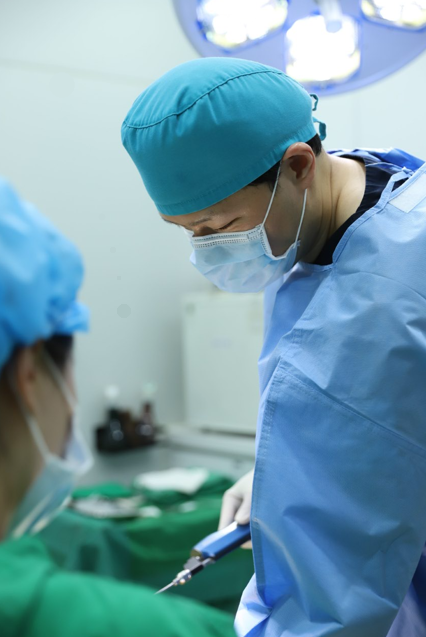
Breast fat grafting
uses a completely different incision method from implant surgery.
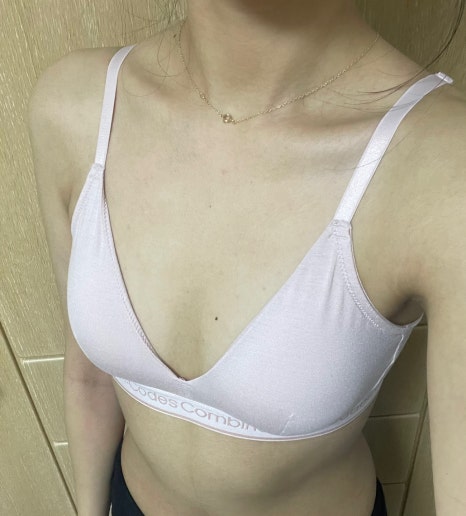
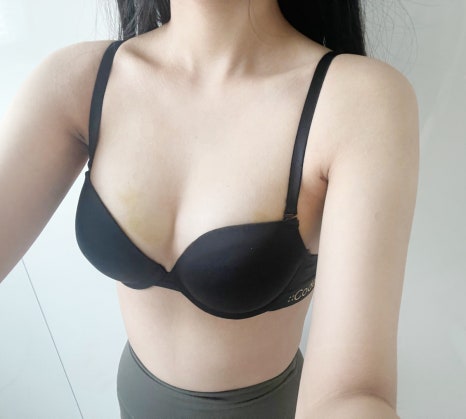
Unlike implant surgery, which requires an incision beneath the breast or around the areola,
fat grafting generally requires only
a small opening approximately 3–5 mm in size
along the inner part of the armpit crease.
This is because the opening only needs to be large enough
for the thin tube called a “cannula,”
which is used to inject the fat, to pass through.
If you ask whether even an opening of this size can leave a mark,
we should answer honestly.
It can.
It would be inaccurate to say that there will be no mark at all
when the skin has been affected.
However, how visible it is can vary greatly depending on the incision location and suturing method.
The most common reason a wound becomes wider
is excessive tension at the sutured area—in other words,
excessive pulling on the skin.
If the skin is pulled too tightly during suturing,
it is more likely to heal as a thick, wide scar.
For this reason, we first check the thickness and elasticity of the skin during the consultation
and then determine the incision location.
When suturing, we also use a method that distributes tension
and choose a naturally concealed location,
such as the armpit crease.
There is one more point I would like to mention.
An access point is also made on the thigh to harvest fat,
and this area may also leave a small mark.
People with low skin elasticity or a tendency to develop keloids
may experience a stronger scar response
even after undergoing the same procedure.
In such cases,
it is advisable to first determine through a consultation
whether the procedure is suitable for you.
Scar care:
When to begin and how to maintain it
Breast Fat Grafting Scars
Can I apply ointment immediately after the stitches are removed?
This is a question we frequently hear in the consultation room.
Stitches are removed approximately 5–7 days after surgery,
and many people start applying ointment immediately afterward.
Even if the wound looks completely healed on the outside,
the tissues beneath the skin need more time to recover.
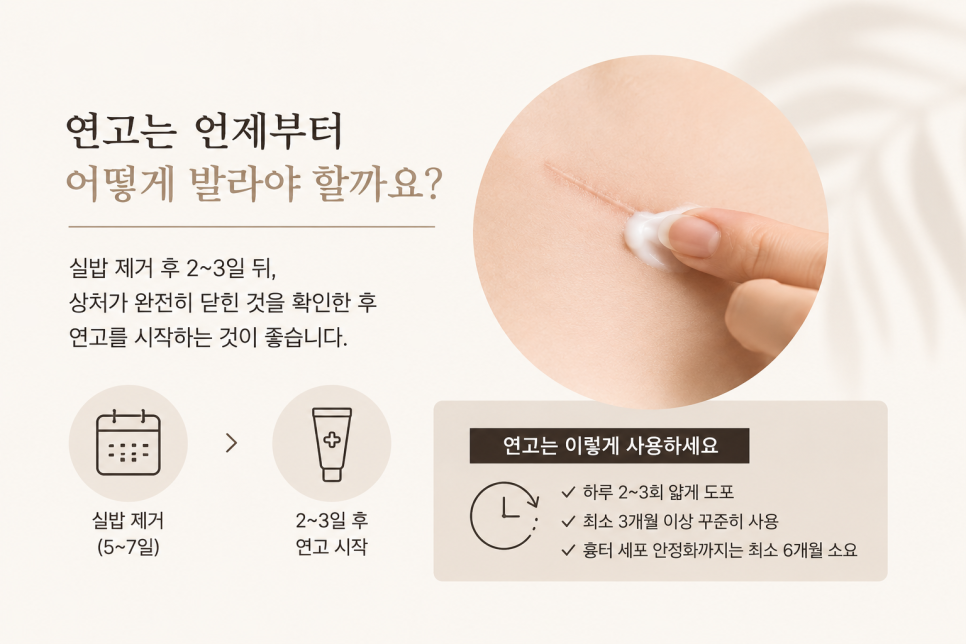
Therefore, ointment is generally started 2–3 days after the stitches are removed,
after first confirming that the wound has completely closed.
Once it has been confirmed that the wound is properly closed,
ointment is generally applied thinly 2–3 times a day.
Some people stop using it after a few days
because they do not see any noticeable change,
but scar tissue takes at least six months to stabilize.
This is why we emphasize that you should continue care consistently
for at least three months, even if there are no visible changes.
It is also a good idea to use scar-prevention tape
immediately after the stitches are removed.
It helps keep the incision from opening,
and it is important to replace it with a new strip as soon as its adhesive strength decreases after showering.
Light daily activities are generally possible gradually
from 2–3 days after surgery,
but it is best to avoid strenuous walking or exercise
for two weeks when it involves the thigh from which fat was harvested.
Ultraviolet exposure is another factor that is easy to overlook.
After the wound has healed, when engaging in outdoor activities
or wearing sleeveless clothing, you should take particular care
to protect the area from ultraviolet rays.
Ultraviolet exposure can cause pigmentation at the wound site
and may make the mark appear darker.
It takes approximately six months to one year
for the mark to become closer to your natural skin color,
so there is no need to worry too much if it looks red during the first one or two months.
If it remains more noticeable than expected despite consistent care,
you may discuss additional improvement options,
such as laser treatment, with a medical professional.
It is natural to be concerned about scars after breast fat grafting.
At Globie Plastic Surgery Clinic, our principle is to honestly explain in advance
that marks may occur and to provide guidance on how to care for them.
If you would first like to find out what results you can expect based on your skin condition,
please feel free to contact us.
< Recommended Articles to Read Together >
Globie Plastic Surgery Clinic
is located a one-minute walk from Exit 4 of Apgujeong Station on Subway Line 3,
at 5th and 6th Floors, EGI Building, 843 Nonhyeon-ro, Gangnam-gu, Seoul.
Consultation reservations are available on weekdays and weekends.
All consultations are conducted privately on a one-on-one basis.
For detailed inquiries and reservations, please leave a message through the channel below.



Breast Fat Grafting Scars