First-Time Rhinoplasty,
How to Create a Natural Change Without Going Too Far
Hello,
This is Globie Plastic Surgery Clinic.

First-Time Rhinoplasty
| A Clinic That Follows the Principles of Plastic Surgery, Globie Plastic Surgery Clinic |
|---|
| The most important thing in plastic surgery is following the fundamentals. Procedures should be designed with the patient's entire lifetime in mind. Both the process and the results must be safe. Globie always puts patients first. |
| Consultation is an important step that leads to surgery. To help you feel satisfied with your surgical results, we promise personalized consultations with medical professionals who have extensive clinical experience. |
| Postoperative care can also be considered an extension of the surgery. We provide personalized care programs to help our patients recover quickly. |
When consulting with people who are considering rhinoplasty for the first time,
there is one question we hear most often:
What if it looks too obvious that I had surgery?
What they clearly want is to “become more attractive,”
but once they make the decision, many people actually become
more anxious because they worry about going too far.
In fact, we fully understand that feeling
during every consultation as well.
That is why, in this article, we will explain in detail
what we always discuss in the consultation room
to help create a natural change without going too far,
particularly during a first surgery.
What exactly does “natural” mean?
First-Time Rhinoplasty
During consultations, the request we hear most often is,
“Please make it look natural.”
However, after many years of treatment,
we have come to understand more clearly that
every patient has different thoughts and
a different image in mind behind this short request.
For some people, true naturalness means
not looking significantly different from before,
while for others, it means looking more attractive
without being able to pinpoint exactly what has changed.
Therefore, we cannot begin designing a procedure
based on this one phrase alone.
This is why Globie clarifies this concept
with patients from the beginning of the consultation
before moving forward.
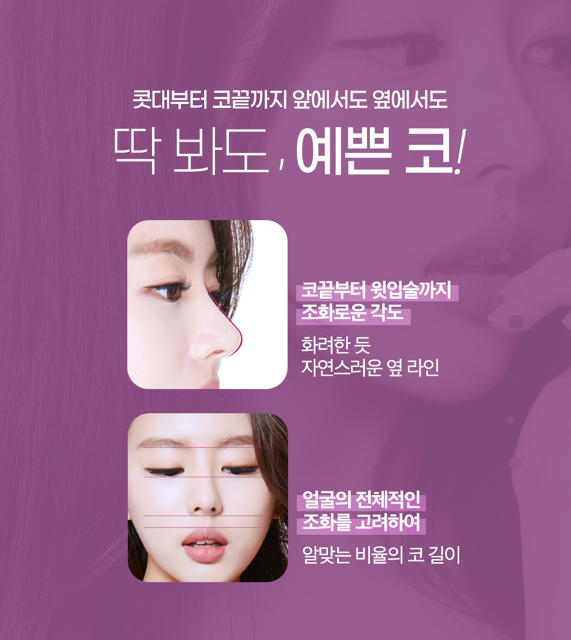
The key to a natural-looking nose
lies in its proportions with the entire face,
rather than in the nose itself.
It is not enough simply to raise the bridge of the nose.
The slope extending from the forehead to the bridge,
the direction of the tip, and the balance of its length
with the philtrum must all be considered together.
If these proportions are even slightly off,
the nose itself may look attractive but still
stand out awkwardly from the rest of the face.
That is why, after establishing the overall balance,
we also need to pay attention to the smallest details.
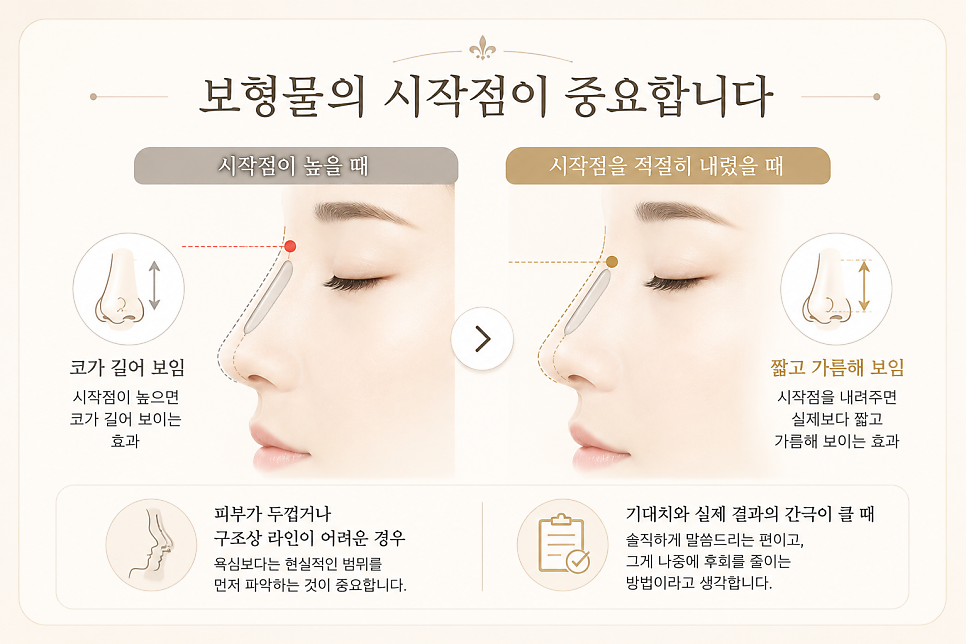
There is one detail that many people overlook:
the starting point of the implant.
If the starting point is too high, the nose can look longer,
while lowering it appropriately can make the nose appear
shorter and more slender than it actually is.
The reaction, “It somehow looks prettier,
but I don’t know what changed,”
comes from precisely these invisible details.
However, if the skin is very thick or
the structure of the nasal bones makes it difficult
to create the desired contour,
it is more important to first understand
the realistic range of possibilities
rather than pursuing an overly ambitious result.
When there is a large gap between expectations
and the results that are actually possible,
we prefer to explain this honestly.
We believe this is the way to reduce regret later.
Why Silicone Should Not Be Used at the Nasal Tip
First-Time Rhinoplasty
Material selection is just as important
as proportions and surgical planning.
Why must autologous cartilage be used at the nasal tip?
Can’t everything be resolved with just one silicone implant?
These are common questions from people
who come in for their first consultation,
but surprisingly, not many fully understand this issue.
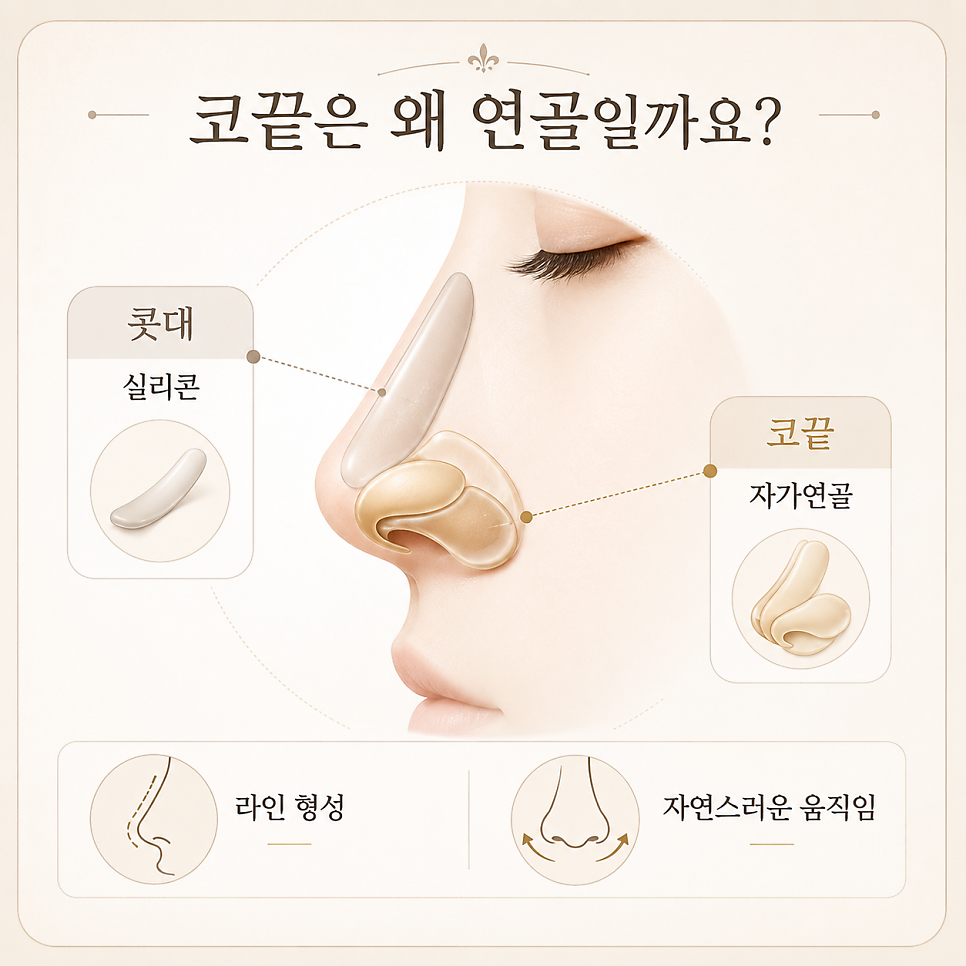
To give you the conclusion first,
using different materials for the bridge and the tip
has become the most common and stable approach today.
A silicone implant is used to establish the height
and contour of the bridge,
while the tip is shaped using the patient’s own cartilage.
Why should different materials be used in these two areas?
It is easy to understand when you look at the structure of the nose.
The nasal tip is an area that moves constantly
when you smile or speak.
If hard silicone extends all the way to the tip,
it can create an awkward appearance in which
the tip seems to move separately when making expressions.
Over time, the implant may also continuously press
against the skin from the inside,
causing it to become thinner or become visible through the skin.
That is why the tip is always finished
using the patient’s own tissue.
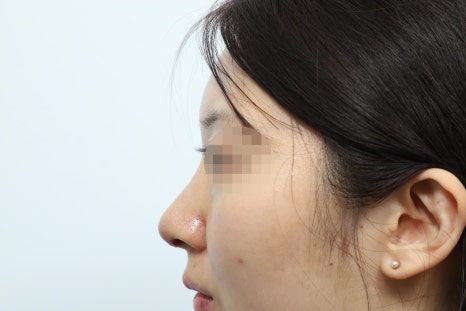
The material most commonly used
for first-time surgery is septal cartilage.
It is a partition-like structure that divides
the inside of the nose into left and right sides.
A portion of it is harvested to build the columellar support
and shape the nasal tip.
Some people worry, “Won’t the nose collapse if cartilage is removed?”
However, enough of the supporting structures of the nose
are left in place during harvesting,
so there is generally no need for significant concern.
However, if the skin is thick
or the tip needs to be raised substantially,
the amount of septal cartilage may not be sufficient.
In such cases, ear cartilage may also be used.
It is natural for the nasal tip to feel hard
for a while after surgery as part of the recovery process.
It usually gradually becomes softer after about three months,
and the final shape settles around six months after surgery.
Until then, you may feel more at ease
if you avoid looking in the mirror too often.
Creating the correct structure with the correct materials
from the beginning can help reduce
the possibility of revision surgery later.
Providing straightforward information about
the possibility of complications and the recovery process
is a principle that Globie has consistently upheld
since the very first consultation.
Because this is your first surgery,
we hope you do not later regret your decision
because of incorrect information or vague expectations.
If you are unsure which approach is right
for the condition of your nose,
it is not too late to check first and then decide.
Please feel free to leave us a question about anything you are curious about.
※ Plastic surgery may cause side effects such as bleeding, inflammation, infection,
or asymmetry depending on the individual, so caution is required.
< Recommended Related Reading >
Globie Plastic Surgery Clinic
is located at 5th and 6th floors of the EGI Building,
843 Nonhyeon-ro, Gangnam-gu, Seoul,
just a one-minute walk from Exit 4 of Apgujeong Station
on Subway Line 3.
Consultation reservations are available on weekdays and weekends.
All consultations are conducted privately on a one-on-one basis.
For detailed inquiries and reservations, please leave a message through the channel below.



First-Time Rhinoplasty