Breast surgery pain,
may be a warning sign your body should not ignore if you try to endure it
Hello,
This is Globee Plastic Surgery Clinic.

Pain after breast surgery
| A clinic that follows the principles of plastic surgery, Globee Plastic Surgery Clinic |
|---|
| The most important thing in plastic surgery is following the fundamentals. Plastic surgery should be planned with the client's entire life in mind. Both the process and the results of plastic surgery must be safe. At Globee, our clients always come first. |
| Consultation is an important step that leads to surgery. To help you feel satisfied with your surgical results, we promise personalized consultations with medical professionals who have extensive clinical experience. |
| Postoperative care can also be considered an extension of surgery. We provide personalized care programs to help our patients recover quickly. |
Many people experience pain after breast surgery but dismiss it, thinking,
“Isn't this just how it normally is?”
Of course, some degree of soreness and discomfort
is a natural part of the recovery process.
However, not all pain is a sign
that it is safe to simply endure it.
In this article, we will explain how to distinguish
normal reactions that occur during recovery from
warning signs that require you to visit a hospital.
If you have been losing sleep because of your symptoms,
we recommend reading to the end.
Normal pain and warning signs,
you need to be able to tell them apart
Pain after breast surgery
How much pain after surgery is normal?
This is the question we receive most often
from people who contact us starting the day after surgery.
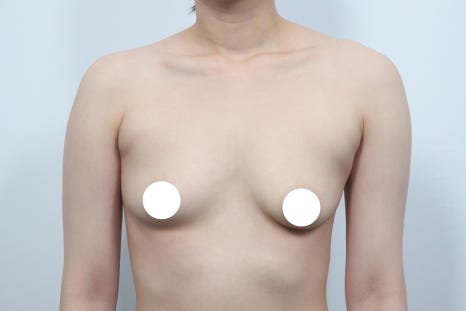
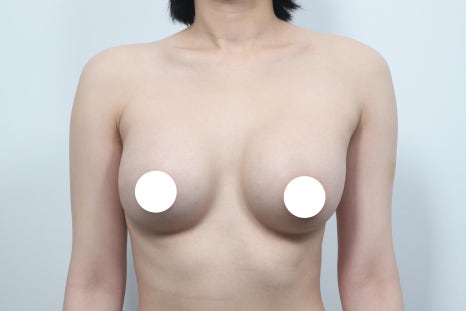
First, let us explain what falls within the normal range.
Immediately after surgery, it is common to feel
a heavy pressure and soreness.
Because a patient-controlled analgesia pump is connected, many people describe
more of a feeling that the entire chest is tightening
than extreme discomfort,
and symptoms worsening when raising the arms or sitting up
are also a natural reaction that occurs because the pocket containing the implant
has not yet settled into place.
A tingling sensation or changes in nipple sensation can also be caused by temporary nerve irritation,
and in most cases these symptoms improve within six months to one year.
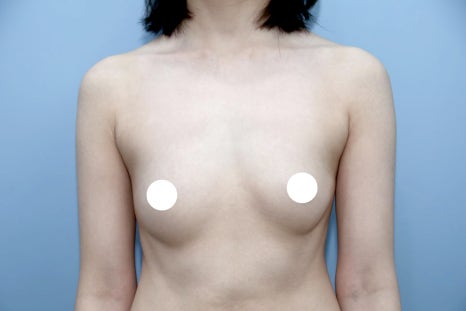
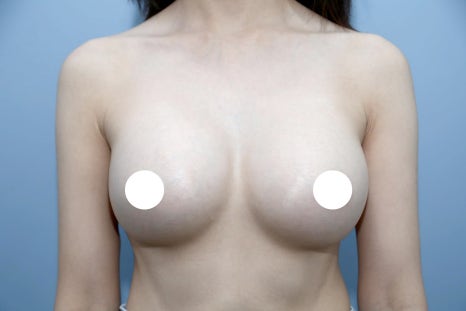
However, when we explain this,
there are always some people who say:
“Isn't everything just normal?
Shouldn't I just endure it?”
That is not necessarily the case.
If the symptoms do not subside even after taking medication
and instead become stronger, or if they do not decrease even after 24 hours,
infection or a hematoma cannot be ruled out.
If the breast suddenly becomes red and feels hot,
and the swelling rapidly worsens, this is a sign
that an inflammatory reaction should be suspected.
In people who have visited us because a hematoma was suspected,
we have found that they commonly felt that
one breast was noticeably larger and firmer than the other.
In such cases, seeking prompt medical attention is more important than self-judgment.
If even one of these applies to you,
please do not endure it—contact us immediately.
A common feature of these symptoms is that
the earlier they are checked, the simpler the treatment can be.
Recovery care to reduce pain,
following these guidelines can make a difference
Pain after breast surgery
What can I do to reduce discomfort?
Once it has been confirmed that the symptoms are not warning signs,
this is usually the next question.
When we speak in detail with people who contact us because
their symptoms seem more severe than expected during recovery,
we often find a common pattern.
They often skip their prescribed medication when they have no symptoms,
or wear their compression bra loosely
because they find it uncomfortable.
Both can contribute to increased discomfort.
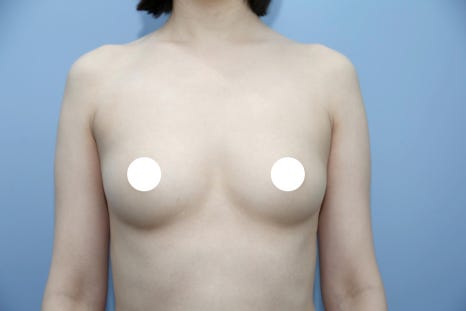
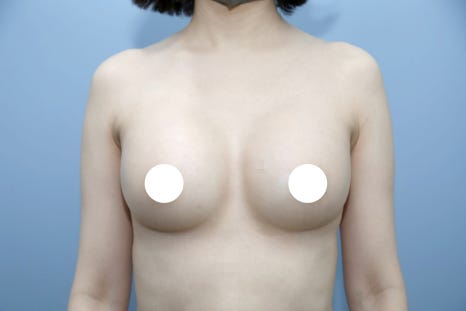
Swelling is usually at its worst on postoperative days 2 to 4
and then gradually subsides. During this period, simply changing your sleeping position
can often make a noticeable difference in swelling and discomfort.
Even sleeping with your upper body slightly elevated for one week
can change how you feel.
As a rule, prescribed painkillers and antibiotics
should be taken three times a day after meals at the scheduled times,
even if you have no symptoms.
The medication needs to be maintained at a consistent blood concentration
to help prevent both inflammation and discomfort;
if you skip one or two doses, the concentration drops,
which can cause symptoms to return all at once.
If discomfort remains severe after taking the medication,
you may also take Tylenol,
but aspirin, omega-3, and vitamin E
can increase the risk of bleeding, so they should be avoided for one week after surgery.
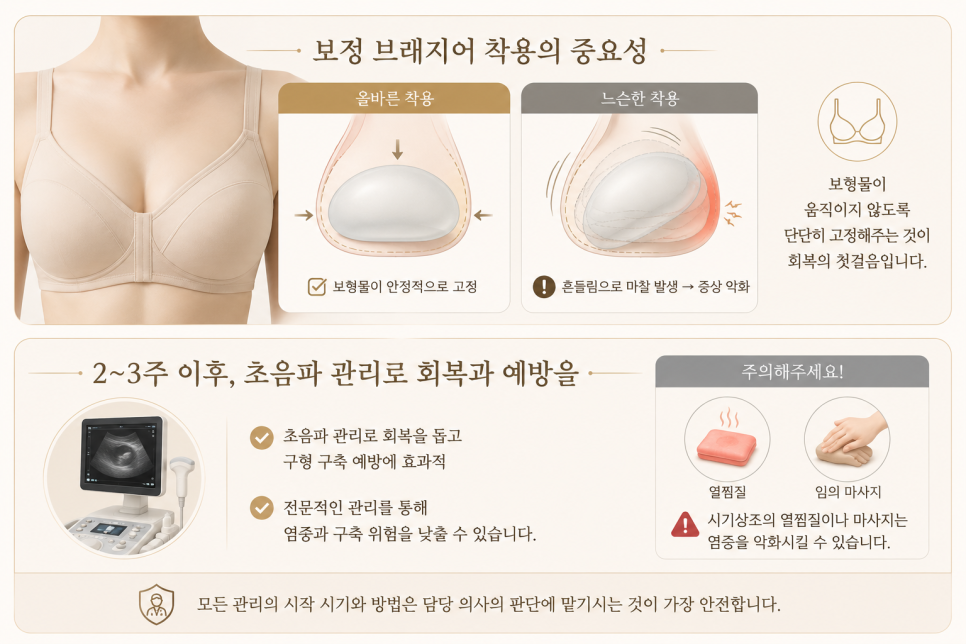
A compression bra
helps keep the implant from moving.
If it is worn loosely, the implant can shift within the pocket,
causing friction with the tissue,
which can actually make the symptoms worse.
After two to three weeks, ultrasound care may help support recovery
and prevent capsular contracture,
but some people apply heat or massage the area on their own during this period.
This may instead worsen inflammation, so
the appropriate time to begin should be determined by your physician.
Pain after surgery is not something you should consider virtuous to endure.
Explaining clearly which symptoms are normal and which signals are dangerous
is the principle of Globee Plastic Surgery Clinic.
If you are worried during your recovery or would like to check
whether your current condition is within the normal range,
please feel free to contact us at any time.
< Recommended further reading >
Globee Plastic Surgery Clinic
is located one minute on foot from Exit 4 of Apgujeong Station on Subway Line 3,
at Floors 5 and 6 of the EGI Building, 843 Nonhyeon-ro, Gangnam-gu, Seoul.
Consultation appointments are available on weekdays and weekends.
All consultations are conducted privately on a one-on-one basis.
For detailed inquiries and reservations, please leave a message through the channel below.
Pain after breast surgery