Worried about re-adhesion after lateral canthoplasty,
those concerns disappear when the surgical technique is different
Hello,
This is 글로비성형외과의원.

Worried about re-adhesion after lateral canthoplasty
| A clinic that follows the principles of plastic surgery, 글로비성형외과의원 |
|---|
| The most important thing in plastic surgery is to follow the fundamentals. Procedures should be designed with the patient's entire lifetime in mind. Both the process and the results must be safe. 글로비 always puts patients first. |
| Consultation is an important step that leads to surgery. To help you be satisfied with your results, we promise personalized consultations with medical professionals who have extensive clinical experience. |
| Postoperative care can also be considered an extension of the surgery. We provide personalized care programs to support our patients' prompt recovery. |
There is one phrase people hear most often when considering lateral canthoplasty.
“I heard it grows back together.”
In fact, many of the people who visit our consultation room
hesitate to undergo surgery because they are anxious
about this very issue of re-adhesion.
As the internet is full of reviews,
it is also flooded with information of unclear origin.
Many people come in concerned about possible complications
before they even consider the surgery itself.
That is why understanding the causes of adhesion
and the differences between incision techniques
can significantly reduce this vague anxiety.
Today, we would like to discuss that topic.
Why does re-adhesion occur?
Worried about re-adhesion after lateral canthoplasty
When we explain to those considering lateral canthoplasty
why re-adhesion occurs,
most of them respond, “So that is how it works,”
and their expressions gradually relax.
That is because vague fear can turn into trust
once its cause is clearly understood.
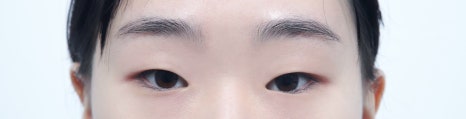
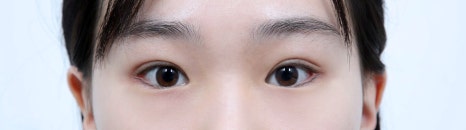
Lateral canthoplasty is a procedure in which an incision is made
at the outer corner of the eye to reveal the sclera that was hidden.
At this point, the body recognizes the incised area as a wound
and responds by producing collagen
to fill it in on its own.
This healing response itself is natural,
but the issue is that, depending on the direction of the incision,
it may occur in an undesired way.
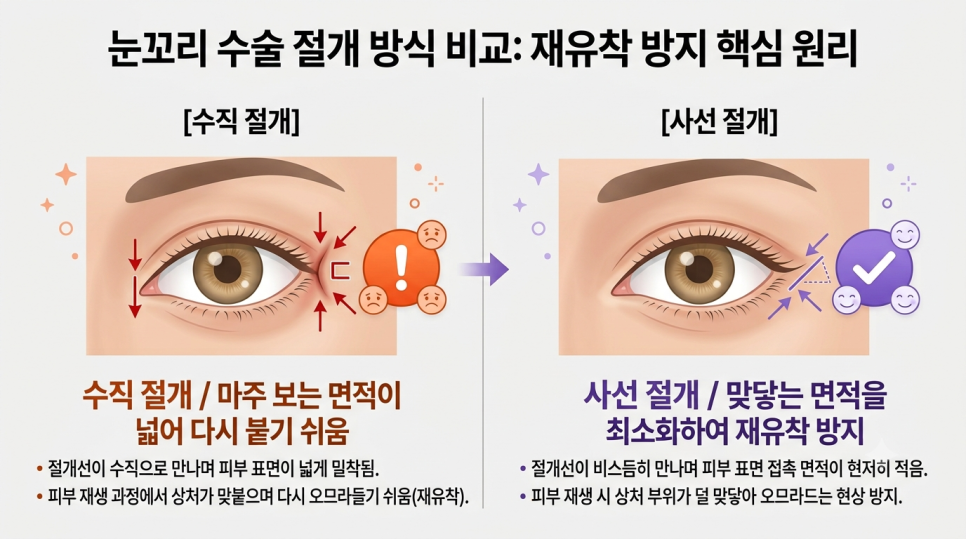
If the outer canthus is incised in a straight line
that is close to vertical,
the opposing surfaces of the separated skin edges
become relatively extensive.
As healing takes place, the tissues may become more likely
to adhere again along these opposing surfaces.
In severe cases, this can lead to a deformity
in which the outer corner of the eye contracts into a “ㄷ” shape.
By contrast, when the incision is made diagonally,
parallel to the natural flow of the upper eyelid,
the skin edges naturally interlock.
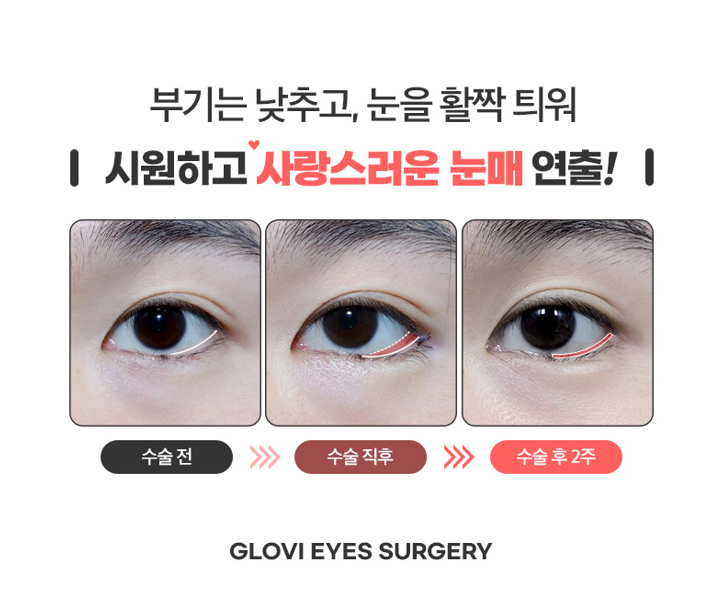
Because the area where the tissues come into excessive contact
after suturing is reduced,
it may help reduce excessive scar-tissue buildup.
However, if the skin is very thin
or the tissues around the outer corner of the eye have already been damaged,
the risk of re-adhesion may increase regardless of the incision technique,
so the procedure should be approached carefully.
In such cases, rather than strongly recommending surgery,
we first take sufficient time to assess the condition.

This is precisely why 글로비 preserves the structure of the outer canthus
and makes a diagonal incision
following its natural contour.
The more closely the incision line follows the eye's natural direction,
the less likely it is that the tissues will adhere
in an unintended direction during recovery.
The things that matter more than expected one month after surgery
Worried about re-adhesion after lateral canthoplasty
Once you understand the principles,
the next important question is
what you actually need to observe during recovery.
There is a question we often hear in the consultation room.
“I keep wanting to pull the outer corner with my fingers
to check whether it has healed properly.”
We fully understand that feeling.
However, from a medical perspective,
this small action can become one of the biggest obstacles
during early recovery.
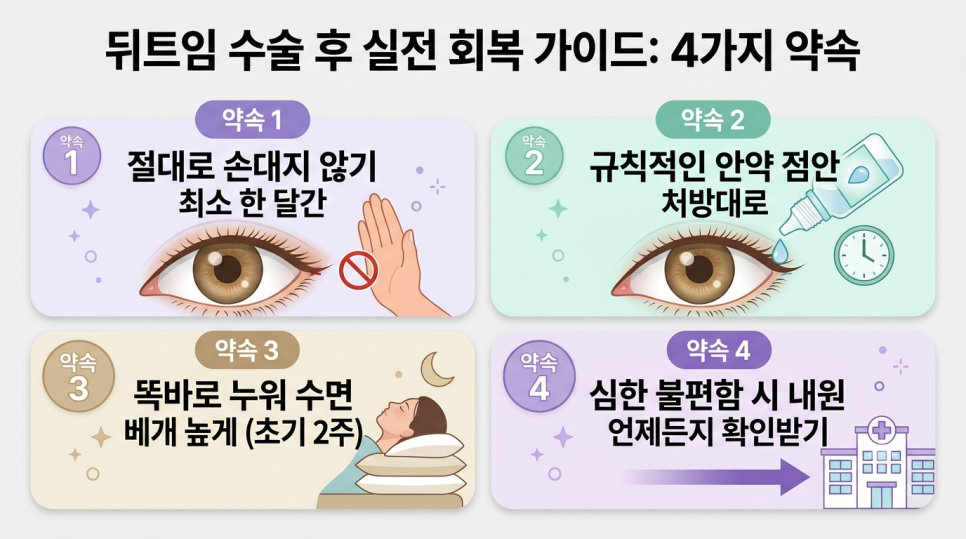
The moment you spread the outer corner of the eye with your fingers,
the healing tissue is physically pulled,
which can cause the wound to open.
It may widen the scar or, conversely,
cause the tissues to adhere in an unintended direction.
Not touching the surgical site for at least one month
is, in fact, one of the most important parts
of preventing re-adhesion.
During the early recovery period, the sclera may look swollen
or redness may occur.
These are temporary effects that can appear after a conjunctival incision
and generally improve within two to three weeks.
Using the prescribed eye drops regularly during this period
can greatly reduce discomfort.
Even after the stitches are removed,
you may experience a temporary foreign-body sensation
for one or two months, but it gradually eases.
If the discomfort is severe, it is advisable to visit the clinic
at any time for an examination.

Your sleeping position can also affect recovery more than expected.
Sleeping on your side can put pressure on the surgical site,
causing swelling to collect on one side
and taking more time for the tissues to settle.
For about the first two weeks, sleep on your back,
and simply raising your pillow slightly
can make swelling easier to manage.
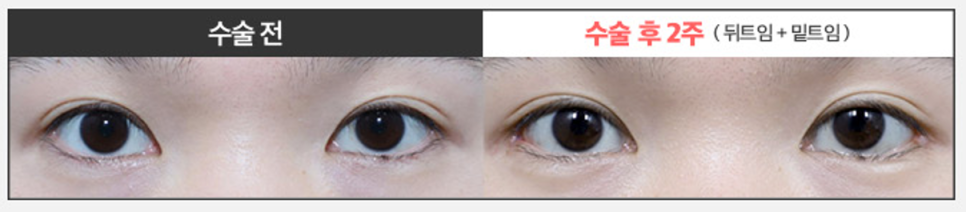
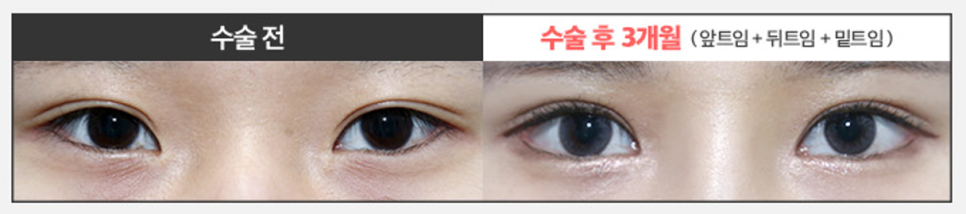
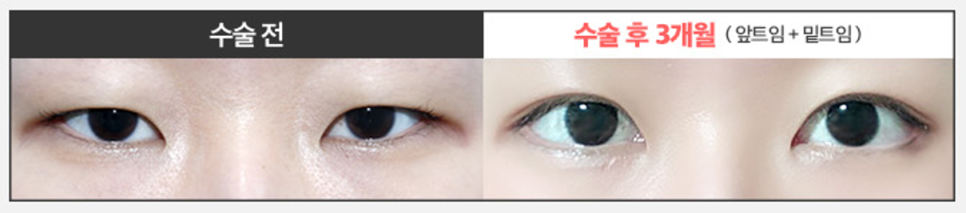
In practice, those who follow these instructions carefully
often show noticeably more stable recovery
at their three-week follow-up visit.

Lateral canthoplasty is a procedure in which the details of the surgical technique
directly affect the results,
to the extent that even the direction of a single incision
can change the possibility of re-adhesion.
Providing transparent, honest guidance
about possible complications and the recovery process
is the first conversation 글로비 shares with its patients.
If you would like to accurately confirm
which technique is appropriate for your eye condition
and what you should be careful about during recovery,
please feel free to contact us.
| 글로비성형외과의원 |
|---|
| Thank you for reading this lengthy post. When making an appointment or booking a consultation, please simply say, “I contacted you after reading your blog.” We will be happy to assist you with even greater care and attention to detail! |
< Recommended articles to read together >
글로비성형외과의원
is located on the 5th and 6th floors of the EGI Building,
843 Nonhyeon-ro, Gangnam-gu, Seoul,
just a one-minute walk from Exit 4 of Apgujeong Station on Subway Line 3.
Consultation appointments are available on weekdays and weekends.
All consultations are conducted privately on a one-to-one basis.
For detailed inquiries and appointments, please leave a message through the channel below.


Worried about re-adhesion after lateral canthoplasty