Autologous Dermal Graft Rhinoplasty,
Read This If You’re Concerned About Resorption
Hello,
This is Globie Plastic Surgery Clinic.

Autologous Dermal Graft Rhinoplasty
| A Clinic That Upholds the Principles of Plastic Surgery, Globie Plastic Surgery Clinic |
|---|
| The most important thing in plastic surgery is to follow the fundamentals. Procedures should be planned with the patient’s entire lifetime in mind. Both the process and the results must be safe. At Globie, our patients always come first. |
| Consultation is an important step that leads to surgery. To help you be satisfied with your surgical results, we promise personalized consultations with medical professionals who have extensive clinical experience. |
| Postoperative care can also be considered an extension of the surgery. We provide personalized care programs to help our patients recover quickly. |
When researching rhinoplasty,
you may come across the term “autologous dermis.”
But when you search for it,
the first posts you often see are concerned questions such as,
“Doesn’t it all get absorbed over time?”
A concern that began with the desire to create a beautiful nose
can instead turn into anxiety.
We will explain exactly what we explain in every consultation:
what kind of material autologous dermis actually is used for,
and how realistic concerns about resorption are.
“Does that mean I can’t have surgery if the skin at the tip of my nose is thin?”
Autologous Dermal Graft Rhinoplasty
This is a question we encounter quite often in the consultation room.
To give you the conclusion first,
having thin skin does not mean that surgery is impossible.
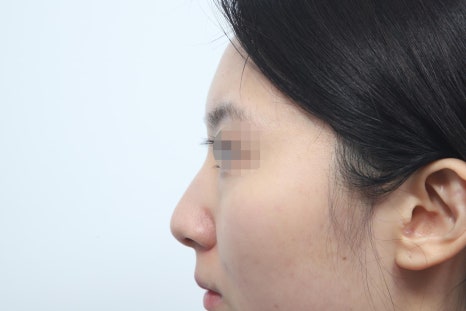
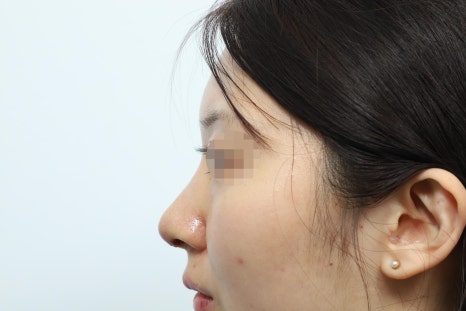
However, the approach needs to be different.
For people with thick skin at the tip of the nose, even when the cartilage is raised,
its shape is naturally expressed on the outside.
In contrast, for people who are naturally born with thin skin,
the shape may look good immediately after surgery,
but after several months, the edges of the cartilage placed inside
may gradually begin to show through.
It is similar to placing a hard object beneath a thin cloth:
its shape becomes clearly visible.
In cases where the nasal tip is low and the skin is thin,
raising the cartilage alone increases the likelihood
that it will become visible through the skin later.
In such cases, a layer of autologous dermis can be placed over the cartilage
to reinforce the skin thickness, block visibility,
and achieve a natural-looking result.
However, autologous dermis is not necessary for everyone.
Adding it unnecessarily for someone with sufficient skin thickness
may make the nasal tip look more bulbous than expected,
so we apply it selectively only in cases where it is truly needed.
“Then does autologous dermis
eventually all dissolve over time?”
Autologous Dermal Graft Rhinoplasty
Almost everyone who asks about this has concerns about resorption.
Let us answer honestly.
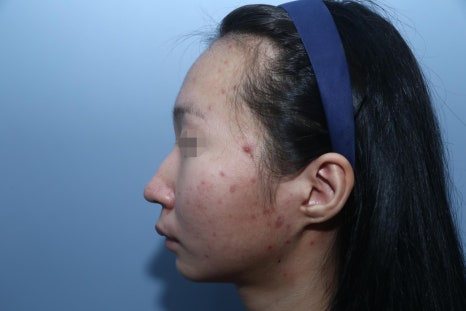
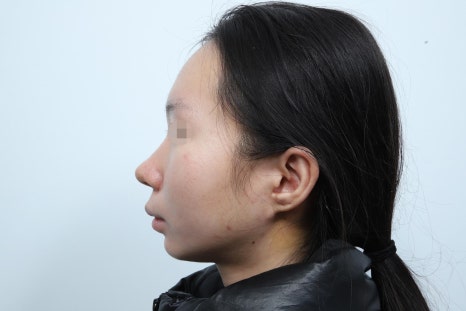
Some resorption occurs during the early period after the graft is placed.
It is generally around 20–30% of the initial volume,
which means there may be a period when the nasal tip looks slightly fuller than expected.
When you first look in the mirror, you may wonder,
“Has it become too thick?”
but this is a completely normal part of the process,
so you can feel reassured.
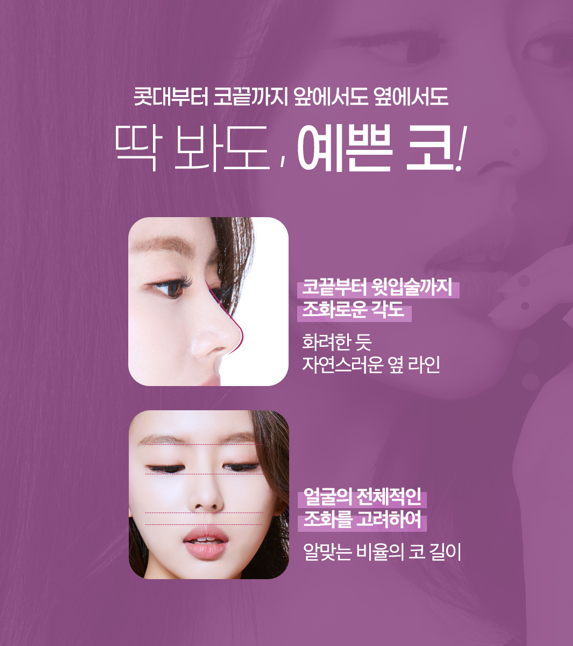
Resorption generally finishes to some extent around six months.
From this point, the remaining tissue begins to integrate with the surrounding tissue
and settle as if it were part of your own body.
This is where it differs significantly from fillers or donor dermis.
Fillers continue to break down,
while donor dermis, because it is tissue from another person,
may have a higher resorption rate.
By contrast, autologous dermis tends not to continue resorbing
after it has stabilized.
The key point is that this state is maintained.
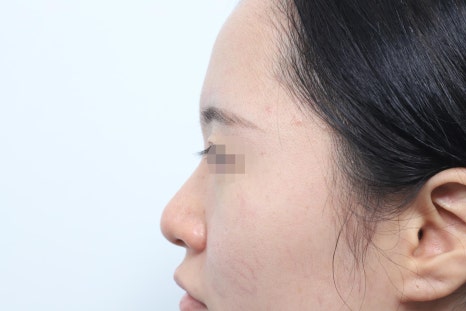
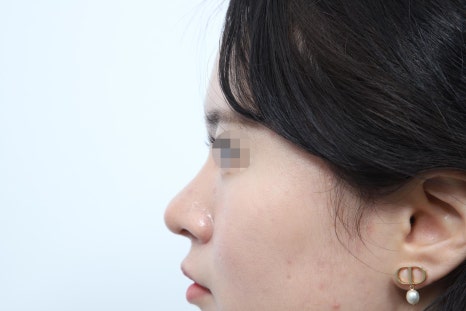
It may also help to know in advance where the graft is harvested from.
It is usually taken very thinly from areas that are not normally visible,
such as behind the ear or the inner groin.
As the harvest site heals over time,
it becomes almost unnoticeable,
so giving up on autologous dermis solely because of concerns about scarring
may be an unnecessarily regrettable choice.

Autologous Dermal Graft Rhinoplasty
However, if you are prone to noticeable scarring, please be sure to mention it during your consultation.
There are also some practical points to know about the recovery process.
It is natural for the nasal tip to feel firm and swollen during the early stages,
and it gradually softens after around three months.
When sleeping, it is better to lie on your back facing the ceiling
rather than on your stomach,
and please avoid rubbing the nasal tip as if massaging it when washing your face.
These habits may seem minor,
but each one can have a considerable effect on the results.
Being transparent about the possibility of side effects and the recovery process
is a firm principle that Globie has upheld since the first day of every consultation.
It is not too late to first check whether autologous dermis is the right choice for your case
and what condition your skin is in before making a decision.
Please feel free to leave a question if there is anything you would like to know.
※ Plastic surgery may cause side effects, including postoperative bleeding, infection, inflammation, asymmetry, and differences in the rate of resorption, depending on an individual’s constitution and anatomical structure. Caution is required.
| Globie Plastic Surgery Clinic |
|---|
| Thank you for reading this long post. When making a reservation or scheduling a consultation, just mention, “I’m contacting you after seeing your blog.” We will be delighted to welcome you and assist you with even greater care and attention to detail! |
< Other Posts You May Find Helpful >
Globie Plastic Surgery Clinic
is located a one-minute walk from Exit 4 of Apgujeong Station on Subway Line 3,
on Floors 5 and 6 of the EGI Building, 843 Nonhyeon-ro, Gangnam-gu, Seoul.
Consultation reservations are available on weekdays and weekends.
All consultations are conducted privately on a one-to-one basis.
For detailed inquiries and reservations, please contact us through the channel below.



Autologous Dermal Graft Rhinoplasty