Breast Fat Grafting: Amount of Fat
Criteria for Determining the Amount and Considerations for Injection
Hello,
This is Globee Plastic Surgery Clinic.

Amount of Fat for Breast Fat Grafting
| A clinic that upholds the principles of plastic surgery, Globee Plastic Surgery Clinic |
|---|
| Upholding the fundamentals is the most important principle in plastic surgery. Procedures should be designed with the patient's entire lifetime in mind. Both the process and the results must be safe. At Globee, our patients always come first. |
| Consultation is an important step that leads to surgery. To help you be satisfied with your surgical results, we promise personalized consultations with medical professionals who have extensive clinical experience. |
| Postoperative care can also be considered an extension of the surgery. We provide personalized care programs to help our patients recover quickly. |
As patients prepare for breast fat grafting,
we are most often asked,
“How much fat needs to be injected for it to be enough?”
Many people understand that the amount of fat changes the result,
but are unsure what the actual criteria are
and come to us after spending the night searching online.
In this post, we will honestly explain
the actual criteria used to determine the amount of fat
and the variables that must be considered during injection.
The amount of fat is determined not by
the desired size, but by the available space
Amount of Fat for Breast Fat Grafting
Doesn’t a larger number of cc mean a larger result?
When this question comes up in the consultation room,
we pause for a moment.
It is natural to feel that way intuitively,
but in practice, the situation is almost the opposite.
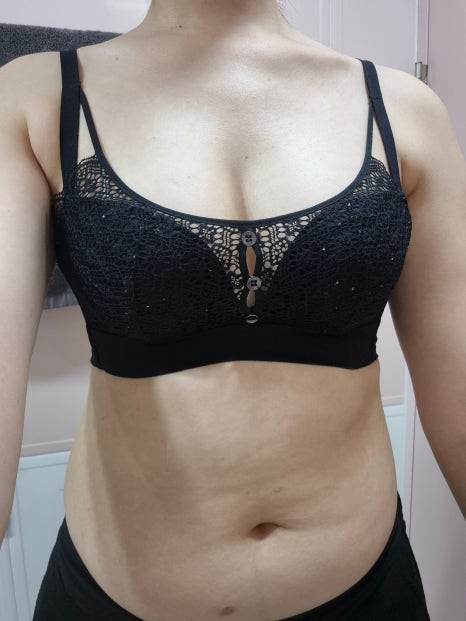
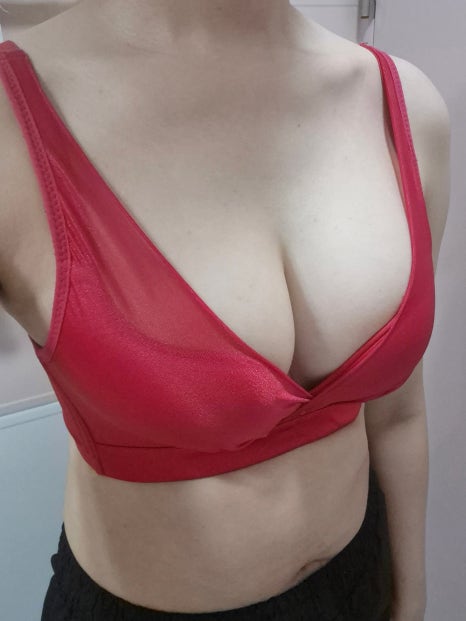
Breast fat grafting involves distributing fat
within existing tissue layers,
so its structure is fundamentally different
from implant surgery, which creates a new space.
When filling a flowerpot with soil,
if you put in more than the pot can hold,
the soil eventually spills over.
Likewise, the thickness and width of each person’s
different tissue layers determine
the “upper limit” of the amount of fat that can be injected.

The volume change that can be clinically expected
is approximately half a cup to one cup from the current size.
If an excessive amount is injected beyond this,
fat that cannot settle within the tissue layers
may clump together and undergo necrosis,
or lead to calcification or cysts.
The complication most closely watched for in clinical practice
is necrosis caused by over-injection.
Fat necrosis can be difficult to identify visually in its early stages
and begins first with changes in the internal tissue,
so particular care is required during surgery.
The choice of the fat-harvesting site also directly affects the result.
If 1,000 cc is aspirated from the thighs,
approximately 500 cc of pure fat cells can be obtained after centrifugation,
but the abdomen or arms contain more oily tissue,
so even when the same amount is aspirated,
the yield is often only around 300 cc.

At Globee, we generally harvest fat from the thighs
with cell quality in mind,
while following the principle of aspirating evenly
so that the inner thigh, outer thigh, and inner knee lines
are not distorted.
For body types with very little body fat,
where it is difficult to obtain a sufficient amount for harvesting,
we first recommend implant surgery as an alternative
rather than fat grafting.
This is because Globee’s policy
is to tell patients what they need to know first,
rather than simply saying what they want to hear.
Where and how the fat is injected
determines the result
Amount of Fat for Breast Fat Grafting
If enough fat has been harvested,
can’t we simply inject all of it?
How the harvested fat is placed
is a more important variable than the amount of fat.
For people with thin skin and narrow glandular tissue layers,
concentrating fat in one area
increases the possibility of necrosis.
In such cases, rather than injecting excessively,
fat should be precisely distributed in small amounts
across multiple layers
to improve tissue stability and create balanced volume.
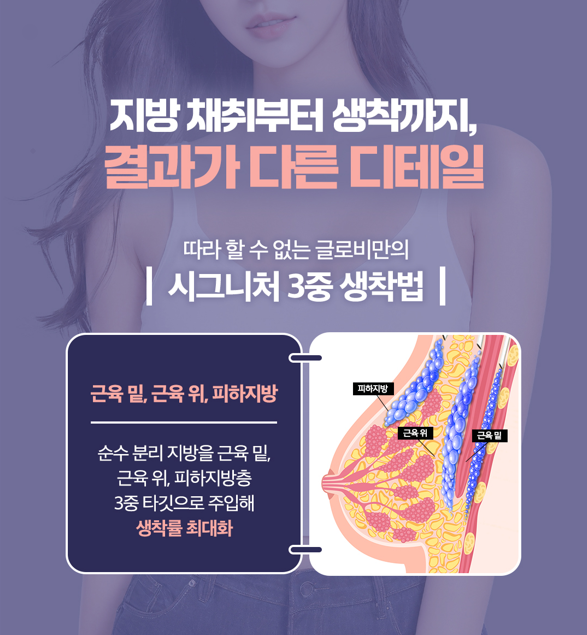
The triple-layer fat retention technique involves
distributing and injecting small amounts of fat evenly
into three layers: beneath the muscle,
beneath the glandular tissue,
and beneath the skin.
Just as thin sheets of paper are placed one by one
between the pages of a thick book,
fat cells must be positioned as close as possible
to the surrounding blood vessels
so that oxygen and nutrients can be supplied smoothly.
If SVF (stem cells) is injected together with the fat,
it may accelerate blood vessel regeneration around the grafted area,
allowing the process of fat cells settling into their new location
to proceed more stably.
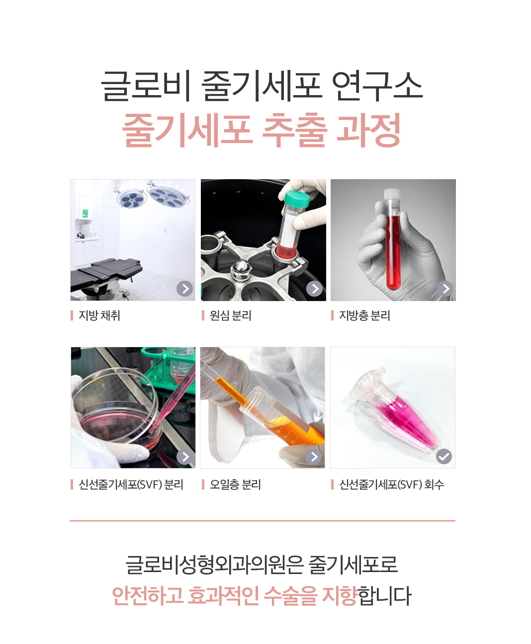
SVF consists of stem cells extracted from adipose tissue
and contains abundant growth factors that promote tissue regeneration,
so it serves as an adjunct to improve the grafting environment.
However, it is difficult to state definitively that SVF guarantees every result,
and individual factors and postoperative care
still play a significant role.
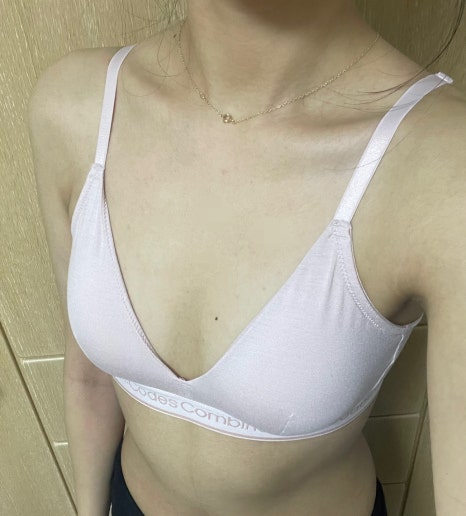
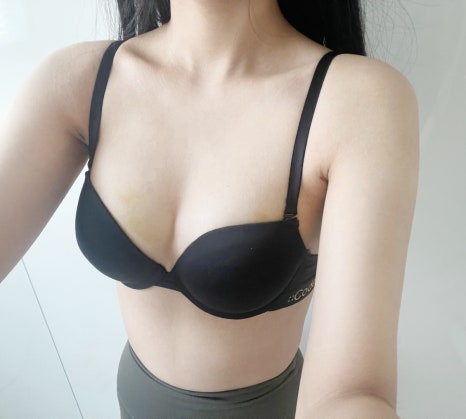
For one month after surgery,
avoid wearing undergarments with underwires
or firm padding
so that blood flow to the grafted area is not compressed.
When sleeping, do not lie on your stomach.
Raising your upper body by the height of one pillow
can help maintain blood flow and reduce swelling.
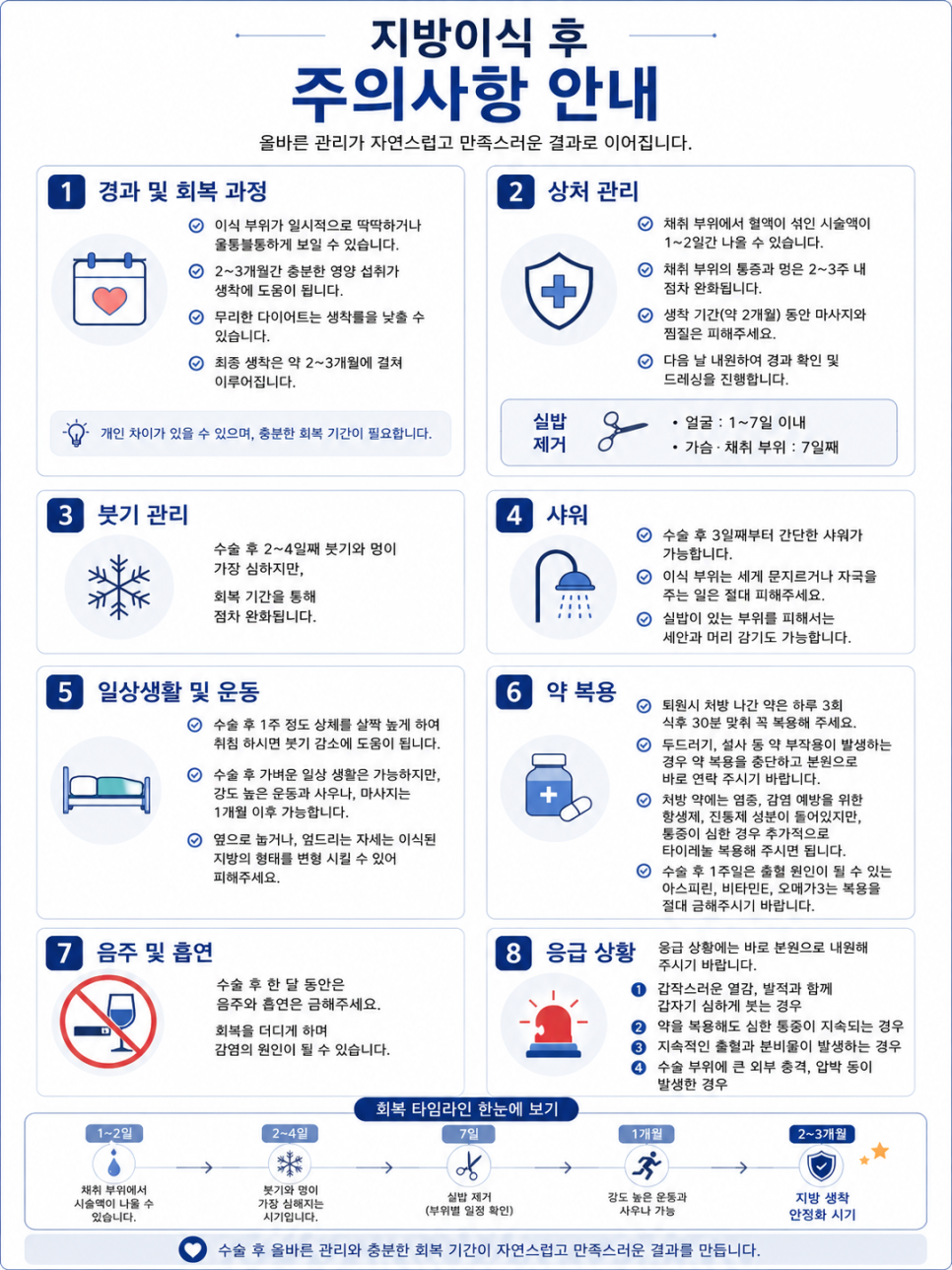
When showering, rather than rubbing the area around the breasts firmly with your fingertips,
gently patting it dry can make a practical difference in stabilization.
Smoking constricts blood vessels and interferes with the blood supply
to the grafted fat, so it should be strictly avoided
for at least one month before and after surgery,
including exposure to secondhand smoke.


Breast fat grafting is a procedure in which
the amount of fat, the method of placement,
and postoperative care must work together
in order to expect the desired result.
At Globee, our principle is to share the potential for complications
and realistic limitations as they are,
and to establish a harvesting and injection plan
suited to each patient’s body type.
We recommend first confirming whether fat grafting
is the right choice for your circumstances
and reviewing a plan suited to your individual case.
※ Breast fat grafting may involve risks of complications
such as inflammation, infection, calcification, and fat necrosis,
so diagnosis by an experienced specialist is essential.
| Globee Plastic Surgery Clinic |
|---|
| Thank you for reading this lengthy post. When making an appointment or consultation inquiry, please just mention, “I’m contacting you after seeing your blog.” We will be delighted to assist you with even greater care and attention to detail! |
< Recommended related reading >
Globee Plastic Surgery Clinic
is located a one-minute walk from Exit 4 of Apgujeong Station
on Seoul Subway Line 3,
at Floors 5 and 6 of the EGI Building,
843 Nonhyeon-ro, Gangnam-gu, Seoul.
Consultation appointments are available on both weekdays and weekends.
All consultations are conducted privately on a one-on-one basis.
For detailed inquiries and appointments, please leave a message through the channel below.



Amount of Fat for Breast Fat Grafting