Open vs. closed rhinoplasty,
if you’re wondering which surgical approach
is right for you,
please read on.
Hello,
This is 글로비성형외과의원.

Open vs. closed rhinoplasty
| A clinic that upholds the principles of plastic surgery, 글로비성형외과의원 |
|---|
| The most important thing in plastic surgery is adhering to the basics. Procedures should be designed with the patient’s lifelong well-being in mind. Both the process and the results must be safe. 글로비 always puts patients first. |
| Consultation is an important step that leads to surgery. To help you feel satisfied with your surgical results, we promise personalized consultations with medical professionals who have extensive clinical experience. |
| Postoperative care can also be considered an extension of the surgery. We provide personalized care programs to help our patients recover quickly. |
When you are considering rhinoplasty,
you eventually find yourself pausing at this question:
People say an open approach is better,
but won’t it leave a scar under my nose?
Because of this concern, many people put off choosing a surgical approach
or choose a closed approach simply
because it does not leave a visible scar.
I will honestly explain the practical differences between the two approaches, the reality of scarring,
and which approach produces better results for which nasal structures,
based on what can actually be seen in the operating room.
It is the difference between
working with the lights on
and working with the lights off.
Open vs. closed rhinoplasty
If the results are the same,
why would anyone choose an approach that leaves a scar?
This is something we hear very often in the consultation room.
To get straight to the point, the two approaches clearly differ
in the range and precision of the surgical access they provide.
To put it simply,
it is like the difference between “tidying a room with the lights fully on”
and “tidying it with the lights off,
relying on delicate touch and the silhouette.”
First, because the closed approach is completed using only incisions inside the nostrils,
it does not leave a visible external scar.
However, from the surgeon’s perspective, the position of the nasal tip cartilage and left-right symmetry cannot be seen directly.
This means that precise procedures such as adjusting angles, balancing the cartilage, and building up the columella must rely on tactile sensation.
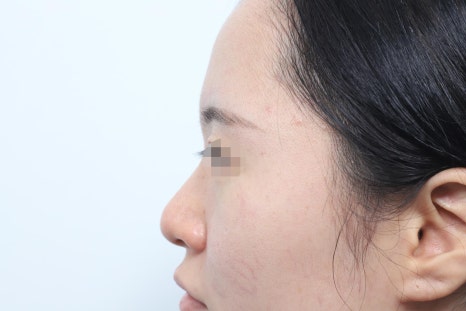
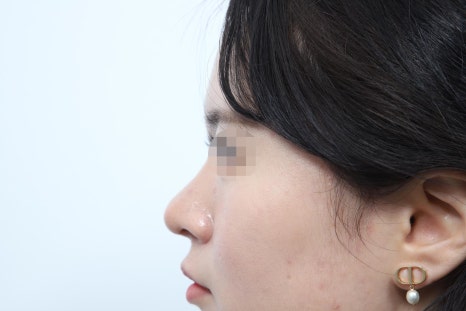
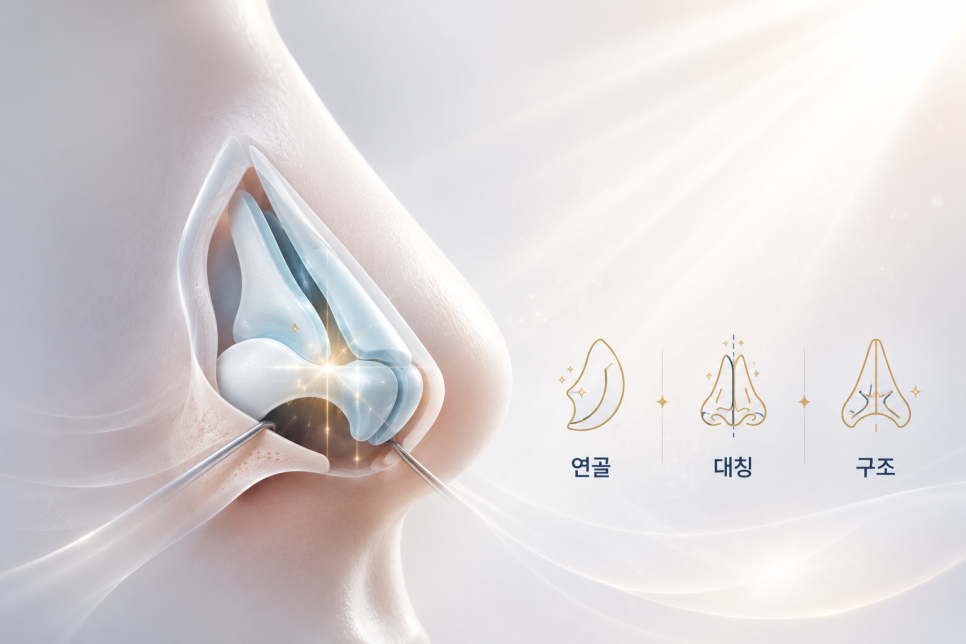
In contrast, the open approach involves making a very short incision beneath the columella,
lifting the skin, and proceeding with the internal structures fully exposed.
This makes it possible to visually assess and adjust the actual thickness of the nasal tip cartilage, its symmetry,
and any structural issues.
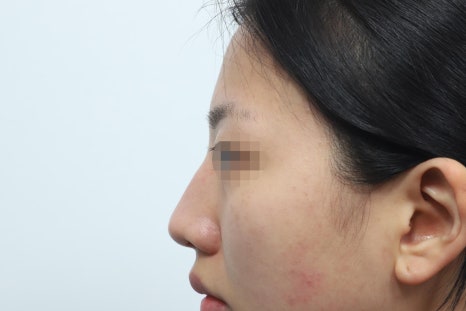
I once met someone like this in the consultation room.
The nasal tip was slightly deviated to one side,
and the cartilage was splayed apart.
It was a case that had previously been performed using a closed approach.
The height had been increased without identifying the condition of the cartilage,
and only after viewing the inside directly and realigning the cartilage
did the nasal tip settle into its proper position.
If the scope of nasal tip correction is limited and the structure is simple,
the closed approach can also produce sufficient results.
Therefore, before choosing a surgical approach,
accurately understanding which category your nasal structure falls into
should be the first step.
“How much of a scar is honestly left?”
Open vs. closed rhinoplasty
I will tell you exactly as it is.
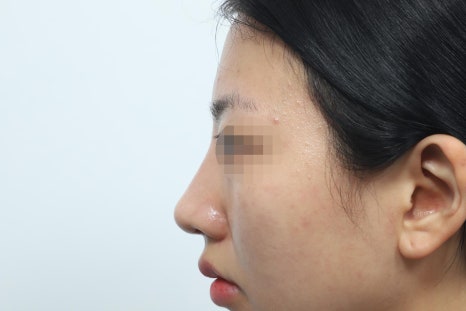
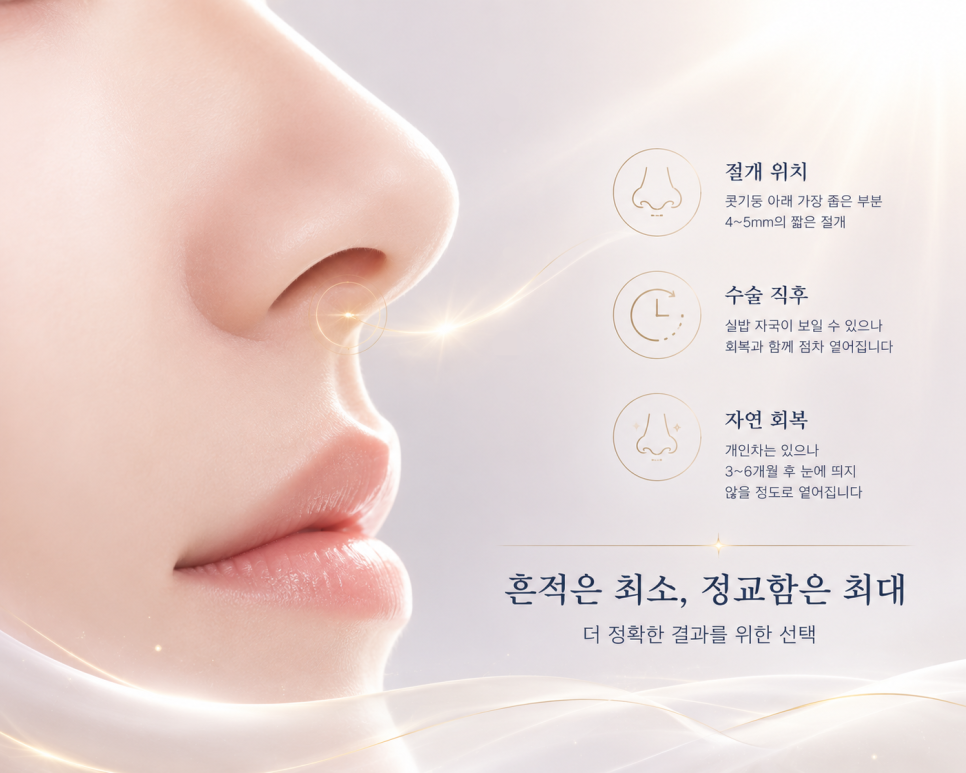
The incision is made beneath the columella,
in the narrowest, most folded area.
It is very short, approximately 4–5 mm.
The stitch marks may be noticeable immediately after surgery,
but because individual results vary, they tend to fade to the point of being barely noticeable after 3–6 months.
They cannot be seen from the front
and are located where they can only just be seen when looking up from beneath the nose.
For people with keloid-prone skin or a tendency to scar,
we provide an honest explanation during the consultation
and, if necessary, consider the closed approach together.
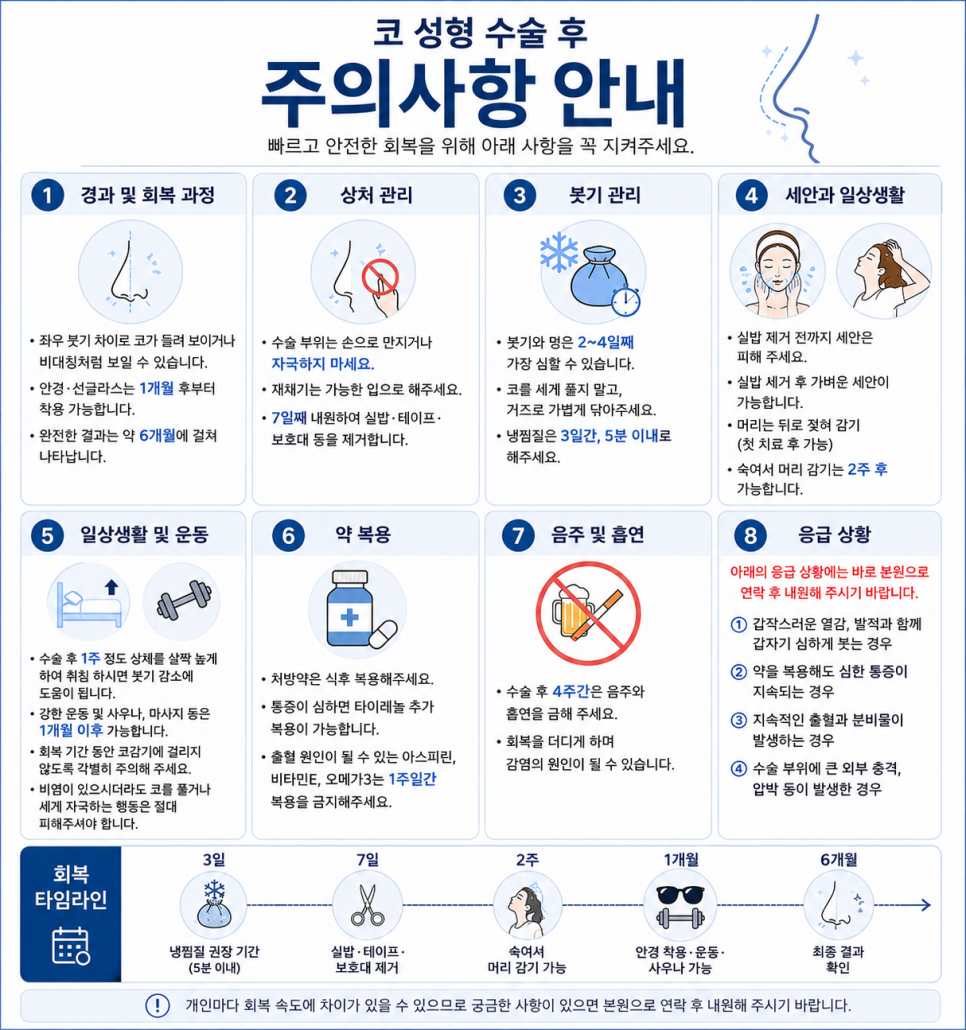
There are also things that may be helpful to know during the recovery process.
Until the incision has completely healed,
rather than directly wetting the area beneath the nose when washing your face,
it is more hygienic to gently wipe it with a cotton swab moistened with saline solution.
When sleeping, placing your head above the level of your heart by using a higher pillow
can be very helpful in reducing swelling during the early stages.
Avoiding the incision area, begin makeup with the eyes and lips,
and for safety, start applying makeup to the nose only after checking its recovery status for at least 2–3 weeks.
The open approach is not a method that simply accepts scarring.
It is closer to choosing a location where almost no trace remains
in order to achieve more precise results.
There is only one reason 글로비 recommends this approach:
we can provide patients with more accurate results
when we make adjustments while viewing the structures directly.


Explaining potential postoperative side effects and the recovery process
as they are,
is a principle that 글로비 has consistently upheld since the very first consultation.
It is not too late to check directly and decide which of the two approaches is more suitable for your nasal structure.
Please feel free to leave us a message about anything you would like to know.
※ Depending on the individual, plastic surgery may involve infection, bleeding, inflammation,
asymmetry, complications related to implants, and other side effects.
You should make your decision carefully after having a thorough consultation with a specialist.
| 글로비성형외과의원 |
|---|
| Thank you for reading this long post. When making a reservation or consultation appointment, please just mention, “I’m contacting you after seeing your blog.” We will be delighted to assist you with even greater care and attention to detail! |
< Other Posts You May Enjoy >
글로비성형외과의원
is located a one-minute walk from Exit 4 of Apgujeong Station on Subway Line 3,
at Floors 5 and 6 of the EGI Building, 843 Nonhyeon-ro, Gangnam-gu, Seoul.
Consultation reservations are available on both weekdays and weekends.
All consultations are conducted privately on a one-on-one basis.
For detailed inquiries and reservations, please leave a message through the channel below.



Open vs. closed rhinoplasty