The Process of Autologous Rib Cartilage Rhinoplasty and
Its Advantages and Disadvantages Compared with Implants
Hello,
This is Glovi Plastic Surgery Clinic.

Autologous Rib Cartilage Rhinoplasty
| A Clinic That Upholds the Principles of Plastic Surgery, Glovi Plastic Surgery Clinic |
|---|
| Upholding the fundamentals is the most important aspect of plastic surgery. Procedures should be designed with the client’s lifelong well-being in mind. Both the process and the results must be safe. Glovi always puts its clients first. |
| Consultation is an important step that leads to surgery. To help you feel satisfied with your surgical results, we promise personalized consultations with medical professionals who have extensive clinical experience. |
| Postoperative care can also be considered an extension of the surgery. We provide personalized care programs to help our patients recover quickly. |
When searching for autologous rib cartilage rhinoplasty,
you may have first come across frightening statements such as
“it leaves a scar on the chest,” “the recovery takes a long time,”
and “do I really have to endure that much pain?”
These concerns come up very frequently in our consultation room.
However, quite a few people postpone their decision based only on those stories,
then undergo surgery using a different material, experience disappointing results,
and eventually begin considering revision surgery.
In this article, we will honestly explain from a clinical perspective
what the actual process of autologous rib cartilage rhinoplasty involves,
and precisely what advantages and disadvantages it has
compared with silicone implants.
How Is Autologous Rib Cartilage Rhinoplasty Actually Performed?
Autologous Rib Cartilage Rhinoplasty
If the procedure involves taking cartilage from the chest,
isn’t it too extensive and frightening?
Many people express this exact concern in the consultation room.
However, once they understand the actual process,
most respond, “The structure is simpler than I expected.”
Much of our fear comes from not knowing what to expect.

Autologous rib cartilage rhinoplasty is performed under general anesthesia.
A minimal incision is made along the inframammary fold to harvest rib cartilage,
which is then shaped as needed
and grafted into place.
General anesthesia is recommended because
the rib cartilage is located very close to the lungs.
Because the rib cartilage is near the lungs,
general anesthesia is chosen to completely prevent the possibility
of potential safety incidents such as pneumothorax.
Although the likelihood is extremely low,
general anesthesia is selected to protect patient safety
without even a 1% compromise.

It is also helpful to understand the recovery process after harvesting
in specific terms.
For 2–3 days after surgery, you should avoid coughing, deep breathing,
and excessive movement.
You should also take care not to let water come directly into contact
with the chest incision for two weeks.
When sleeping, keeping your upper body slightly elevated
can make a meaningful difference in reducing swelling,
and it is advisable to avoid unnecessary pressure on the nose
for up to three months.

Also, if the rib cartilage is used whole and lengthwise for the nasal bridge,
a phenomenon called “warping,” in which the line may appear curved over time,
can occur.
Therefore, you should first discuss with your surgeon
which approach is suitable for your case.
Autologous Rib Cartilage Compared with Silicone Implants:
What Is the Difference?
Autologous Rib Cartilage Rhinoplasty
Can’t I just use silicone?
Do I really need to use autologous rib cartilage
while accepting a scar on my chest?
It is difficult to readily answer these questions by simply saying,
“Just go ahead with it.”
You need to understand the differences between the two materials first
to avoid regretting your choice.
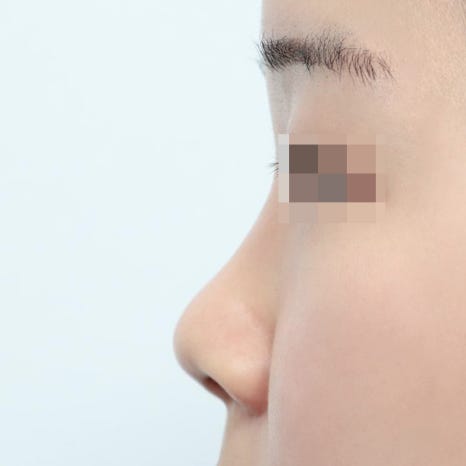
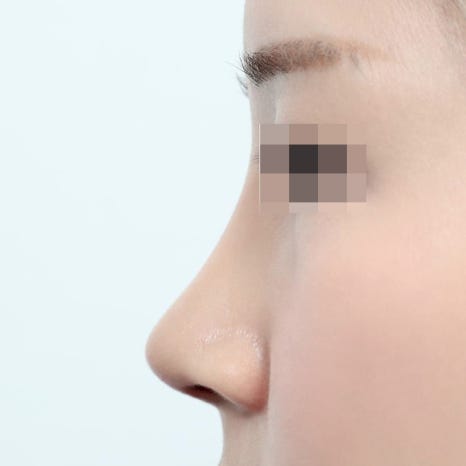
Generally, when the nose is very low and short overall
and substantial structural improvement is needed,
or when the septal cartilage has already been used up
due to previous surgery or nasal surgery for rhinitis,
it can be difficult to build a strong columellar support
using only ear cartilage.
If the nasal tip is raised excessively using only an artificial implant,
the skin at the nasal tip may become thinner over time,
or the implant may become visible through the skin,
leading to complications.

This is precisely why autologous rib cartilage is chosen
for cases like these.
Compared with other autologous cartilage,
it provides a considerably larger amount of material,
has almost no risk of rejection because it is the patient’s own tissue,
and has a relatively low rate of cartilage absorption
by the body over time.
On the other hand, an L-shaped implant that extends to the nasal tip
may press against and deform the tip cartilage over time
or cause contracture, a fact that has been demonstrated
through numerous clinical cases.
However, you should be fully aware in advance
of the chest incision scar, the lengthy operating time,
and differences in results depending on the surgeon’s level of expertise.

If these conditions feel burdensome,
or if your nasal condition can be sufficiently corrected
without autologous rib cartilage,
we generally do not recommend this approach unnecessarily.
Rather than asking which material is better,
the priority should always be determining which choice suits your current condition.


With autologous rib cartilage rhinoplasty, rather than focusing on the superiority of the material itself,
it is important first to determine whether your current condition
meets the criteria for needing this material.
Providing accurate and honest information, including the possibility of complications
and cases for which the procedure may not be suitable,
is the first principle Glovi upholds during consultations.
If you would like to reduce trial and error caused by incorrect information,
we recommend first confirming an accurate plan suited to your individual circumstances.
※ Plastic surgery may cause complications such as inflammation, bleeding, nerve damage,
or asymmetry depending on the individual, so caution is required.
| Glovi Plastic Surgery Clinic |
|---|
| Thank you for reading this lengthy post. When making a reservation or consultation, just mention, “I’m contacting you after seeing your blog.” We will be delighted to assist you with even greater care and attention! |
< Other Articles You May Find Helpful >
Glovi Plastic Surgery Clinic
is located one minute on foot from Exit 4 of Apgujeong Station on Subway Line 3,
at 5th and 6th floors of the EGI Building,
843 Nonhyeon-ro, Gangnam-gu, Seoul.
Consultation reservations are available on weekdays and weekends.
All consultations are conducted privately on a one-on-one basis.
For more information or reservations, please leave a message through the channel below.



Autologous Rib Cartilage Rhinoplasty