Size Changes After Breast Fat Grafting and
Differences in Individual Fat-Graft Survival Rates
Hello,
This is 글로비성형외과의원.

Breast Size After Fat Grafting
| A clinic that follows the principles of plastic surgery, 글로비성형외과의원 |
|---|
| Following the basics is the most important principle in plastic surgery. Procedures should be planned with the client’s entire lifetime in mind. Both the process and the results must be safe. 글로비 always puts clients first. |
| Consultation is an important step that leads to surgery. To help you feel satisfied with your surgical results, we promise personalized consultations with medical professionals who have extensive clinical experience. |
| Postoperative care can also be considered an extension of the surgery. We provide personalized care programs to support our patients’ rapid recovery. |
When looking into breast fat grafting,
there is one question you inevitably encounter at some point.
“How much larger will my breasts become?” And soon after,
“Why are the results different for each person?”
In fact, these two questions get to the heart of breast fat grafting.
Because this is not a procedure in which a specific volume is selected
and the breasts increase by exactly that amount, as with implants,
there can be a significant difference in postoperative satisfaction
between those who fully understand this structure before surgery
and those who do not.
In this article, we will honestly explain the reasons
that create these differences.
How much does breast size change after fat grafting?
Breast Size After Fat Grafting
How many cup sizes will I gain after surgery?
This is the first question most often asked in the consultation room.
Let us first give you a more honest answer
than what you may be expecting.
The size change that can generally be expected from breast fat grafting
is approximately half to one cup size compared with the current size.
Medically, “one cup size” means that the difference between the chest circumference
and the bust circumference increases by approximately 2.5 cm,
and we understand that this may seem small when viewed as a number alone.
However, when comparing before-and-after photos in actual cases,
many people say that this half-cup difference is much more noticeable than expected
in the way clothes fit and in the overall silhouette.

There is one important point that must be emphasized here.
The extent of this change depends on how much of the transplanted fat
survives in the body—in other words, on the “fat-graft survival rate.”
Even when the same amount is grafted,
some people maintain sufficient volume,
while others experience noticeable loss of volume after three months.
According to published studies, survival rates range
from 15% to 75%. This variation itself
shows that fat grafting is fundamentally different from implant surgery.
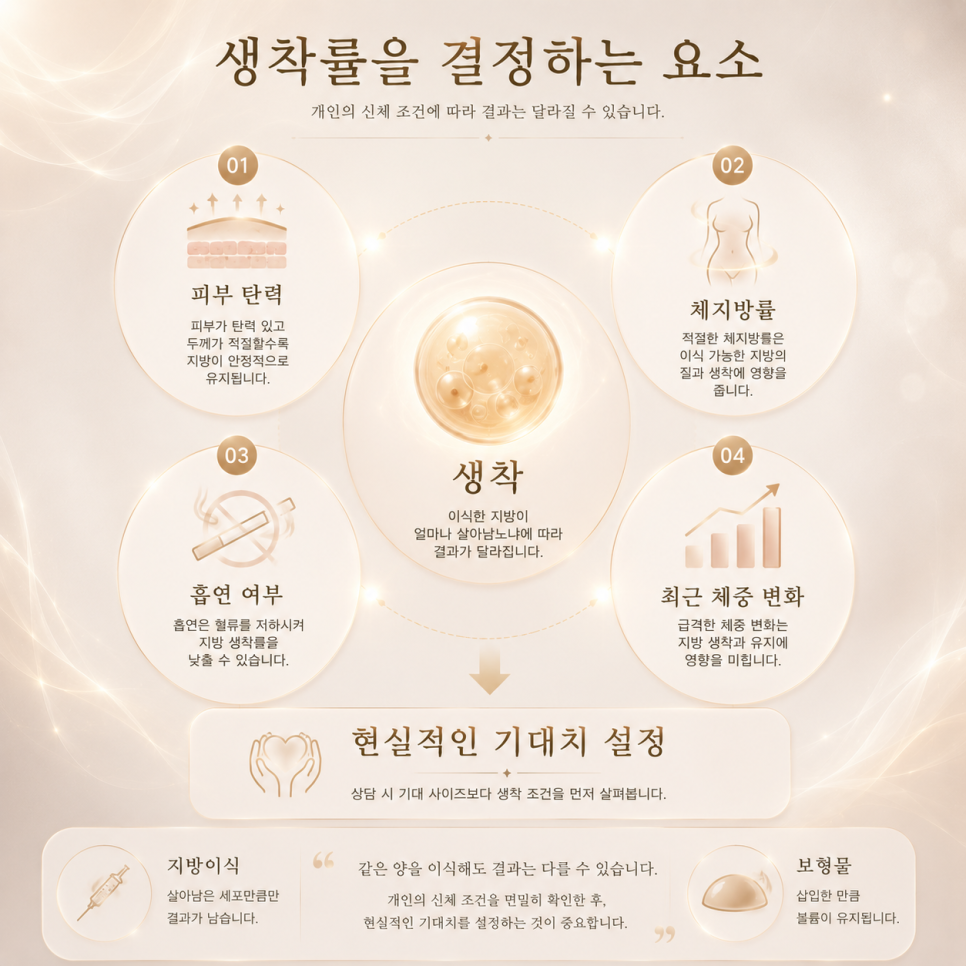
The volume of an implant is maintained according to the amount inserted,
but with fat grafting, only the volume corresponding to the surviving cells remains.
That is why 글로비성형외과의원 first examines the conditions for fat-graft survival
during consultation, rather than focusing on the expected size.
For people with thin skin and dense breast tissue,
the space available for evenly distributing and grafting fat
may itself be limited.
Body fat percentage, skin elasticity, smoking status,
and recent changes in body weight—these factors
are practical variables that can determine the outcome.
Therefore, closely examining these physical conditions first
and setting realistic expectations
is a consultation principle of 글로비성형외과의원.
Conditions that create differences in fat-graft survival rates,
and the true role of postoperative care
Breast Size After Fat Grafting
Why are the results different even when the same procedure is performed?
Whenever we receive this question, we discuss two factors together:
differences in surgical technique,
and individual characteristics and postoperative care.
From a technical perspective, the most important principle in the operating room
is not to concentrate the fat in one area.
If too much fat is placed in a single area,
oxygen and nutrients may not reach the cells deeper inside,
which can lead to fat necrosis or side effects
such as calcification and cysts caused by hardened clumps.
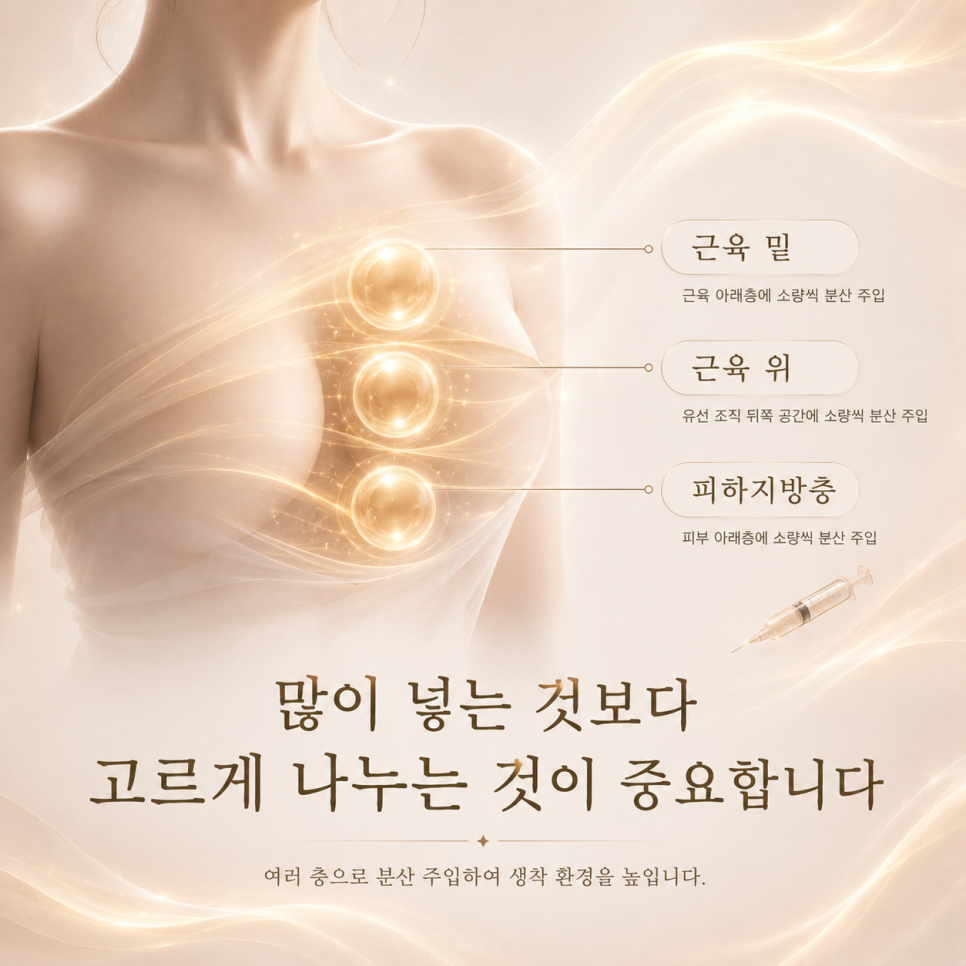
To prevent this, 글로비성형외과의원 applies a three-layer grafting technique,
injecting small amounts evenly across multiple layers of the breast,
including beneath the muscle, above the muscle, and in the subcutaneous fat layer.
Although this takes longer than simply filling the area,
we do not shorten this process because each fat cell can be positioned closer
to blood vessels, improving the environment for fat-graft survival.
When SVF (stem cells) is applied together,
it may help with the formation of new blood vessels and promote the settling of fat cells,
so it may be expected to help improve the fat-graft survival rate.
However, postoperative care during the three months after surgery
is just as important as a precise surgical technique in determining the final volume.
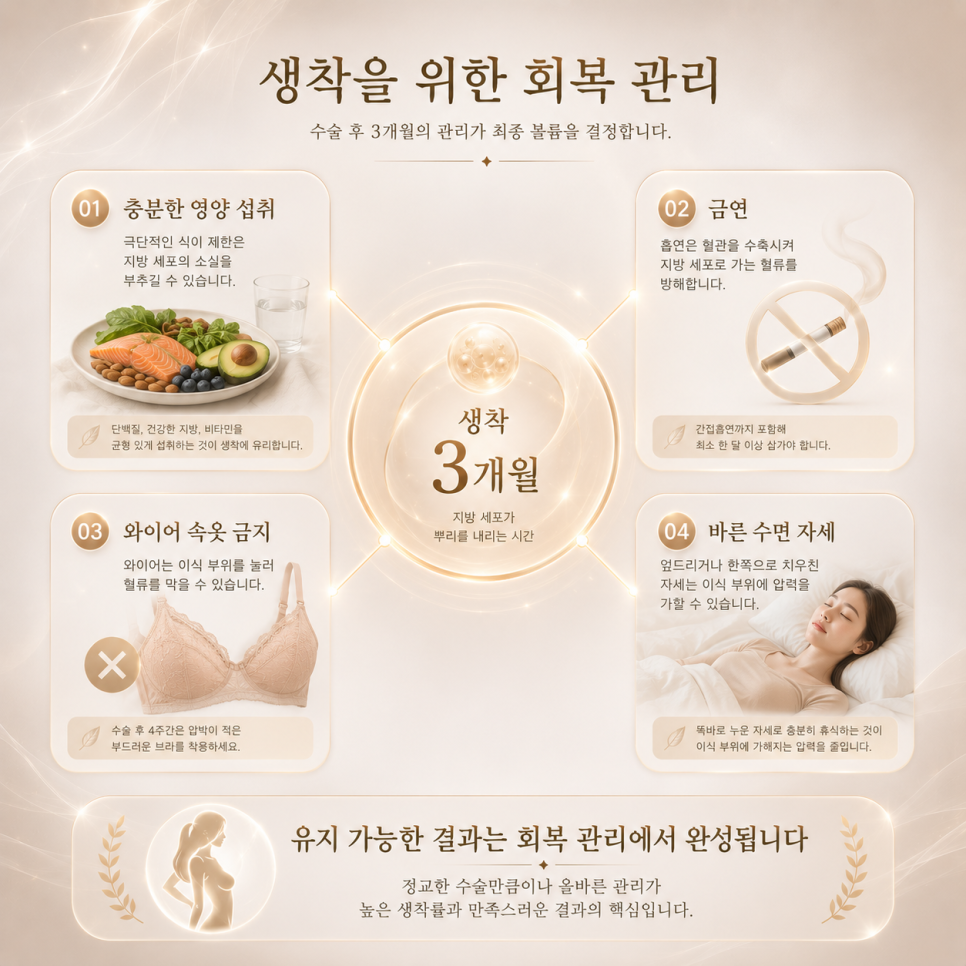
During this period, the transplanted fat cells
are still establishing themselves,
so each aspect of your lifestyle can directly affect the results.
Extreme dietary restriction during the first month after surgery
is not recommended because it may accelerate the loss of transplanted fat cells;
instead, adequate nutritional intake is favorable for fat-graft survival.
Smoking constricts peripheral blood vessels and interferes with blood flow
to the fat cells, so smoking—including exposure to secondhand smoke—
should be avoided for at least one month.
Underwire bras can press on the grafted area and obstruct blood flow,
so they should not be worn for four weeks after surgery.
When sleeping, lying on your back rather than on your stomach
or in a position that places pressure on one side
can also help reduce pressure on the grafted area.
There is one more point we would like to state honestly.
For people with very little body fat who may have difficulty securing
a sufficient amount for harvesting, or those with thin skin
and insufficient space for distributed grafting,
we may first suggest discussing the appropriate approach
rather than proceeding directly with surgery.
The priority is a result that can be maintained,
rather than the desired size.
This is the standard that 글로비성형외과의원 follows during consultations.

The size change after breast fat grafting
depends not on the amount grafted, but on how much survives,
and those conditions differ from person to person.
It is a principle of 글로비성형외과의원 to transparently share
both the possibility of side effects such as calcification after surgery
and each individual’s physical limitations.
We welcome consultations from anyone who wants to confirm
an accurate plan for the amount of change that is realistically possible
based on their own condition.
| 글로비성형외과의원 |
|---|
| Thank you for reading this long post. When making an appointment or consultation, please simply say, “I’m contacting you because I saw your blog.” We will be happy to assist you with even greater care and attention! |
< Recommended related reading >
글로비성형외과의원
is located one minute on foot from Exit 4 of Apgujeong Station on Subway Line 3,
at Floors 5 and 6 of the EGI Building,
843 Nonhyeon-ro, Gangnam-gu, Seoul.
Consultations can be booked on weekdays and weekends.
All consultations are conducted privately on a one-to-one basis.
For detailed inquiries and appointments, please leave a message through the channel below.



Breast Size After Fat Grafting