Side Effects of Lower Eyelid Fat Repositioning:
A Guide to Conjunctival Edema Symptoms and Individual Recovery Processes
Hello,
This is Globie Plastic Surgery Clinic.
Side Effects of Lower Eyelid Fat Repositioning
| A clinic that follows the principles of plastic surgery, Globie Plastic Surgery Clinic |
|---|
| Following the basics is the most important principle in plastic surgery. Procedures should be planned with the client’s entire lifetime in mind. Both the process and the results must be safe. Globie always puts its clients first. |
| Consultation is an important step that leads to surgery. To help you be satisfied with your surgical results, we promise personalized consultations with experienced medical professionals. |
| Postoperative care can also be considered an extension of the surgery. We provide personalized care programs to help our patients recover quickly. |
Hello, this is Globie Plastic Surgery Clinic.
When you begin searching before undergoing lower eyelid fat repositioning surgery,
your fingers may stop in front of the word “side effects” at some point.
You know the results can be good,
but you may put off making a decision because you cannot predict what your eyes will look like after surgery.
Among these concerns, “conjunctival edema” is considered one of the strangest and most unsettling symptoms after surgery.
When you first see the whites of your eyes swollen,
it is natural to feel anxious and wonder, “Could something have gone wrong?”
Today, we will honestly explain why this symptom occurs and how it usually subsides.
Why Does Conjunctival Edema Occur?
Side Effects of Lower Eyelid Fat Repositioning
“I woke up the day after surgery,
and the whites of my eyes were swollen like jelly.
Is this normal?”
This is one of the first things patients often say
when they open the examination room door for a postoperative checkup.
Whenever we see patients arrive with visibly alarmed expressions,
we regret that we should have explained this aspect more thoroughly before surgery.
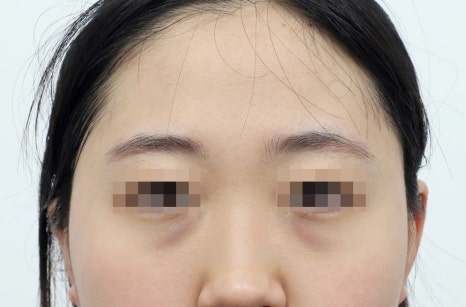
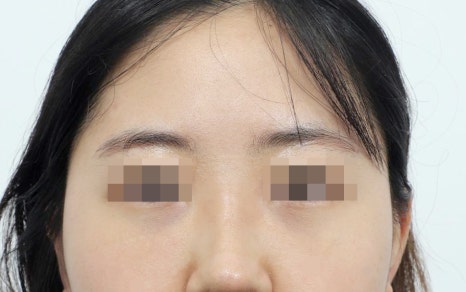
Conjunctival edema is part of the recovery process that may occur after lower eyelid fat repositioning surgery.

Because the incision is made through the conjunctiva on the inner surface of the eye,
fluid may temporarily collect in the conjunctival tissue in response to the irritation, making the whites of the eyes appear swollen.
Just as the area around an ankle may become puffy after a sprain,
it may help to understand this as the body’s natural response to external irritation.
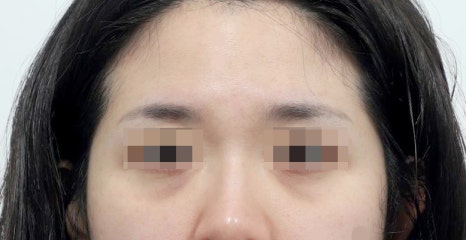
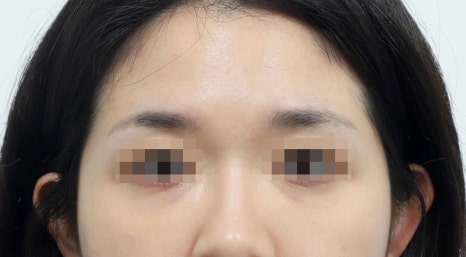
There is one fact that may be helpful to know.
The conjunctiva is very thin and transparent,
so the swelling may look much more severe visually
than it actually is.
Some people may appear very swollen
but improve sooner than expected,
while others may appear to have less swelling but experience it for longer due to their individual constitution.
Therefore, the shock you feel when looking in the mirror
is not necessarily proportional to the actual recovery period.
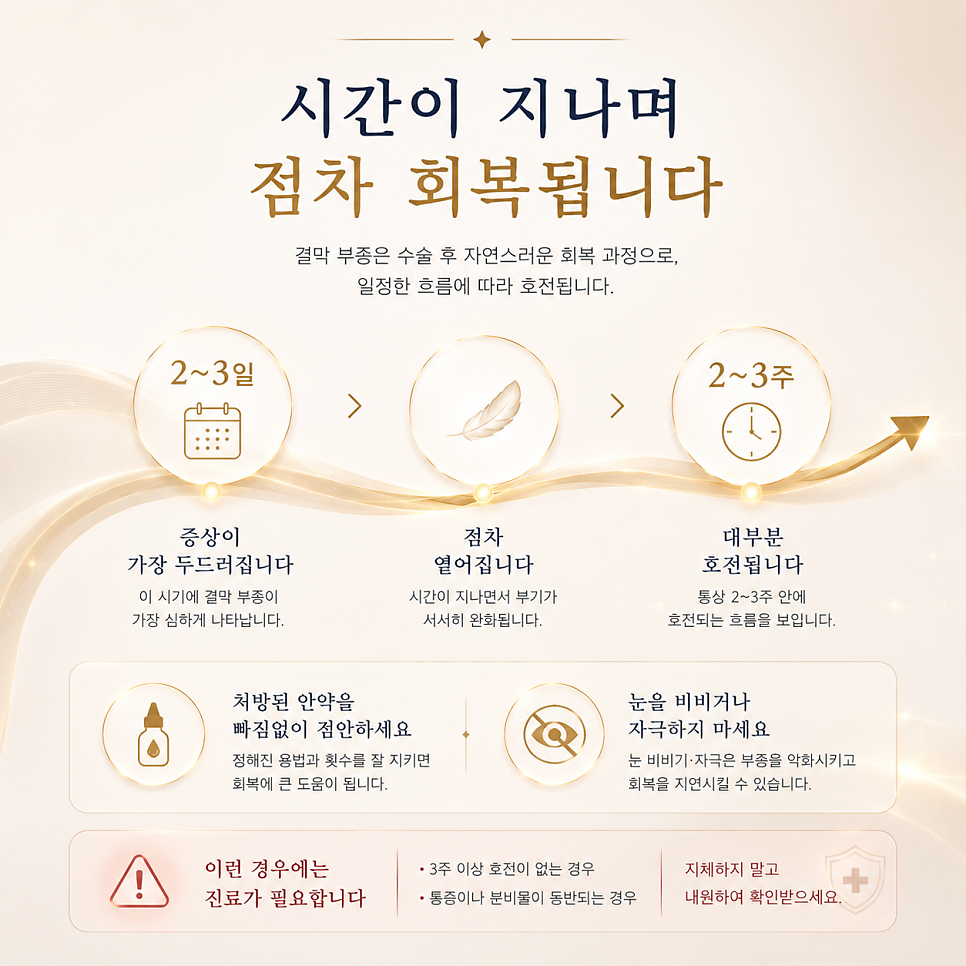
The symptoms are usually most noticeable two to three days after surgery,
then gradually fade and generally improve within two to three weeks.
During this period, using the prescribed eye drops without missing any doses
and avoiding rubbing or otherwise irritating the eyes can provide practical help in reducing the symptoms.
However, if the swelling does not decrease after three weeks,
or if it is accompanied by pain or discharge,
this may indicate that it is outside the normal range of recovery.
In this situation, it is safest to visit the clinic without delay for an examination.
Why Does Recovery Take Different Amounts of Time for Different People?
Side Effects of Lower Eyelid Fat Repositioning
“My friend looked fine after just one week.
Why is mine lasting so long?”
Whenever we hear this,
there is one answer we give first.
The speed of recovery does not reflect the outcome of the surgery;
it is influenced much more by each person’s individual constitution.

We fully understand the anxiety that comes from comparing yourself with someone else,
but such comparisons can often interfere with recovery instead.
People who tend to swell easily,
whose lymphatic circulation is not smooth,
or who move around frequently during sleep may tend to need more time to settle.
This is not a sign that the surgery went wrong;
it is simply a difference in how each body handles recovery.
However, individual care methods can also have a considerable effect on recovery speed,
so care appropriate to each stage is important.
After searching online, many people believe
that “you must apply warm compresses starting on the third day after surgery.”
However, this generally applies only to ordinary skin swelling,
and when conjunctival edema is present, the type of compress must be carefully distinguished.

During the first two days after surgery,
cold compresses are recommended to help prevent the swelling from spreading,
and from the third day, it is generally advisable to switch to warm compresses.
Warm compresses at this stage promote blood circulation,
helping bruising and residual swelling to be absorbed more quickly.
However, the situation is different when conjunctival edema is present.
Conjunctival edema is caused by lymphatic fluid collecting,
rather than by blood.
If you apply a warm compress simply because it is the third day,
heat may dilate the blood vessels,
causing the whites of the eyes to swell even more, like blisters.
Therefore, if conjunctival edema is present,
stop warm compresses and continue cold compresses for at least five to seven days
to soothe the area and prevent further accumulation of tissue fluid.
Keeping your head slightly higher than your heart while sleeping
can also provide practical help in reducing swelling.
Alcohol consumption and overexertion can dilate blood vessels
and slow recovery,
so we recommend avoiding them for at least three to four weeks.
One additional point is that,
for people with severe dry eyes or ocular surface disease,
surgery using a conjunctival incision may worsen these symptoms,
so sufficient evaluation should be conducted before surgery.
In such cases, rather than proceeding with surgery unnecessarily,
personalized alternatives suited to the individual’s eye condition
should be considered the highest priority.


You do not have to face anxiety during the recovery process alone.
There is nothing more exhausting than spending the night searching on your own
when an unexpected symptom appears after surgery.
Questions about the recovery process, including conjunctival edema,
can cause an anxiety that only someone who has experienced it can truly understand.
Checking your recovery plan in advance based on your individual constitution and condition
is the most reliable way to reduce unnecessary trial and error.
Globie Plastic Surgery Clinic pays close attention not only to the expectations before surgery
but also to the process of recovering safely afterward.
By clearly explaining possible physical reactions and precautions,
we will always be here to help our patients return to their daily lives in good health.
※ All surgeries and procedures may cause side effects such as bleeding, infection, or inflammation depending on the individual, so caution is required.
| Globie Plastic Surgery Clinic |
|---|
| Thank you for reading this long post. When making an appointment or consultation, please simply mention, “I’m contacting you because I saw your blog.” We will be delighted to assist you with even greater care and attention to detail! |
< Recommended Reading >
Globie Plastic Surgery Clinic
is located a one-minute walk from Exit 4 of Apgujeong Station on Subway Line 3,
on the 5th and 6th floors of the EGI Building, 843 Nonhyeon-ro, Gangnam-gu, Seoul.
Consultation appointments are available on both weekdays and weekends.
All consultations are conducted privately on a one-on-one basis.
For detailed inquiries and appointments, please leave a message through the channel below.



Side Effects of Lower Eyelid Fat Repositioning