Sinsa Station Thread Lifting,
What to Check When You’re Concerned About Skin Elasticity
Hello,
This is 글로비성형외과의원.
Sinsa Station Thread Lifting
| A Clinic That Upholds the Principles of Plastic Surgery, 글로비성형외과의원 |
|---|
| Upholding the basics is the most important principle in plastic surgery. Procedures should be planned with the patient’s entire lifetime in mind. Both the process and the results must be safe. 글로비 always puts patients first. |
| Consultation is an important step that leads to surgery. To help you feel satisfied with your surgical results, we promise personalized consultations with medical professionals who have extensive clinical experience. |
| Postoperative care can also be considered an extension of the surgery. We provide personalized care programs to help patients recover quickly. |
There is one thing people who are learning about thread lifting for the first time
say most often.
They say that someone they know had it done
but did not see much of an effect.
That statement is almost always followed by anxiety.
They spent money but saw no noticeable change,
or heard stories from people around them
who looked unnatural after the procedure.
To get straight to the point,
thread lifting is a procedure that clearly provides
a significant lifting effect.
However, it is also true that the results can vary greatly
depending on “which threads are used and how they are designed.”
Today, we will go over two things you must check
for the effects of thread lifting to appear properly.
Not All Threads Are the Same
Sinsa Station Thread Lifting
Aren’t all thread-lifting procedures basically the same?
This is a question we often hear during consultations.
From the outside, they all involve inserting threads,
so it is natural to think that way.
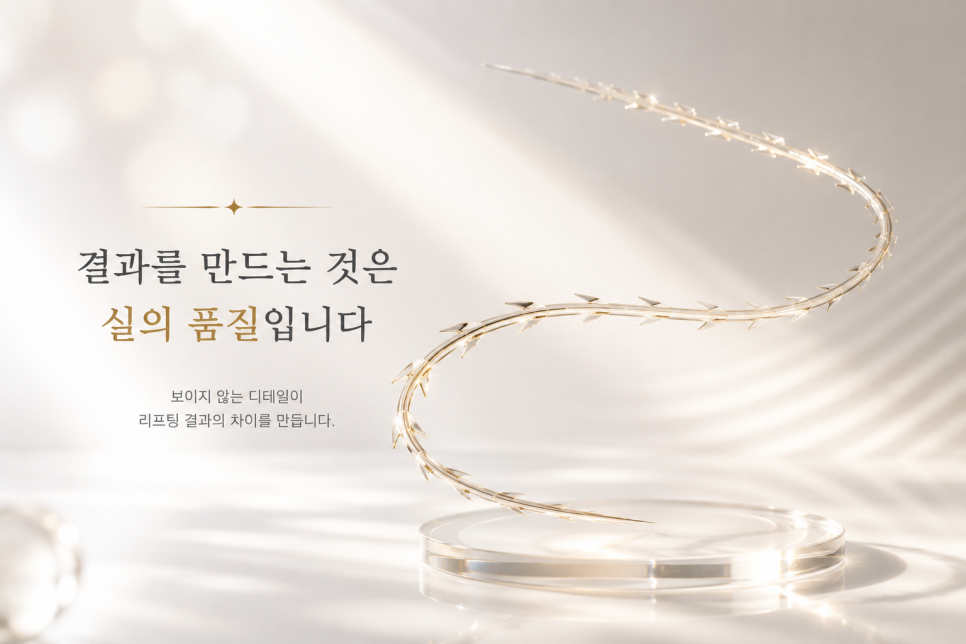
However, to be honest,
the type of thread and the way it is manufactured
are the key variables that determine the outcome.
The threads used in thread lifting are broadly divided into three types.
There are “lifting threads,” which directly pull up sagging skin;
“embedding threads,” which help support elasticity;
and “cavern threads,” which add volume to hollow areas.
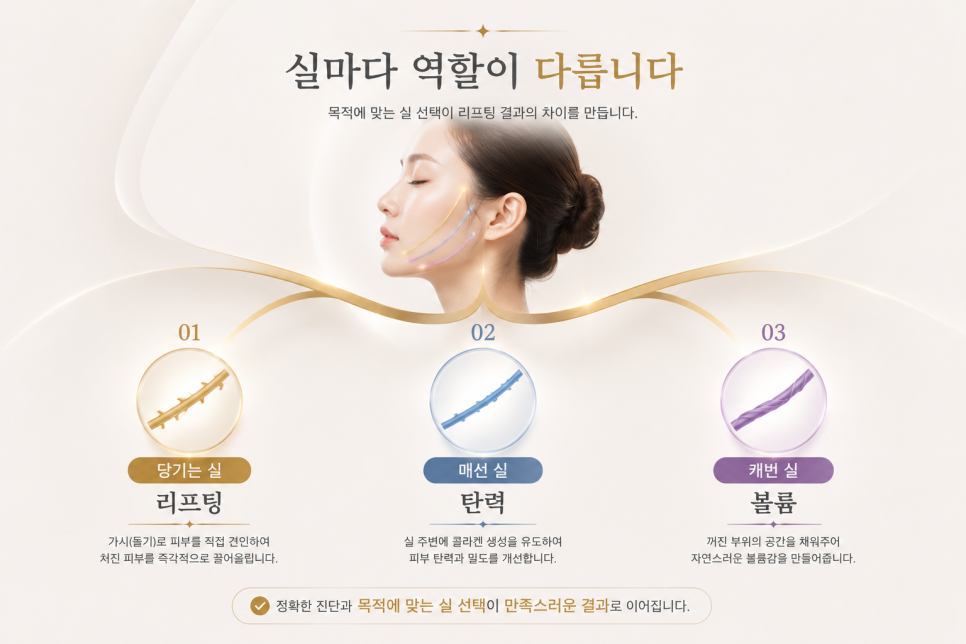
Among these, the threads that are primarily responsible for the lifting effect
are barbed lifting threads.
Their performance varies depending on how the barbs are made.
In the past, barbs were created by cutting the thread with a knife,
but this method resulted in weak threads
that could break easily.
Today, the “molding method,” in which the threads are pressed into shape,
has become the standard,
noticeably improving durability and lifting strength.
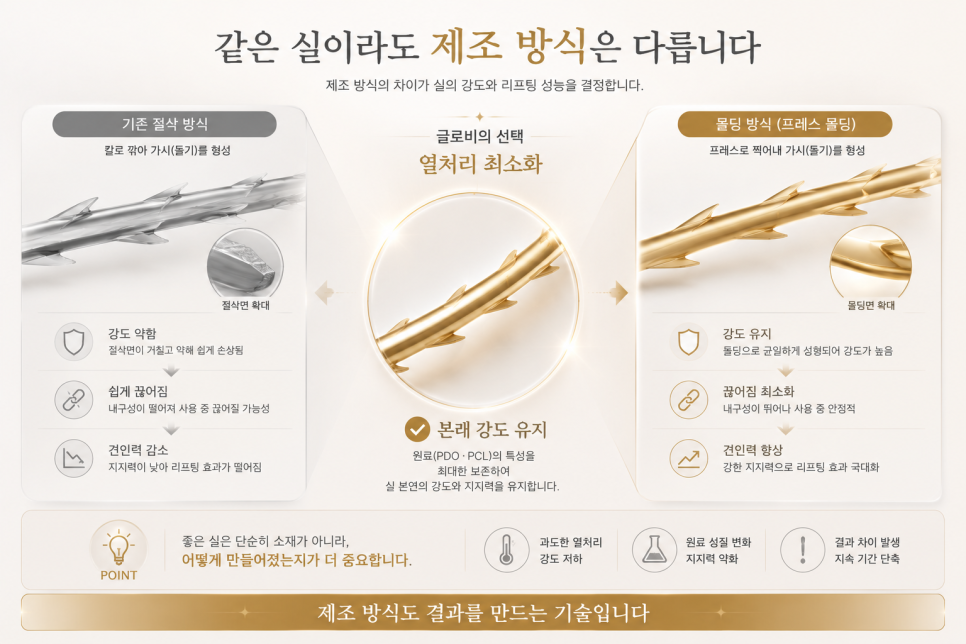
There is one more factor: even among molded threads,
whether they have undergone high-temperature heat treatment
can determine their strength.
Applying excessive heat to PDO or PCL, the materials used to make the threads,
can alter their properties
and reduce the threads’ original strength and support.
This is something that is not always explained clearly during consultations,
but it is a useful point to check.
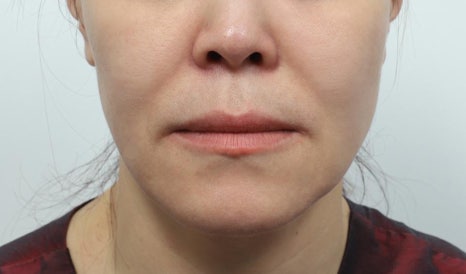
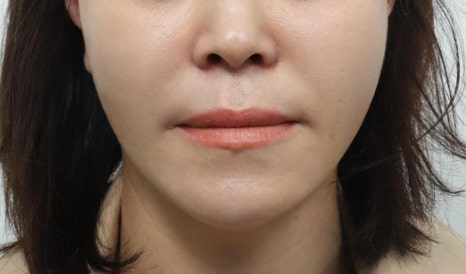
At 글로비, we use threads that undergo minimal heat treatment
to preserve their original strength.
As a result, even short threads with closely spaced barbs—
with many barbs per centimeter—can provide sufficient lifting strength.
Because there is no need to insert them excessively deep toward the scalp,
we can significantly reduce the burden of pain and swelling after the procedure.
Choosing even a single thread requires this kind of judgment.
Rather than simply accepting the claim that “good threads” are used,
we recommend checking the basis behind that claim
before deciding on the procedure.
The Number and Direction of Threads Complete the Effect
Sinsa Station Thread Lifting
How many threads need to be inserted to achieve an effect?
In fact, this question involves context
that is more important than a specific number.
Recently, a patient in her early 40s
requested a consultation, saying,
“I had it done somewhere else, but nothing changed.”
After examining her skin thickness and the direction of sagging,
we found that she had relatively thick cheek fat
but had received only eight threads per side.
When the cheek fat is thick,
the threads must be able to support its weight.
If too few threads are used, the area may initially appear lifted,
but it can return to its original state within a few days.

In general, for people in their 30s and 40s,
around 10–15 threads per side may be needed.
If sagging has progressed further,
around 20 threads per side may sometimes be necessary.
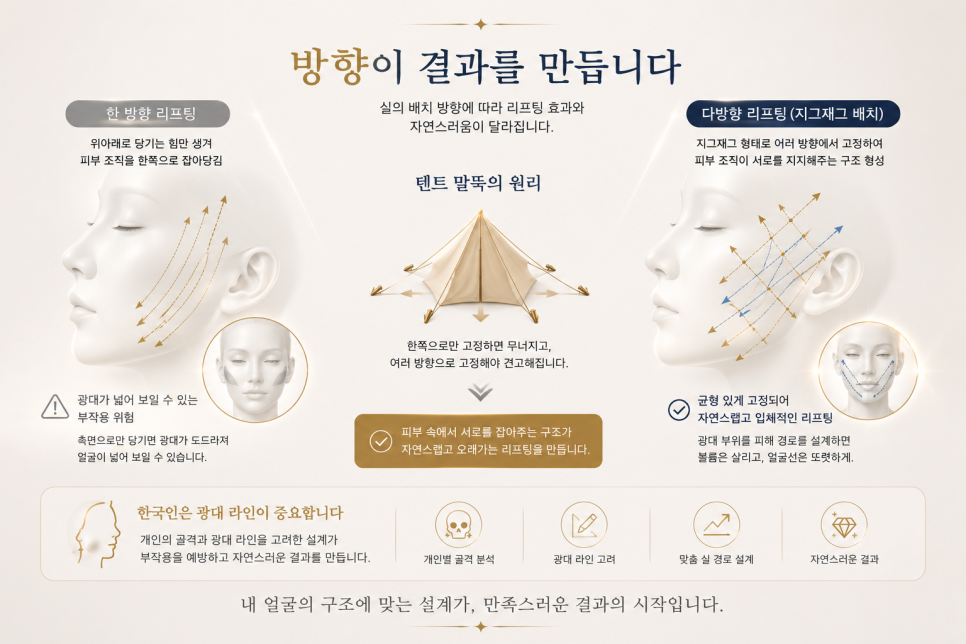
The direction in which the threads are placed is just as important as the number.
Using only bidirectional threads creates pulling forces upward and downward,
whereas combining them with multidirectional anchoring threads in a zigzag pattern
creates a structure in which the threads support one another within the skin tissue.
You can think of it as the difference between driving tent stakes in only one direction
and securing them evenly in all directions for balance.
There is one point that must be considered especially carefully
for Korean patients.
If the skin is pulled only toward the sides using a Western-style method,
the cheekbones may appear wider instead.
This is one of the outcomes of greatest concern in practice.
To prevent this, the thread pathways must be designed separately
to avoid the cheekbone area.
At 글로비, we design each procedure by considering
the individual’s bone structure and cheekbone contours.
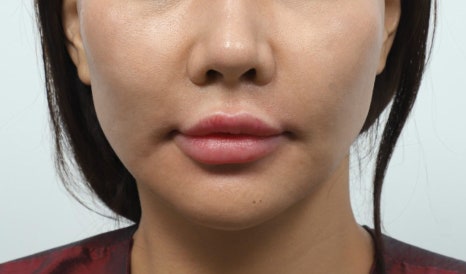
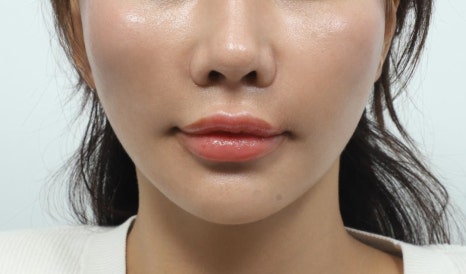
Only when the structure of sagging in your face is accurately assessed,
and the appropriate number and direction of threads are planned,
can natural and satisfying results be achieved.
The results of thread lifting may vary depending on an individual’s skin condition
and degree of sagging, and the possibility of side effects
is transparently explained in advance—
this is a principle of 글로비.
Before the procedure, first check which type of threads and design
are appropriate for your skin conditions.
This is the most reliable way to reduce trial and error
caused by incorrect information.
| 글로비성형외과의원 |
|---|
| Thank you for reading this lengthy post. When making a reservation or scheduling a consultation, just casually mention, “I’m contacting you after seeing your blog.” We will be happy to assist you with even greater care and attention to detail! |
< Recommended Reading >
글로비성형외과의원
is located one minute on foot from Exit 4 of Apgujeong Station
on Subway Line 3,
at 5th and 6th Floors, EGI Building, 843 Nonhyeon-ro, Gangnam-gu, Seoul.
Consultation reservations are available on both weekdays and weekends.
All consultations are conducted privately on a one-on-one basis.
For detailed inquiries and reservations, please leave a message through the channel below.



Sinsa Station Thread Lifting