Short Nose Revision Surgery,
First Identify the Cause of the Previous Failure
Hello,
This is Globie Plastic Surgery Clinic.

Short Nose Revision Surgery
| A Clinic That Upholds the Principles of Plastic Surgery, Globie Plastic Surgery Clinic |
|---|
| Upholding the basics is the most important principle in plastic surgery. Procedures should be planned with the patient's entire lifetime in mind. Both the process and the results must be safe. Globie always puts patients first. |
| Consultation is an important step that leads to surgery. To help you be satisfied with your surgical results, we promise personalized consultations with medical professionals who have extensive clinical experience. |
| Postoperative care can also be considered an extension of the surgery. We provide personalized care programs to help our patients recover quickly. |
Many people considering short nose revision surgery
find that, only a few months after their initial rhinoplasty,
the tip of the nose begins to turn upward and the nostrils
become increasingly exposed.
At first, they may wait, assuming it is due to swelling,
but after seeing no improvement even after six months,
many begin searching online, asking, “Could this be contracture?”
In this article, before deciding on short nose revision surgery,
we would like to clearly organize what must be examined first:
namely, the different causes of failure and how the approach
differs depending on the cause.
If revision is undertaken without accurately identifying the cause,
the same result may be repeated.
To help reduce that kind of trial and error,
Globie would like to share an honest explanation.
Can't it simply be redone?
Short Nose Revision Surgery
This is one of the questions we frequently hear in the consultation room.
It takes courage to decide to undergo revision,
but what comes next is actually more important.
The reason short nose revision surgery is challenging
is not simply a matter of technique.
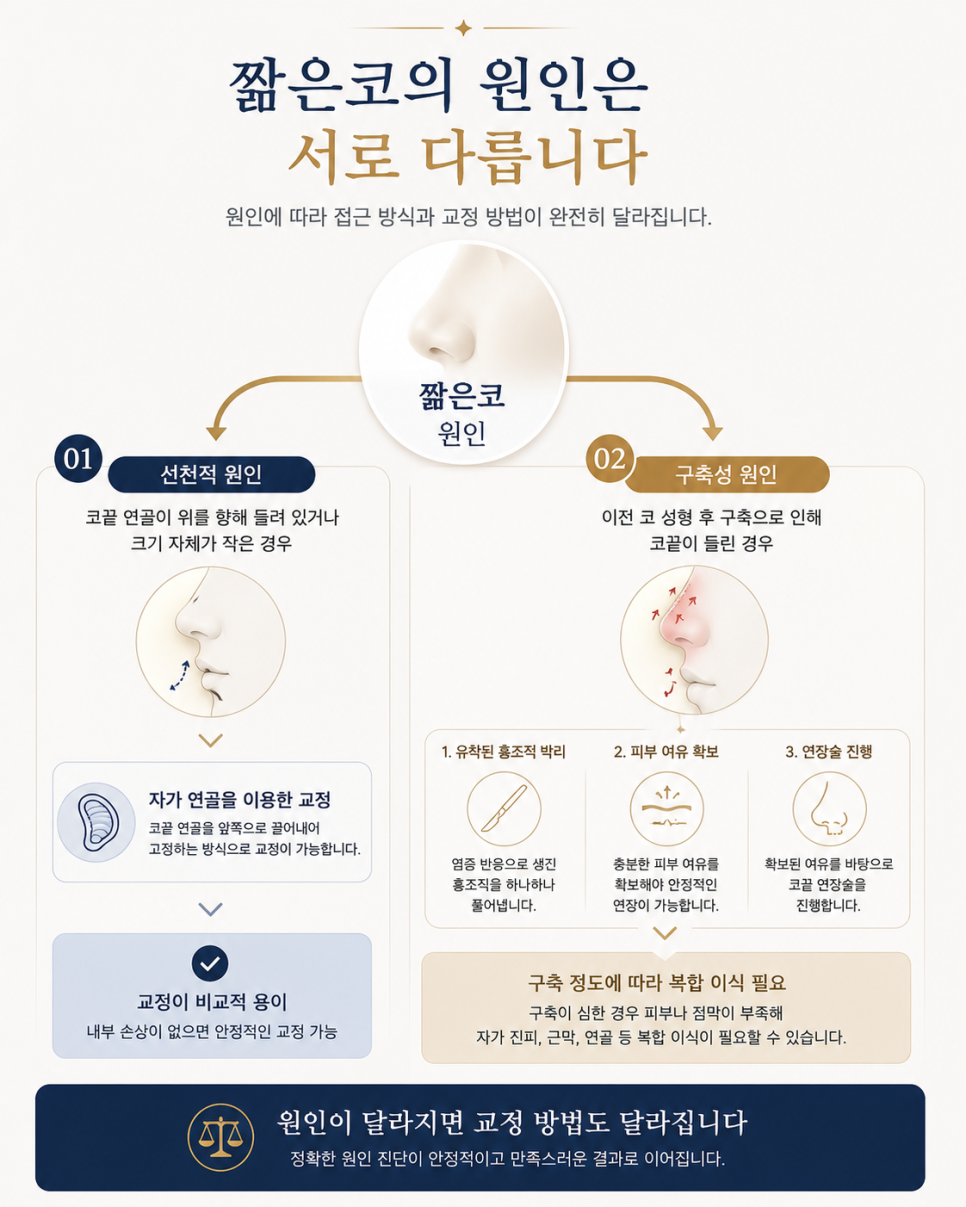
This is because the causes of a shortened nose
can be divided into two categories,
with completely different approaches for each.
The first is a case in which the tip cartilage is naturally
oriented upward and elevated, or is small in size.
If there is no significant internal damage,
correction may be possible by using the patient's own cartilage
to bring the tip cartilage forward and secure it in place.
The second is a case in which the tip has become elevated
due to contracture that developed after previous rhinoplasty.
This is much more complex.
Contracture is a condition in which repeated inflammatory responses
at the incision site cause hard scar tissue to build up internally,
while the skin itself contracts.
Simply put, it is a state in which the inside continues tightening,
pulling the nasal tip upward.
In such cases, simply grafting new tissue
will not resolve the problem.
The adhered scar tissue must first be released piece by piece,
after which lengthening surgery must be performed
once sufficient skin flexibility has been secured.
Depending on the severity of the contracture, the skin or mucosa
may be severely insufficient, making composite grafting necessary.
Thus, even short noses that look the same on the outside
may have completely different underlying conditions.
Without first identifying the cause,
it is impossible to establish an appropriate revision plan.
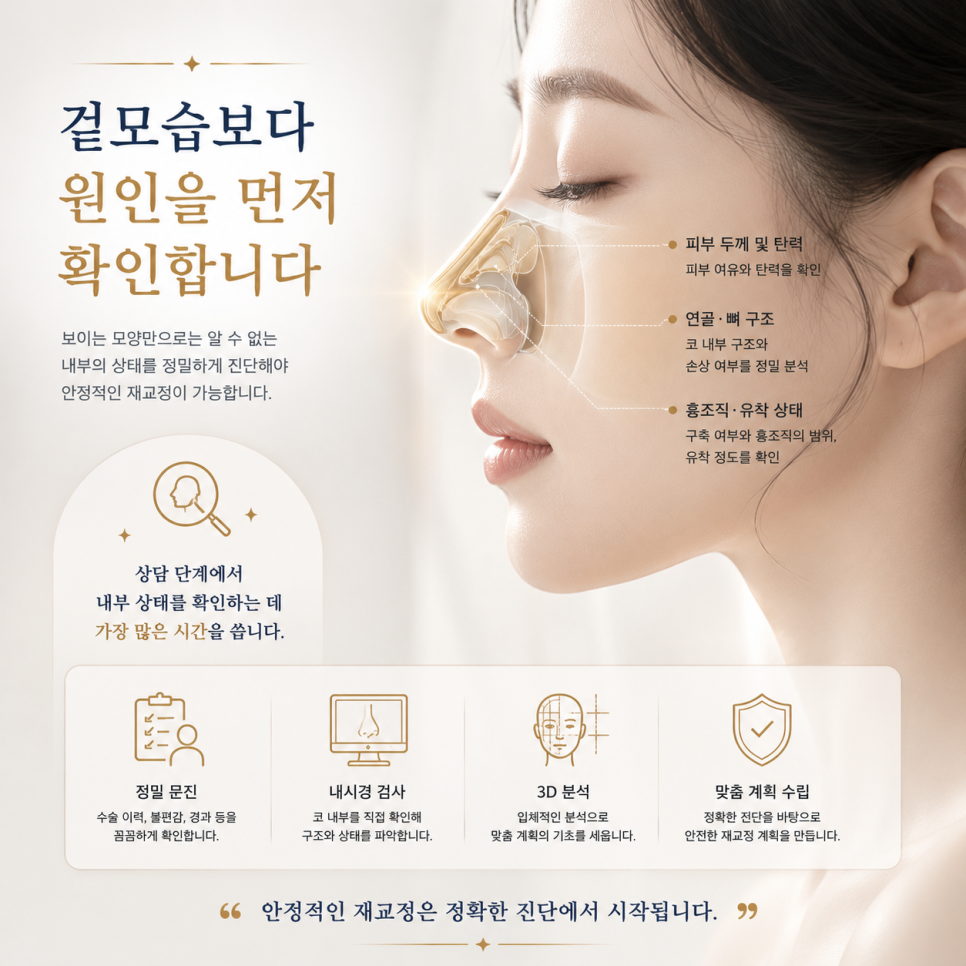
That is why, at Globie, we spend the most time during the consultation stage
examining the current internal condition of the nose.
This is because understanding what is happening inside,
rather than focusing only on the visible shape,
is the first step toward stable revision surgery.
If there is contracture,
must rib cartilage always be used?
Short Nose Revision Surgery
This is another question that frequently comes up during revision consultations.
The choice of material is not determined solely by whether contracture is present.
We must also consider how much usable autologous tissue remains inside the nose
and how much structural support is required.
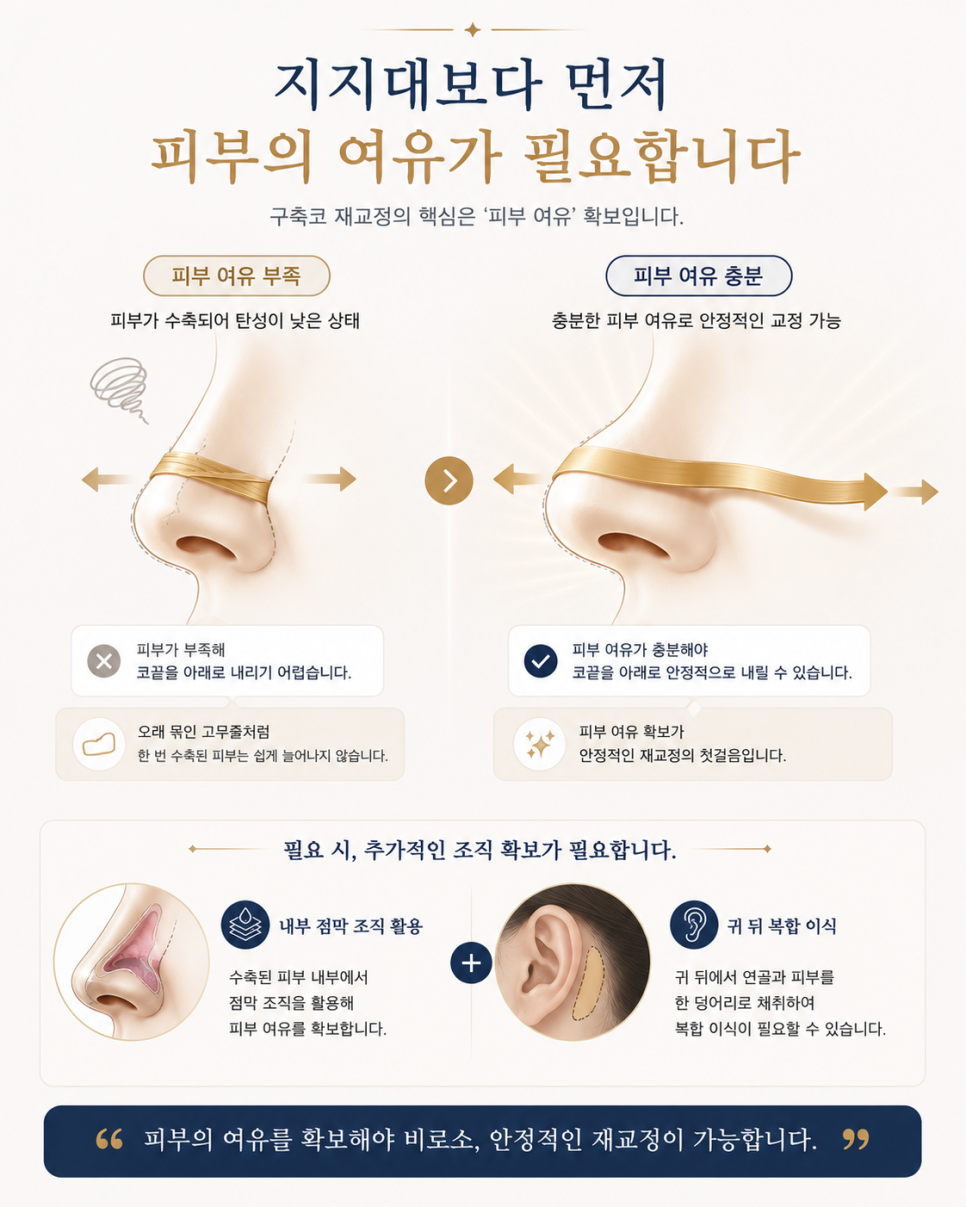
The most difficult aspect of revision surgery for a contracted nose
is securing sufficient “skin flexibility.”
Because the skin has remained contracted and hardened
for an extended period,
even if a support is made sufficiently long,
the tip cannot be lowered if there is not enough skin to cover it.
Like an elastic band that has lost its elasticity after being tied for a long time,
skin that has once contracted does not stretch easily.
In such cases, it may be necessary to use internal mucosal tissue
or perform a composite graft, harvesting cartilage and skin
as one piece from behind the ear.
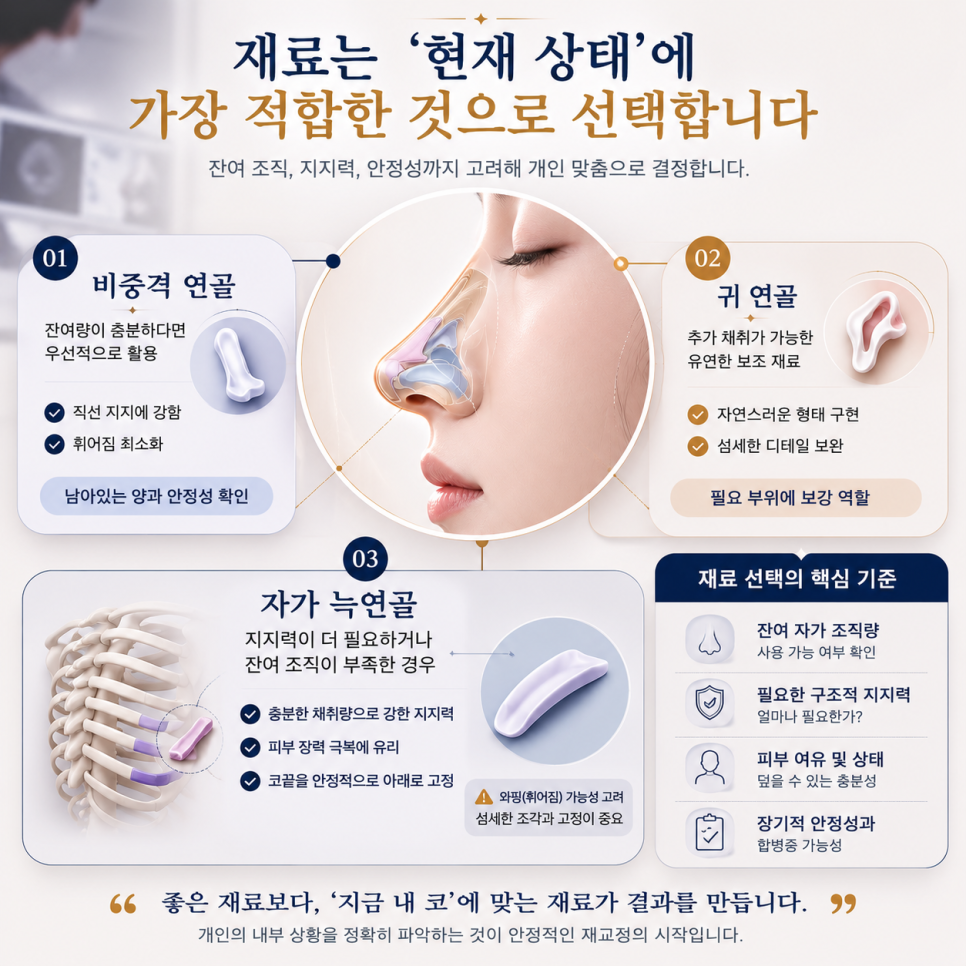
How, then, is the material selected?
Even if the septal or ear cartilage was used
during the previous rhinoplasty,
it can be reused or additional cartilage can be harvested
if a sufficient amount remains.
However, if most of it has already been used
or there is not enough for structural support,
rib cartilage becomes an option.
Autologous rib cartilage offers the advantage of being available
in ample quantity and being firm enough to withstand skin tension,
providing strong force to pull the tip downward and secure it.
However, you should be aware in advance that warping,
or bending, may occur.
Because the tissue tends to return to its original shape,
the nose may gradually bend slightly over time.
Therefore, the method of carving and the fixation technique
are key factors that determine the outcome.
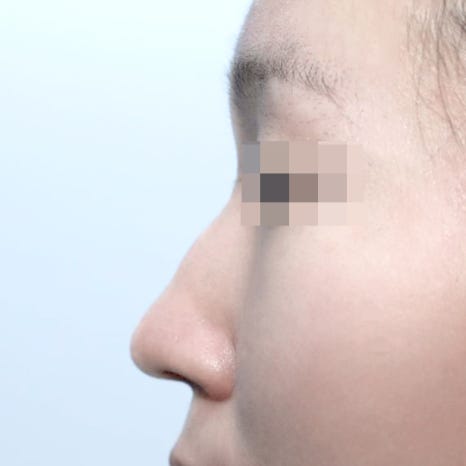
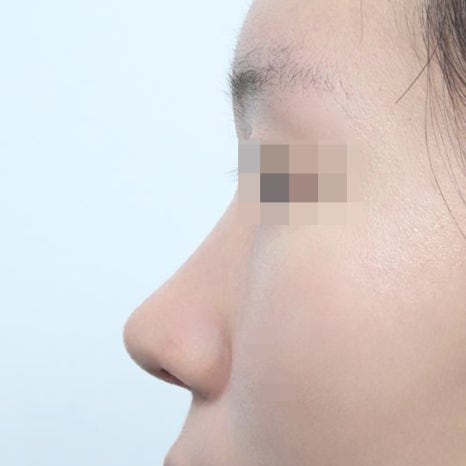
Ultimately, choosing materials for short nose revision surgery
is not simply a matter of whether to use rib cartilage.
It is a matter of accurately determining which material
is most suitable for the current internal condition.
Selecting materials precisely according to each individual's internal condition
is the key to achieving stable results.
Because rhinoplasty involves working with anatomical structures,
it is Globie's principle to transparently share
possible complications and the recovery process.
If you are considering short nose revision surgery,
identifying the cause comes first.
Therefore, we recommend first confirming
a personalized surgical plan suited to the condition of your nose.
Rather than making a hasty decision,
we hope you will begin by accurately understanding
what the problem is in your current condition.
| Globie Plastic Surgery Clinic |
|---|
| Thank you for reading this lengthy post. When making a reservation or consultation appointment, just mention, “I’m contacting you after seeing your blog.” We will be happy to assist you with even greater care and attention! |
< Other Posts You May Also Enjoy >
Globie Plastic Surgery Clinic
is located one minute on foot from Exit 4 of Apgujeong Station on Subway Line 3,
at Floors 5 and 6 of the EGI Building, 843 Nonhyeon-ro, Gangnam-gu, Seoul.
Consultation reservations are available on weekdays and weekends.
All consultations are conducted privately on a one-on-one basis.
For detailed inquiries and reservations, please leave a message through the channel below.


Short Nose Revision Surgery