Facial Lifting for Sagging Skin,
Do You Look Older Than Your Age?
Hello,
This is Globie Plastic Surgery Clinic.

Facial Lifting for Sagging Skin
| A Clinic That Adheres to the Principles of Plastic Surgery, Globie Plastic Surgery Clinic |
|---|
| Following the basics is the most important aspect of plastic surgery. Procedures should be designed with the patient's entire life in mind. Both the process and the outcome must be safe. At Globie, our patients always come first. |
| Consultation is an important step that leads to surgery. To help you feel satisfied with your results, we promise personalized consultations with medical professionals who have extensive clinical experience. |
| Postoperative care can also be considered an extension of the procedure. We provide personalized care programs to help our patients recover quickly. |
Have you ever looked in the mirror and felt that
you appeared older than your actual age?
When the cheeks sag and the jawline becomes less defined,
you may look tired and
older regardless of your actual age.
Most people who look into facial lifting for sagging skin
begin to worry at exactly this point.
However, when they start searching for information,
there are so many options that they often say
they do not know where to begin.
The fact that there are many options also means that choosing
the one suited to your condition is important.
Today, focusing on thread lifting, which can
improve sagging facial skin without incisions,
we will take an honest, practical look at the key factors
that influence the results.
The Type of Thread and How It Is Manufactured Determine the Results
Facial Lifting for Sagging Skin
I understand that it can be effective,
but how does it actually lift the tissue?
When people ask this question, it often seems that
rather than simple curiosity, they mainly want to confirm
whether the procedure is truly reliable before spending money.
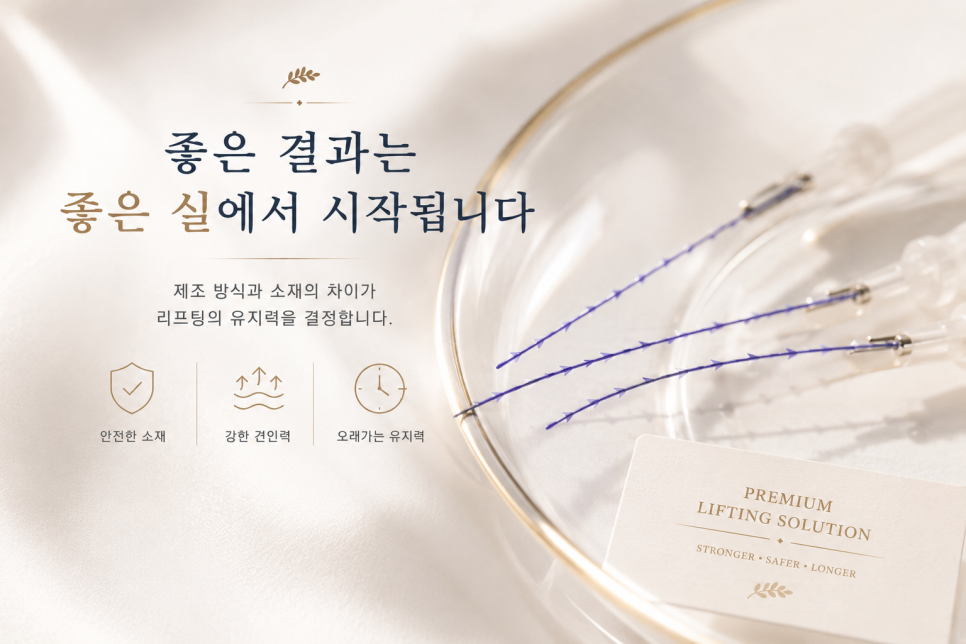
Thread lifting involves inserting traction threads with
barbs beneath the skin to pull sagging tissue upward.
How those barbs are made
determines the traction force.
In the past, barbs were formed by cutting them with a blade,
which created a problem because the threads were weak and could break easily.
Today, molding, in which the threads are pressed into shape,
has become the standard, noticeably improving durability.
There is one more point
that is not often addressed even during consultations.
Even threads made using the molding method may lose
the elasticity of their PDO or PCL material
if they undergo high-temperature heat treatment during manufacturing.
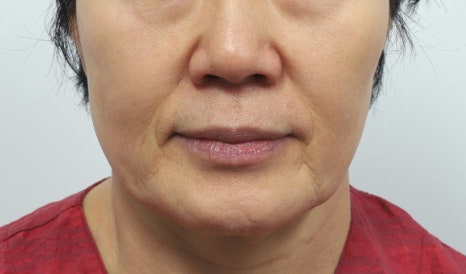
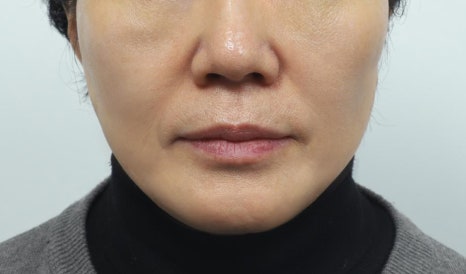
Simply put, the thread's “framework” becomes weaker.
When the material is weak, it may feel as though the skin has been lifted
immediately after insertion, but it becomes difficult for the thread
to support the tissue for a long time,
which can cause the effect to end sooner than expected.
Some people who visit for a consultation
have actually made their decision without knowing about this point
and later experienced disappointing results,
so it is important to understand it from the beginning.
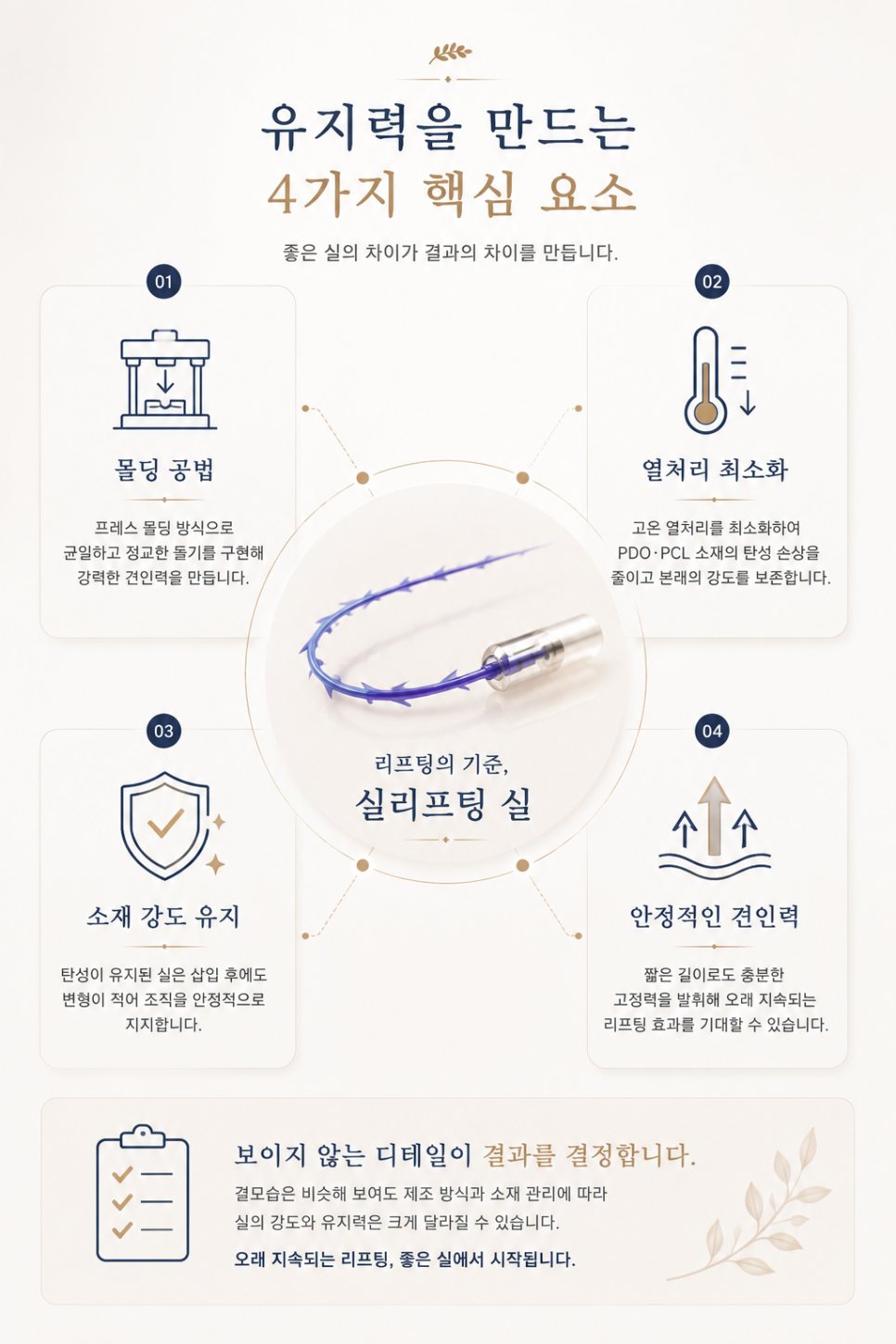 At Globie, we use products that minimize heat treatment
and preserve their original strength.
This allows sufficient traction to be achieved even with shorter threads,
reducing the need for deep insertion toward the scalp
and helping lessen discomfort after the procedure.
Local anesthesia is administered on the day of the procedure.
Your facial expressions may look somewhat awkward due to the effects of anesthesia,
but they usually return to normal by the following day.
We recommend checking the basis for why each material is selected
before making your decision.
Number and Direction—and an Honest Explanation
Facial Lifting for Sagging Skin
How many threads are needed to produce an effect?
Behind this question is often an even greater concern:
worry that there may be no visible change
after spending money on the procedure.
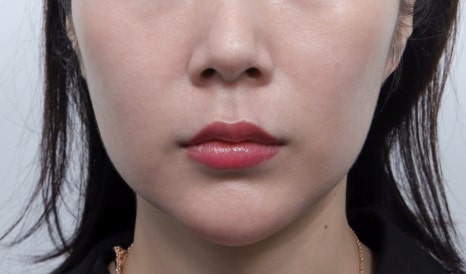
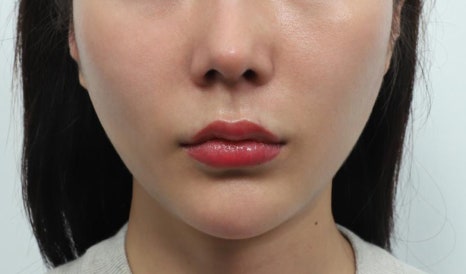
Recently, a patient in their mid-40s visited us,
saying, “I had thread lifting done elsewhere, but
the entire effect disappeared after two months.”
After examining the condition, we found that
the cause was that fewer threads than necessary had been inserted on both sides,
without taking the weight of the cheeks into account.
The thicker the cheeks, the more the inserted traction threads
must be able to withstand their weight.
If too few threads are used, the face may initially appear lifted,
but it can begin to look saggy again over time.
In general, people in their 30s and 40s may need approximately
10–15 threads per side,
while around 20 threads per side may sometimes be needed
when sagging has progressed further.

The placement direction is just as important as the number of threads.
Combining multidirectional fixation threads in a zigzag pattern
creates a structure in which the threads support one another
within the skin tissue, allowing the fixation to last much longer.
Applying a Western-style method that pulls only toward the side
can make the cheekbones appear wider,
which is one of the points we pay the closest attention to in practice.
At Globie, we have long used an approach tailored to Korean facial features,
designing the pathways to avoid the cheekbone area.
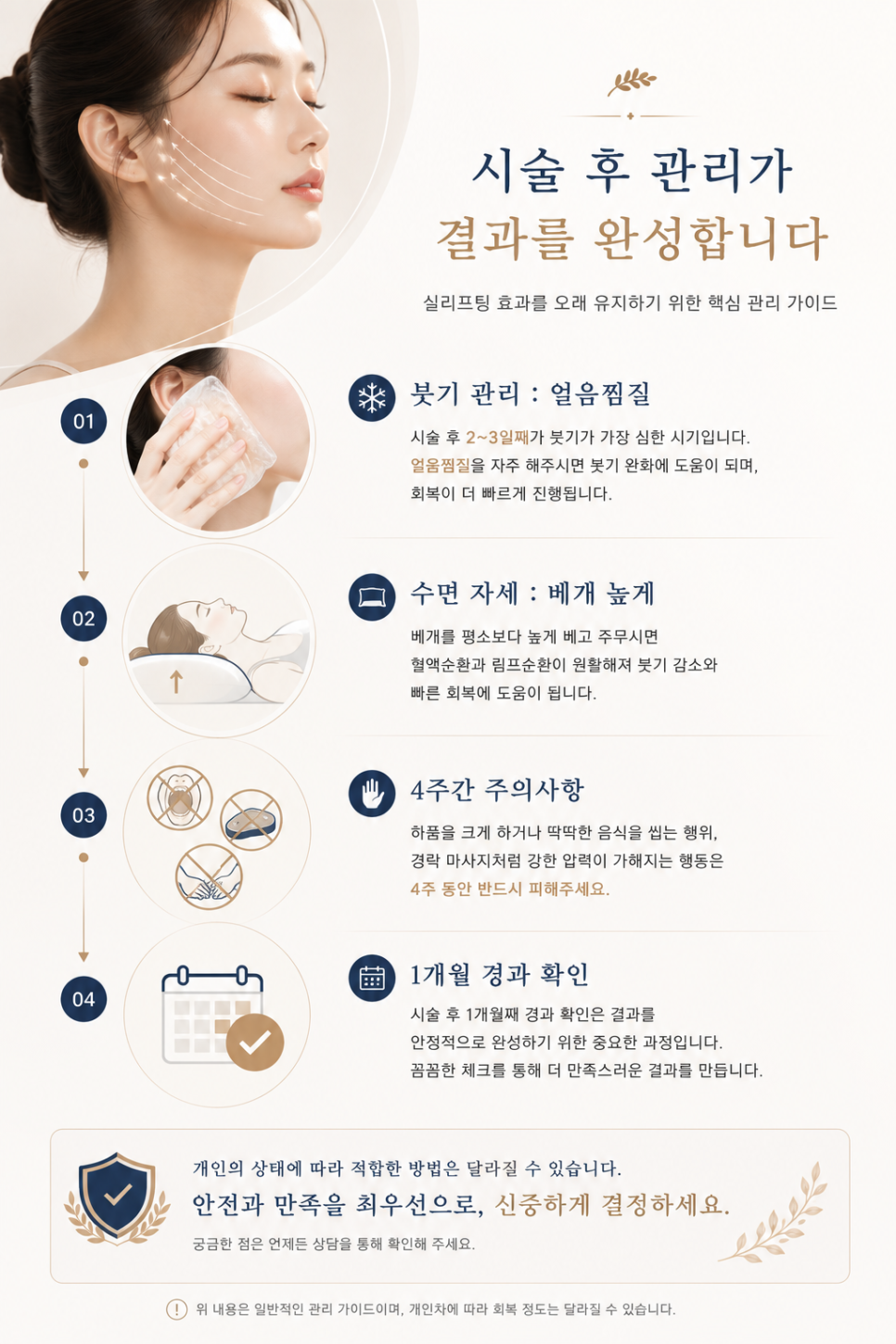
Swelling is usually at its most severe on days 2–3 after the procedure.
Applying ice frequently and sleeping with your head elevated
higher than usual can help speed recovery.
For four weeks, you must avoid activities that apply strong pressure,
such as opening your mouth wide when yawning,
chewing hard foods, or receiving meridian massage.
The one-month follow-up is the final step in completing the result.
For people with very severe sagging or extremely reduced skin elasticity,
rather than recommending an overly aggressive procedure,
we first explain the limitations honestly
and review more suitable options together.
Thread lifting results may vary depending on an individual's skin condition
and degree of sagging. It is also Globie's principle
to explain transparently in advance that dimples
or temporary unevenness may appear after the procedure.
The factors that determine the results depend less on the day of the procedure
than on how accurately your individual conditions are assessed beforehand.
Before undergoing the procedure, first check which type of material,
number of threads, and placement direction are suitable for your face.
This is the most reliable way to reach your desired result
without unnecessary trial and error.
| Globie Plastic Surgery Clinic |
|---|
| Thank you for reading this lengthy post. When making a reservation or consultation, please simply say, “I contacted you after seeing your blog.” We will be delighted to help you with even greater care and attention to detail! |
< Other Posts You May Enjoy >
Globie Plastic Surgery Clinic
is located a one-minute walk from Exit 4 of Apgujeong Station on Subway Line 3,
on Floors 5 and 6 of the EGI Building, 843 Nonhyeon-ro, Gangnam-gu, Seoul.
Consultation reservations are available on weekdays and weekends.
All consultations are conducted privately on a one-to-one basis.
For detailed inquiries and reservations, please leave a message through the channel below.



Facial Lifting for Sagging Skin