Upper Blepharoplasty
How to Improve Covered, Drooping Eyelids
Hello,
This is Glovi Plastic Surgery Clinic.
Upper Blepharoplasty
| A Clinic That Upholds the Principles of Plastic Surgery: Glovi Plastic Surgery Clinic |
|---|
| The most important thing in plastic surgery is to adhere to the basics. Procedures should be planned with the patient's entire lifetime in mind. Both the process and the results must be safe. At Glovi, our patients always come first. |
| Consultation is an important step that leads to surgery. To help you feel satisfied with your surgical results, we promise personalized consultations with medical professionals who have extensive clinical experience. |
| Postoperative care can also be considered an extension of the surgery. We provide personalized care programs to support our patients' speedy recovery. |
People who visit our consultation room because of drooping upper eyelids
commonly say the following:
My eyes have felt heavy and uncomfortable for a long time,
but I didn't know whether they were at the point of needing surgery.
Changes in which the eyelids gradually descend
are often noticed by the individual later than anyone else.
When you look in the mirror every day, the changes become familiar,
and the habit of using your forehead to open your eyes
naturally becomes established before you realize it.
Today, we will explain the conditions in which upper blepharoplasty may be needed,
as well as what must be checked before surgery.
Not all covered eyelids
have the same cause
Upper Blepharoplasty
If the upper eyelid is drooping, doesn't that mean I need upper blepharoplasty?
This is a question we often hear in the consultation room,
but this one question actually contains the key factor
that can determine the surgical results.
Although the visible result may look the same,
the causes can broadly be divided into two types.
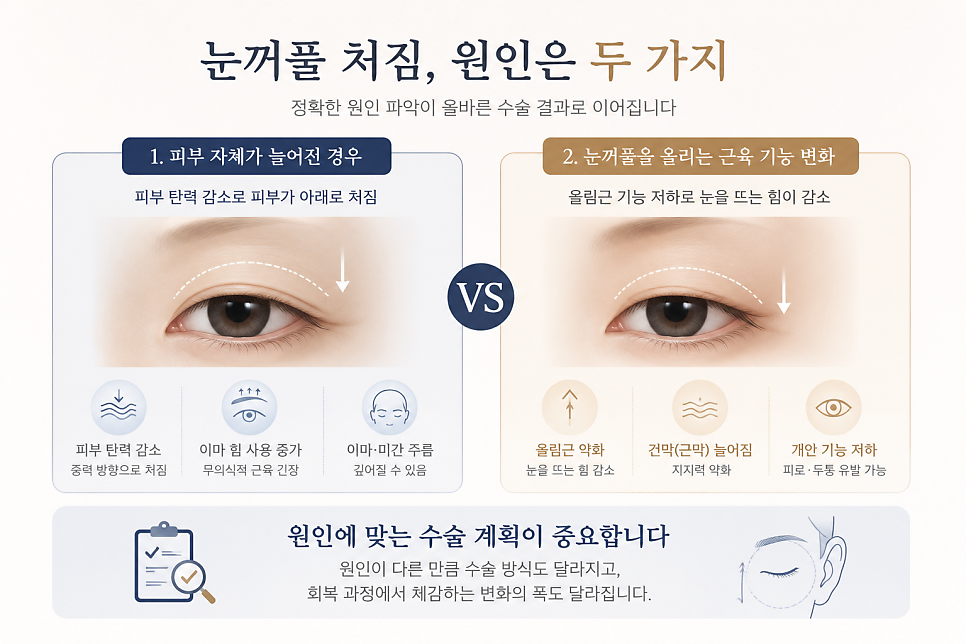
The first is a case in which the skin itself has become loose.
As we age, the elasticity of the eyelid skin decreases,
and as it descends in the direction of gravity,
the skin begins to cover the area above the eyelashes.
When we directly examine the eyelids of people
who visit our consultation room, many of them
are unconsciously exerting a great deal of force on their forehead.
As the state of barely being able to open the eyes without raising the eyebrows
continues for a long time, the forehead muscles become chronically tense.
However, most people are unaware that this is happening.
The second is a case in which there has been a change in the function
of the muscles that lift the eyelids.
When the levator muscle weakens or its aponeurosis stretches,
the force used to open the eyes itself decreases.
Even if it appears externally that the skin is drooping,
the actual cause is different.
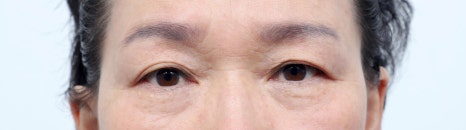

If only the skin is removed without distinguishing between these two causes,
the drooping may not improve sufficiently,
or the expected results may not be achieved.
Therefore, identifying the cause
must come before planning the surgery.

Since the causes differ, the surgical methods also differ,
as does the extent of the changes perceived during recovery.
There are things that must be checked before surgery
Upper Blepharoplasty
The questions we receive most often before upper blepharoplasty
concern the recovery period and scarring.
First, to address a point that may reassure you,
the incision is placed along the existing eyelid crease or wrinkle line,
so over time it tends to blend naturally into the skin texture.
However, recovery varies from person to person.
In general, significant swelling subsides within about a week,
and it may take approximately three to six months
for the incision line to blend with the surrounding area.

We sometimes meet people who have developed deep glabellar lines
after using their forehead muscles to open their eyes for a long time.
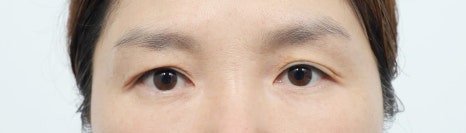
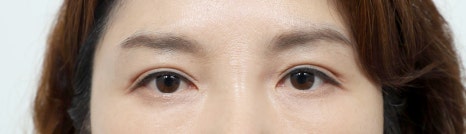
In one actual consultation, we confirmed that, along with skin drooping,
the levator muscle function had also decreased,
so we proceeded by correcting both issues together.
After one month, the habit of using the forehead muscles had gradually decreased,
and at three months, the tension between the eyebrows
was noticeably relieved, according to the patient.
As the feeling of heaviness and discomfort disappeared,
the patient felt that not only their appearance
but also their everyday fatigue had improved.

To be candid about one point,
if the drooping is mild and a certain degree of skin elasticity remains,
there are times when it is more appropriate to monitor the progression
rather than rush into surgery.
Conversely, if excessive use of the forehead muscles
has already begun to affect daily life through headaches or eye fatigue,
that may be a point at which surgery should be actively considered.
At Glovi Plastic Surgery Clinic,
when we determine that surgery is not necessary,
rather than making a premature recommendation,
we prioritize guiding each person toward the approach appropriate for their current condition.
Upper blepharoplasty is not simply
about removing skin.
You must first determine whether the cause of the eyelid coverage is the skin, the muscles,
or a combination of both in order to establish the right approach for you.
If you have been uncomfortable for a long time because of covered, drooping eyelids,
checking what stage your current condition is at
is the starting point.
If you would like to know more about an accurate plan suited to your individual circumstances,
please feel free to ask at Glovi Plastic Surgery Clinic.
| Glovi Plastic Surgery Clinic |
|---|
| Thank you for reading this long post. When making a reservation or consultation, just mention, “I’m contacting you because I saw your blog.” We will be delighted to assist you with even greater care and attention to detail! |
< Articles You May Also Enjoy >
Glovi Plastic Surgery Clinic
is located a one-minute walk from Exit 4 of Apgujeong Station on Subway Line 3,
on the 5th and 6th floors of the EGI Building,
843 Nonhyeon-ro, Gangnam-gu, Seoul.
Consultation appointments are available on both weekdays and weekends.
All consultations are conducted privately on a one-to-one basis.
For detailed inquiries and reservations, please leave a message through the channel below.



Upper Blepharoplasty