Male Rhinoplasty
Clearly Different Design Points from Women’s Rhinoplasty
Hello,
This is Glovi Plastic Surgery Clinic.

Male Rhinoplasty
| A Clinic That Upholds the Principles of Plastic Surgery, Glovi Plastic Surgery Clinic |
|---|
| The most important thing in plastic surgery is to follow the fundamentals. Procedures should be planned with the customer’s entire future in mind. Both the process and the results must be safe. At Glovi, we always put our customers first. |
| Consultation is an important step that leads to surgery. To help you feel satisfied with your surgical results, we promise personalized consultations with medical professionals who have extensive clinical experience. |
| Postoperative care can also be considered an extension of the surgery. We provide personalized care programs to support our patients’ prompt recovery. |
When people considering male rhinoplasty come to the consultation room,
there is one thing we ask first.
The answer to the question, “What kind of nose would you like?”
is clearly different from that of female patients.
While women tend to want a prominent, pointed contour,
most men want
“to look naturally different.”
In fact, this difference completely changes the starting point of the design.
In this article, we will explain in detail
how male rhinoplasty differs from women’s rhinoplasty,
and the design principles behind it.
If you have ever heard someone say,
“Men look strange when they have plastic surgery,”
we will also explain why that can happen.
“Can men also have a prominent nose like women?”
Male Rhinoplasty
This is a question that comes up very often during consultations.
That feeling is completely understandable.
It reflects the wish to look different without making it obvious
that something has been done.
To give you the conclusion first, it is technically possible,
but it often does not suit the face.
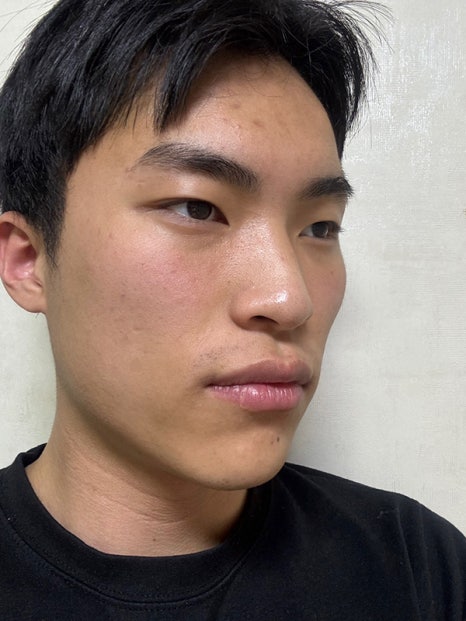

The first thing that differs in male rhinoplasty
is the angle of the nasal tip.
For women, a nasal tip rotation angle of approximately 95–105 degrees,
meaning that the tip points slightly upward, can create a three-dimensional
and bright appearance.
However, applying this standard to men without modification
can make the nose look disconnected from the rest of the face.
We encounter this situation fairly often in practice,
and it is usually the reason behind feedback such as,
“The nose itself looks good, but why does it look awkward?”
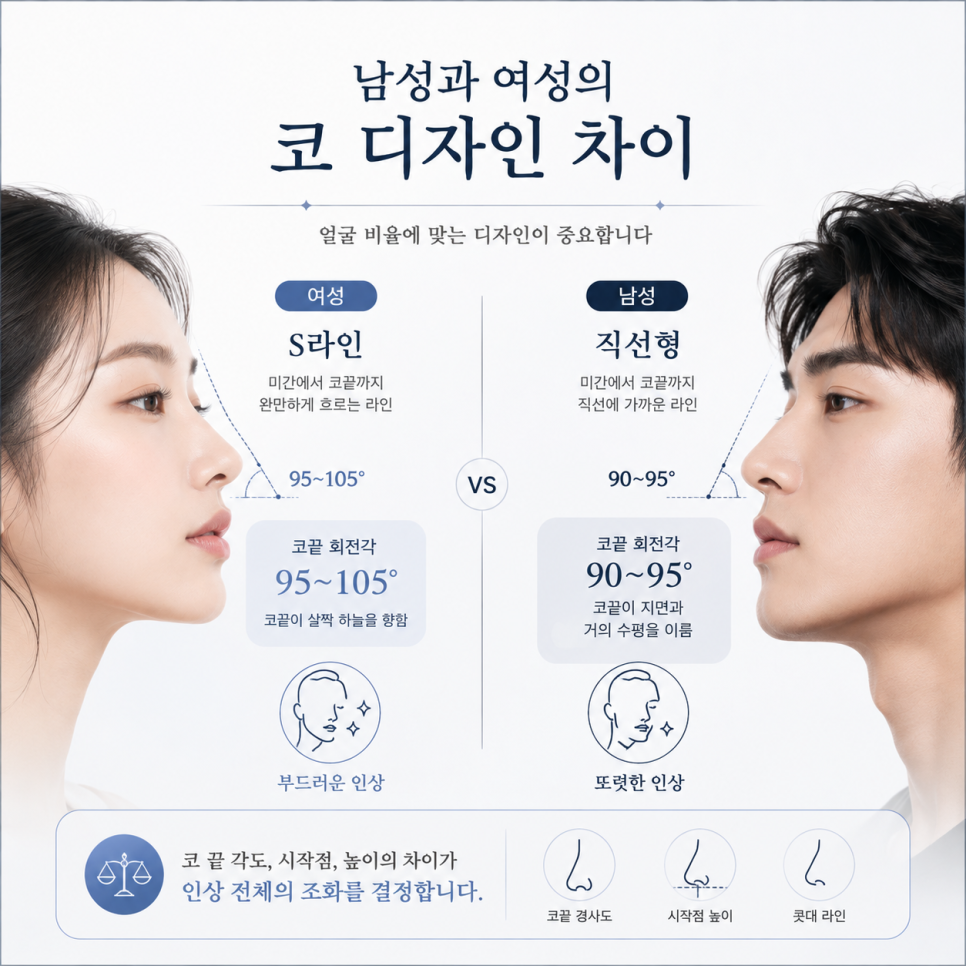
For men, a nasal tip rotation angle of 90–95 degrees,
meaning that the tip is nearly parallel to the ground
or lifted only very slightly, looks natural.
The more the tip is lifted, the more the nostrils are exposed from the front,
creating a youthful rather than masculine impression.
When directly examining the facial proportions of male patients
during consultations, we often find that when the tip is close to horizontal,
the jawline and forehead line connect as if they were one line,
making the overall impression look more refined.
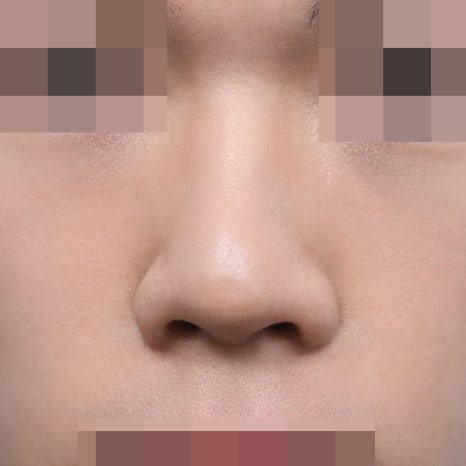
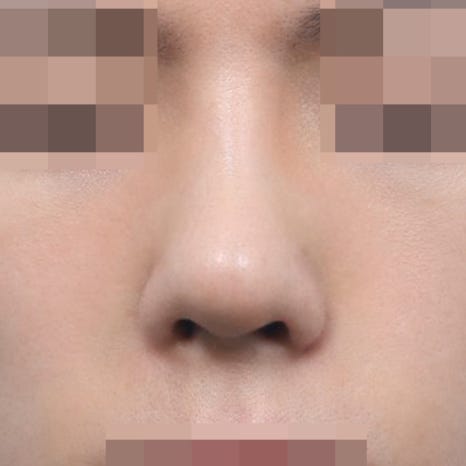
The height and starting point of the nasal bridge must also be designed differently.
Women tend to prefer a soft S-shaped line
that flows gently from the glabella to the tip of the nose.
For men, this line should be closer to straight,
and positioning the starting point of the bridge slightly above the upper line of the pupils
provides a more stable appearance.
If the starting point is too low, the nose may look short,
while if it is too high, the nose can visually weigh down the face
and create a stuffy impression.

At Glovi, when a patient asks us to proceed with a female design
without considering these standards,
we honestly advise against it.
This is because there is a high possibility that the result
will not suit the face, which would not benefit the patient either.
“Isn’t it okay for a man’s nose to be somewhat wide?”
Male Rhinoplasty
This is partly true,
but it is also something that requires caution.
Men’s noses are often wider than women’s,
and the skin is frequently thicker.
This in itself is not a problem that must be corrected.
However, the thicker the skin is, the less clearly
the shape of the transplanted cartilage shows through,
and even if volume is added to the tip,
there are limitations to how clearly it can be defined.
When we directly check the skin thickness at the tip of the nose
during a consultation, the expected result can vary right there
depending on its thickness.
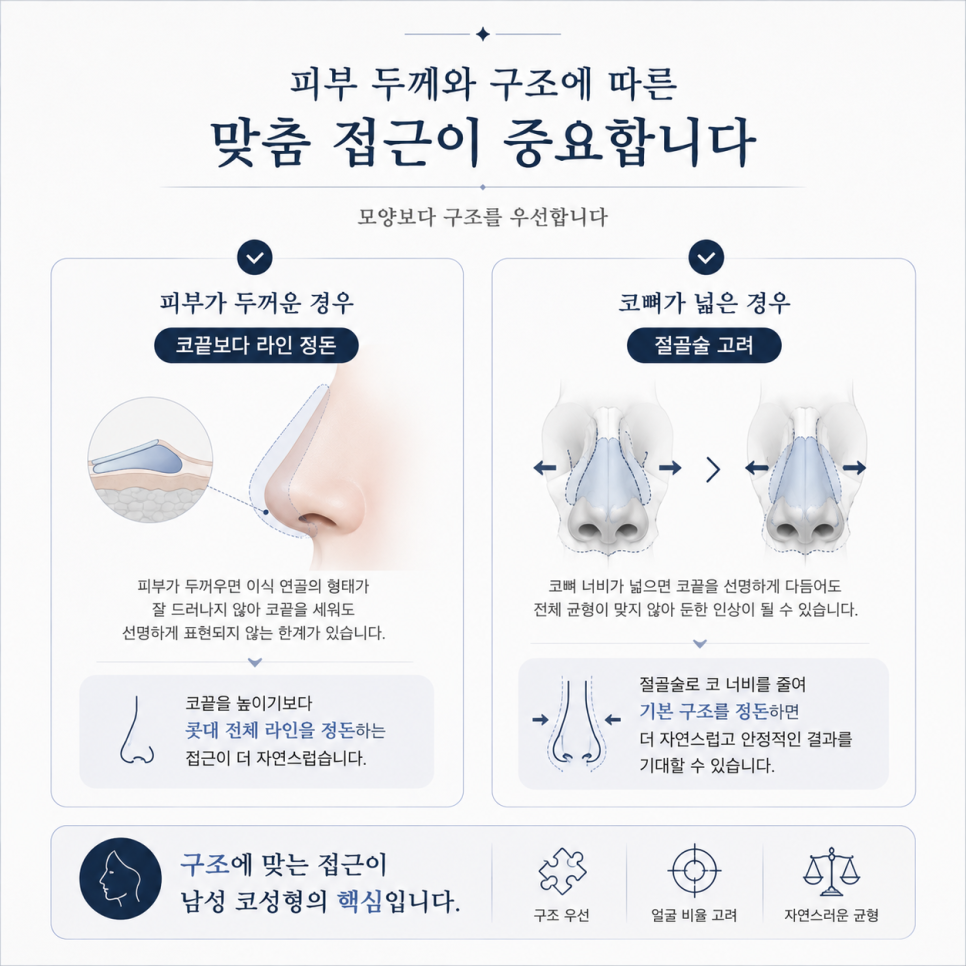
If we try to make the tip sharply defined by force
in someone with very thick skin,
the tip may instead look even bulkier,
while persistent pressure may develop on the skin above the cartilage.
In such cases, rather than focusing on the shape of the tip,
refining the overall bridge line or reducing the width of the nose
through an osteotomy often leads to a much more natural result.
I remember one patient who came in wanting
to raise the bridge and define the tip more clearly.
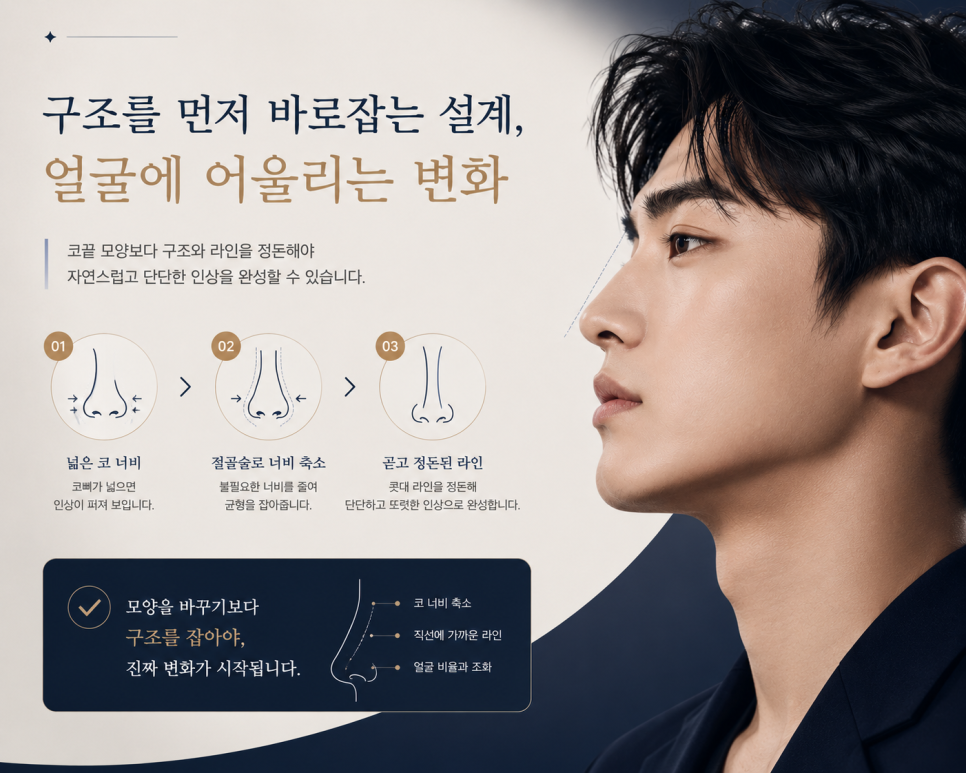
Upon examining the skin at the tip, we found that it was quite thick,
and the nasal bones were also wide.
If the tip cartilage were raised significantly,
the skin would be unlikely to reflect its shape,
making the tip likely to look large and blunt.
Therefore, we suggested first reducing the width of the nose
through an osteotomy and refining the bridge line.
After surgery, the patient said that the overall impression looked much stronger
and more refined.
This is an example of how establishing the structure,
rather than simply changing the shape,
can be an effective approach in male rhinoplasty.
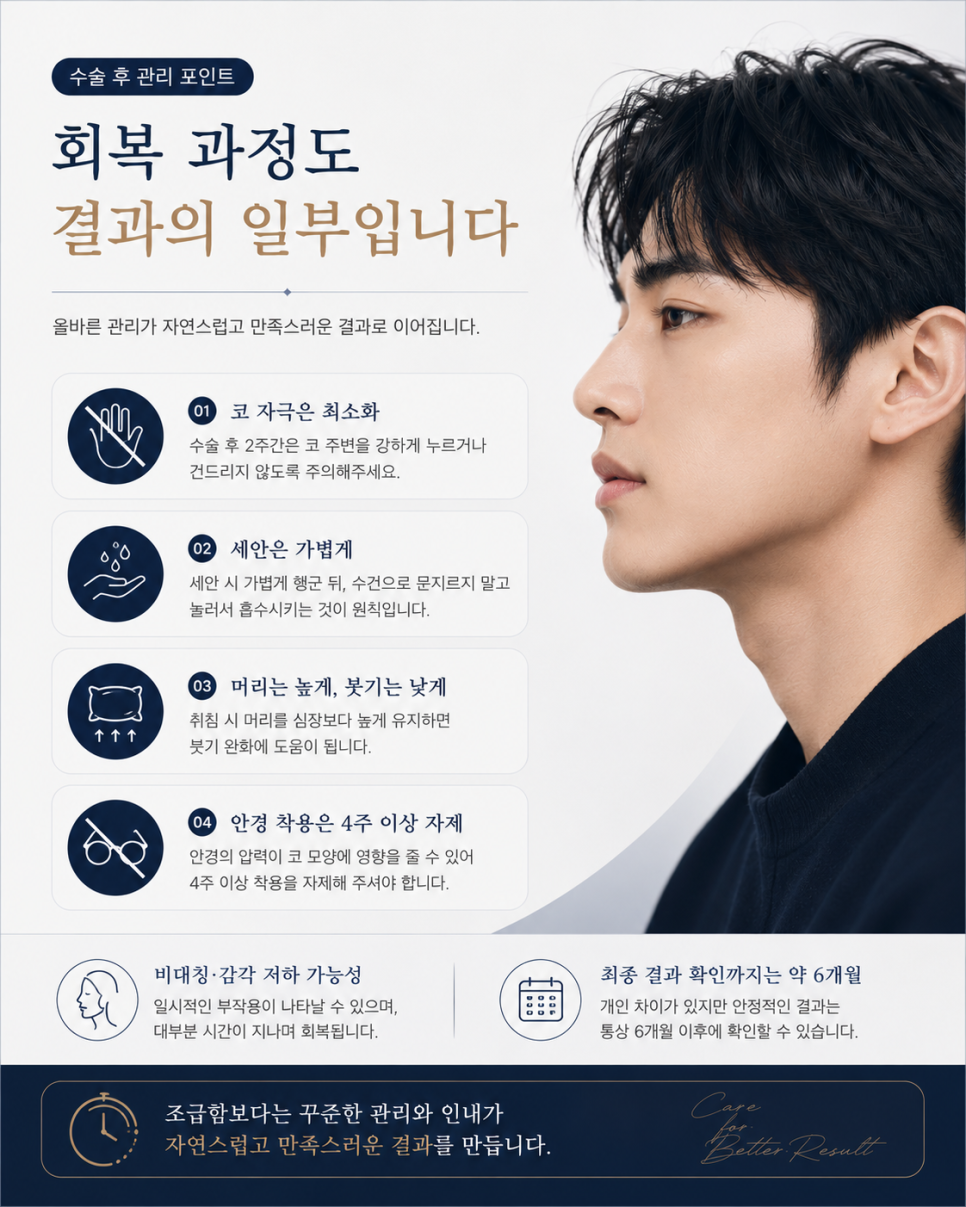
It can be reassuring to know in advance
about the things that may cause concern after surgery.
Because men tend to have thicker skin,
swelling may persist for a longer period.
For the first two weeks immediately after surgery,
avoid strongly pressing or touching the area around the nose.
When washing your face, gently rinse it,
then pat it dry with a towel rather than rubbing it.
Keeping your head higher than your heart while sleeping
can help make a difference in reducing swelling.
You should refrain from wearing glasses for at least four weeks,
and we also explain during the consultation in advance
that there is a possibility of side effects such as asymmetry and reduced sensation,
and that it generally takes six months to confirm the final result.
In male rhinoplasty, the result is determined less by
“how high the nose is raised” than by
“the direction in which it is designed.”
The angle of the nasal tip, the starting point of the bridge,
and the approach based on skin thickness.
These three factors are the key variables in creating
a male nose that looks naturally different.
Only by applying these standards directly to your face
can you determine the right direction for you.
At Glovi, it is our policy to transparently share in advance
possible side effects and the expected recovery process.
Please first confirm through a consultation
what the precise plan suited to your facial proportions would be.
| Glovi Plastic Surgery Clinic |
|---|
| Thank you for reading this long post. When making a reservation or consultation, just mention, “I’m contacting you after seeing your blog.” We will be happy to assist you with even greater care and attention to detail! |
< Related Articles You May Enjoy >
Glovi Plastic Surgery Clinic
is located a one-minute walk from Exit 4 of Apgujeong Station on Subway Line 3,
at Floors 5 and 6 of the EGI Building,
843 Nonhyeon-ro, Gangnam-gu, Seoul.
Consultation reservations are available on both weekdays and weekends.
All consultations are conducted privately on a one-on-one basis.
For detailed inquiries and reservations, please leave a message through the channel below.



Male Rhinoplasty