Fat Transfer Breast Augmentation
Precision Grafting to Reduce Calcification Complications
Hello,
This is Globie Plastic Surgery Clinic.

Fat Transfer Breast Augmentation
| A Clinic That Upholds the Principles of Plastic Surgery: Globie Plastic Surgery Clinic |
|---|
| Upholding the basics is the most important principle in plastic surgery. Procedures should be designed with the client’s lifetime well-being in mind. Both the process and the results must be safe. Globie always puts its clients first. |
| Consultation is an important step that leads to surgery. To help you feel satisfied with your surgical results, we promise personalized consultations with medical professionals who have extensive clinical experience. |
| Postoperative care can also be considered an extension of the surgery. We provide personalized care programs to help our patients recover quickly. |
When looking into fat transfer breast augmentation,
many people stop at the word “calcification.”
What happens if calcification develops?
Could it become cancer?
Whenever I hear these questions in the consultation room,
my first response is to reassure the patient.
There is a reason many people fear this possible occurrence
after autologous fat transfer more than necessary.
A considerable amount of information circulating online
is based on facial fat transfer, so applying it directly to the breasts
can make the situation seem much more frightening than it actually is.
At Globie, we will explain honestly why this occurs
and how it may differ depending on the grafting method.
Why Does Calcification Occur, and How Serious Is It Really?
Fat Transfer Breast Augmentation
I read a review saying that calcification developed
after fat transfer breast augmentation.
Does it absolutely have to be removed?
The faces of people asking this question
share the same expression of fear.
That anxiety is entirely understandable.
Because most of the information about calcification found online
is based on facial fat transfer,
applying it directly to the breasts can inevitably make it seem
much more frightening than it really is.

However, the two procedures differ considerably
in both where it occurs and how it is treated.
Calcification is a phenomenon in which some of the transplanted cells do not receive an adequate blood supply, become necrotic, and cause the surrounding tissue to harden.
In the face, it may be immediately visible through the skin’s surface,
so it generally needs to be removed for cosmetic reasons.
In the breasts, however, depending on its location and size,
it is often possible to monitor its progress without special treatment.
The most important fact to state first is that
calcification and cysts caused by fat transfer
are completely unrelated to cancer.
However, they may resemble breast cancer during a breast ultrasound examination,
so you should always inform the medical staff of your surgical history
before undergoing regular screenings.
In practice, why calcification develops
is more important than its occurrence itself.
When too much fat is injected into one area,
blood vessels cannot reach the center of the mass,
so necrosis begins in the inner cells.
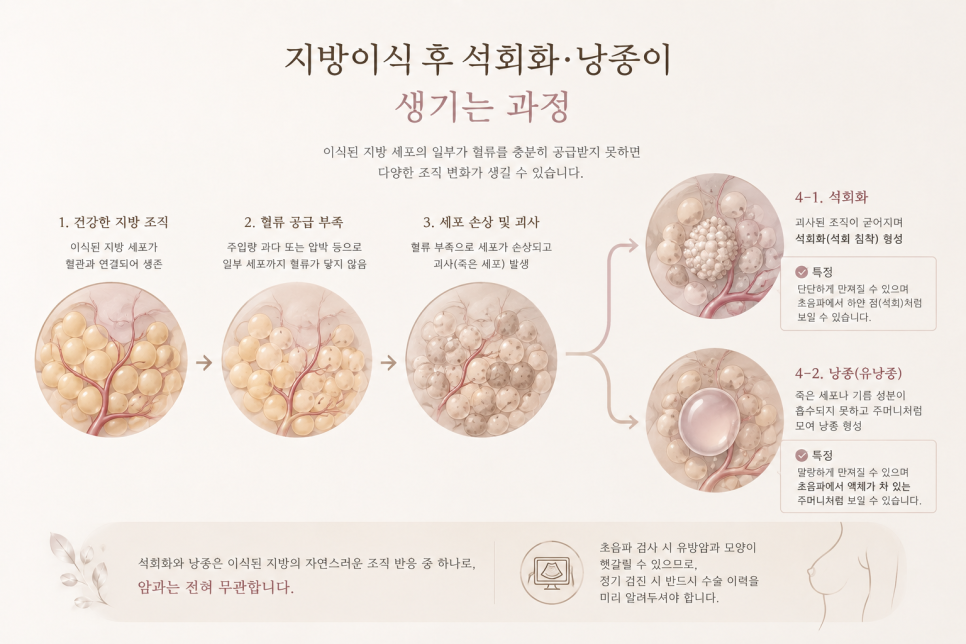
The hardening of this necrotic tissue is calcification,
while a cyst occurs when dead cells or fatty substances are not absorbed
and collect in a pouch-like formation.
If it can be felt near the surface, it can be removed with a needle under ultrasound guidance
or treated through an existing incision,
so there is no need to be excessively afraid of its occurrence.
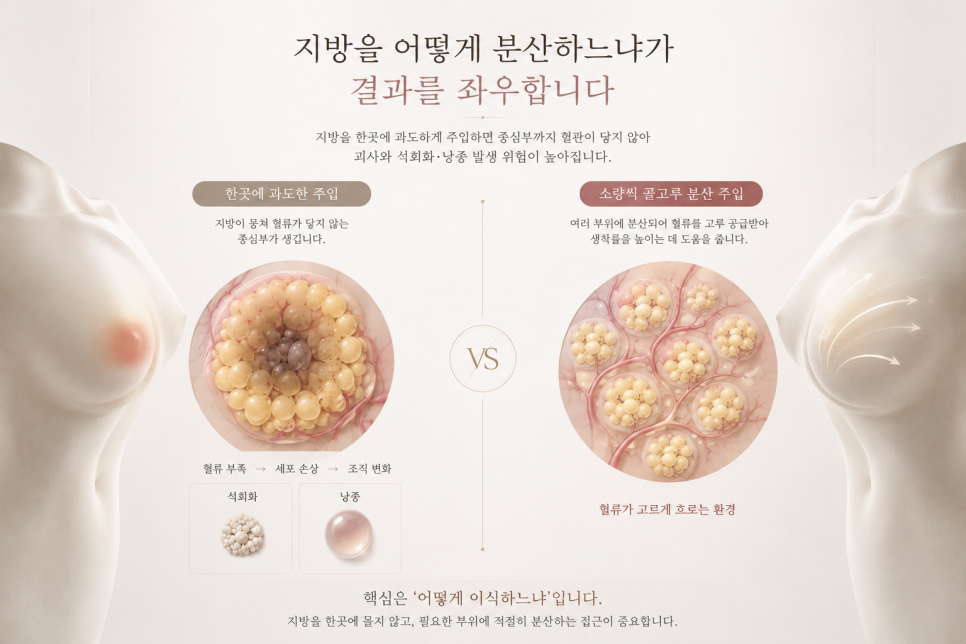
Ultimately, how the fat is grafted
largely determines whether these two conditions develop.
Precision Grafting to Reduce Complications:
How Is It Actually Different?
Fat Transfer Breast Augmentation
Does the grafting method affect calcification?
Which method is safer?
These questions are truly the most important.
Injecting a large amount of fat at once can increase volume,
but blood vessels cannot reach the inside of the mass,
raising the risk of necrosis.
To prevent this, Globie applies a three-layer survival technique,
distributing small amounts evenly across multiple layers,
including beneath the muscle, beneath the mammary glands, and beneath the skin.
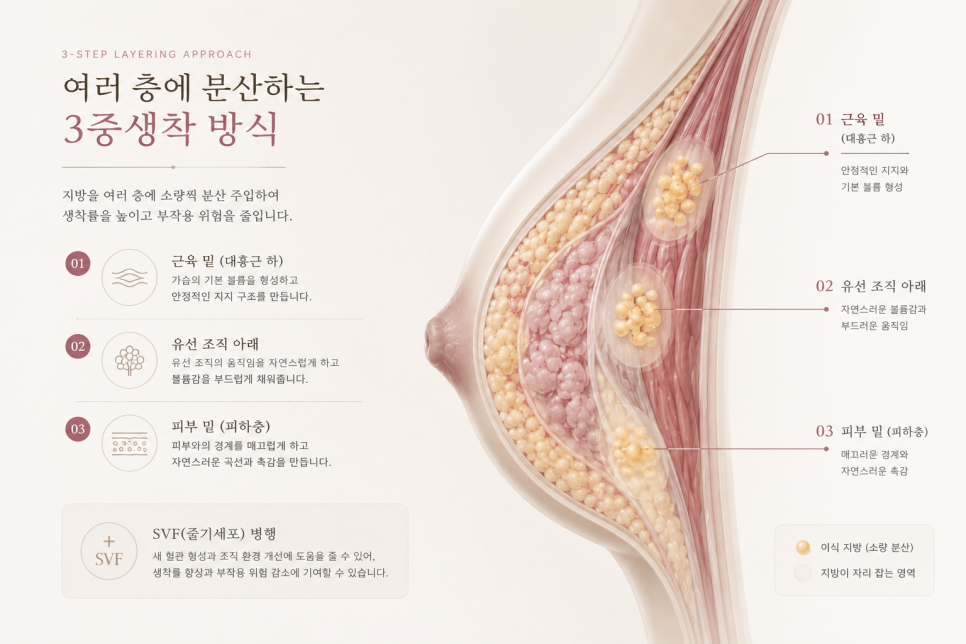
Combining SVF (stem cells) may help create an environment conducive to new blood vessel formation,
making these two approaches a fundamental way to reduce the risk of complications.
Your daily routine during the two to three months it takes for the cells to settle into their new location
determines the final result.
Strict smoking cessation is the first item we emphasize in practice.
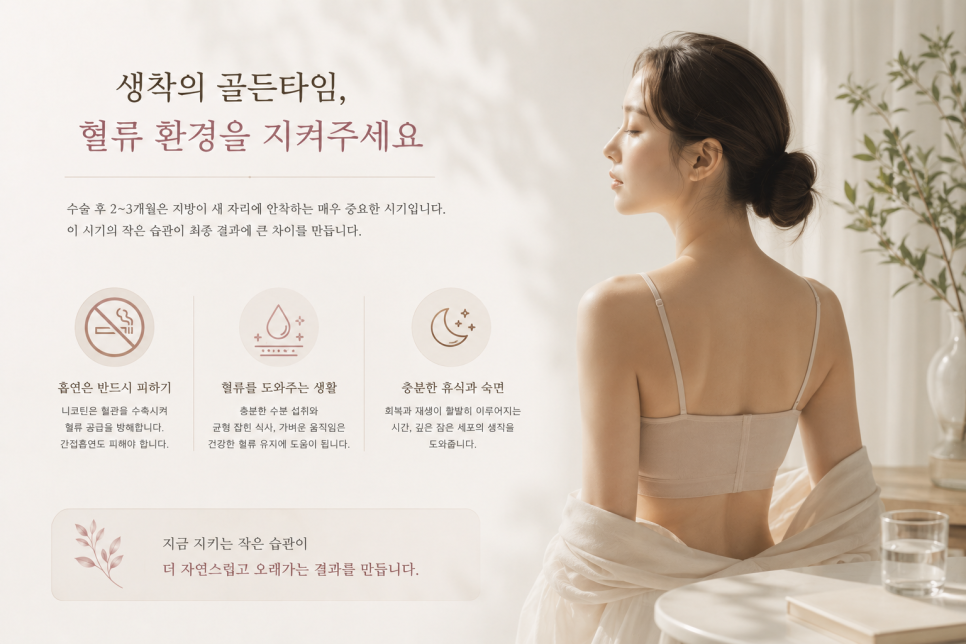
Nicotine constricts peripheral blood vessels
for more than 30 minutes each time you smoke a cigarette.
If blood flow is repeatedly interrupted during this period,
even cells that might have survived may not endure.
Secondhand smoke is no exception,
so it should be completely avoided for at least one month before and after surgery.
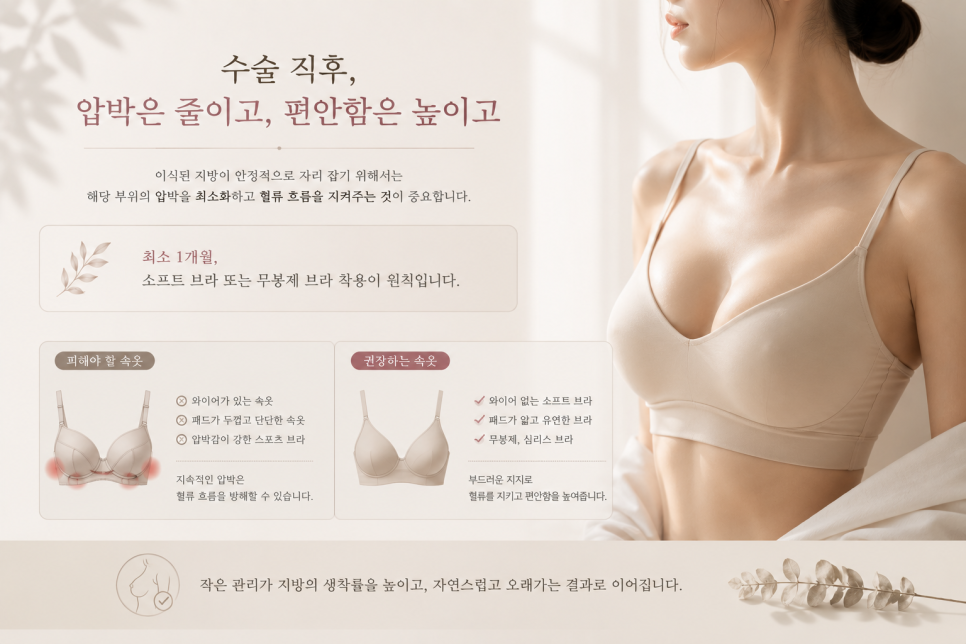
Choosing the right underwear is also easy to overlook.
When the treated area is examined by touch immediately after grafting,
the tissue is generally not yet fully settled.
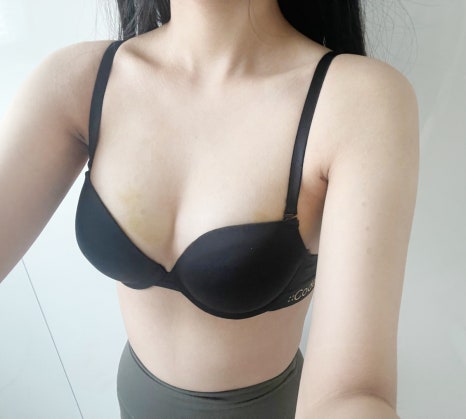
Wearing underwear with underwires or firm padding at this time
can continuously compress the area and obstruct blood flow.
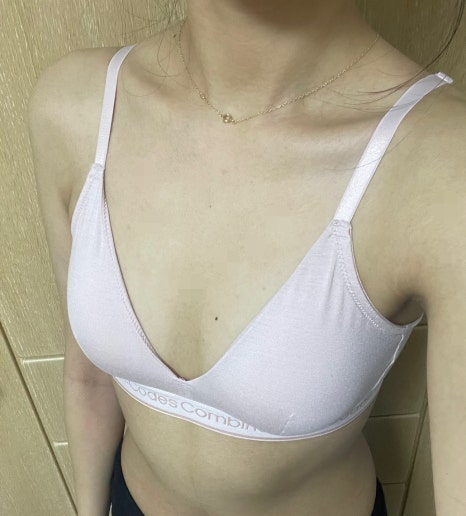
As a general rule, soft bras or seamless bras
should be worn for at least one month.
To speak honestly, for people with very little fat
or an unfavorable condition of the mammary glands,
it can be difficult to achieve the desired volume
even when the procedure is performed with precision.
When these conditions are identified, we explain them candidly
and work together to find an approach better suited to the individual’s body type
rather than recommending an excessive procedure.
Calcification after fat transfer breast augmentation
is determined by both the surgical method and postoperative care.
It is Globie’s principle to provide transparent information
about complications and limitations based on each individual’s circumstances.
If you are hesitating because you are concerned about calcification,
accurately assessing which grafting method suits your tissue condition
is the fastest way to reduce trial and error.
Please feel free to contact us for a consultation at any time.
※ Fat transfer breast augmentation may result in differences in fat survival rates and outcomes depending on an individual’s constitution, amount of fat, lifestyle habits, and surgical method. Complications such as inflammation, calcification, and cysts may occur.
| Globie Plastic Surgery Clinic |
|---|
| Thank you for reading this long post. When making a reservation or consultation request, just mention, “I’m contacting you after seeing your blog.” We will be delighted to assist you with even greater care and attention! |
< Related Articles You May Also Enjoy >
Globie Plastic Surgery Clinic
is located a one-minute walk from Exit 4 of Apgujeong Station on Subway Line 3,
on the 5th and 6th floors of the EGI Building,
843 Nonhyeon-ro, Gangnam-gu, Seoul.
Consultation reservations are available on both weekdays and weekends.
All consultations are conducted privately on a one-on-one basis.
For detailed inquiries and reservations, please leave a message through the channel below.



Fat Transfer Breast Augmentation