If Your Nose Has Become Hard After
Contracted Nose Surgery,
What Changes Should You Check First?
Hello,
This is 글로비성형외과의원.

Contracted Nose Surgery
| A Clinic That Follows the Principles of Plastic Surgery, 글로비성형외과의원 |
|---|
| The most important thing in plastic surgery is to follow the fundamentals. Procedures should be designed with the patient's entire life in mind. Both the process and the results must be safe. At 글로비성형외과의원, patients always come first. |
| Consultation is an important step that leads to surgery. To help you feel satisfied with your surgical results, we promise personalized consultations with medical professionals who have extensive clinical experience. |
| Postoperative care can also be considered an extension of the surgery. We provide customized care programs to help our patients recover quickly. |
Some people feel that their nose is gradually becoming harder
after rhinoplasty.
At first, they may wait, thinking that the swelling has not
fully subsided yet. As time passes, however, they may feel that
the nose is becoming increasingly firm and that the nostrils
seem to be gradually turning upward.
However, many people let time pass because they cannot
distinguish whether these changes are part of normal recovery
or a sign that contraction is progressing.
This article is
for those experiencing these changes.
To determine for yourself whether you are in a condition that
requires contracted nose surgery, you need to know which signs
to check first.
We will now go over changes that are easy to overlook but become
easier to correct when identified early.
“My nose feels somewhat hard, but is this contraction?”
Contracted Nose Surgery
This is a question we hear very often in the consultation room.
Most people who ask this question come in wondering,
“What if I am just being overly sensitive?”
We understand that anxiety.
After rhinoplasty, it is a natural part of the healing process
for the tip of the nose to feel firm for a certain period as scar
tissue forms.
If this firmness gradually softens over time,
there is generally no need to worry.
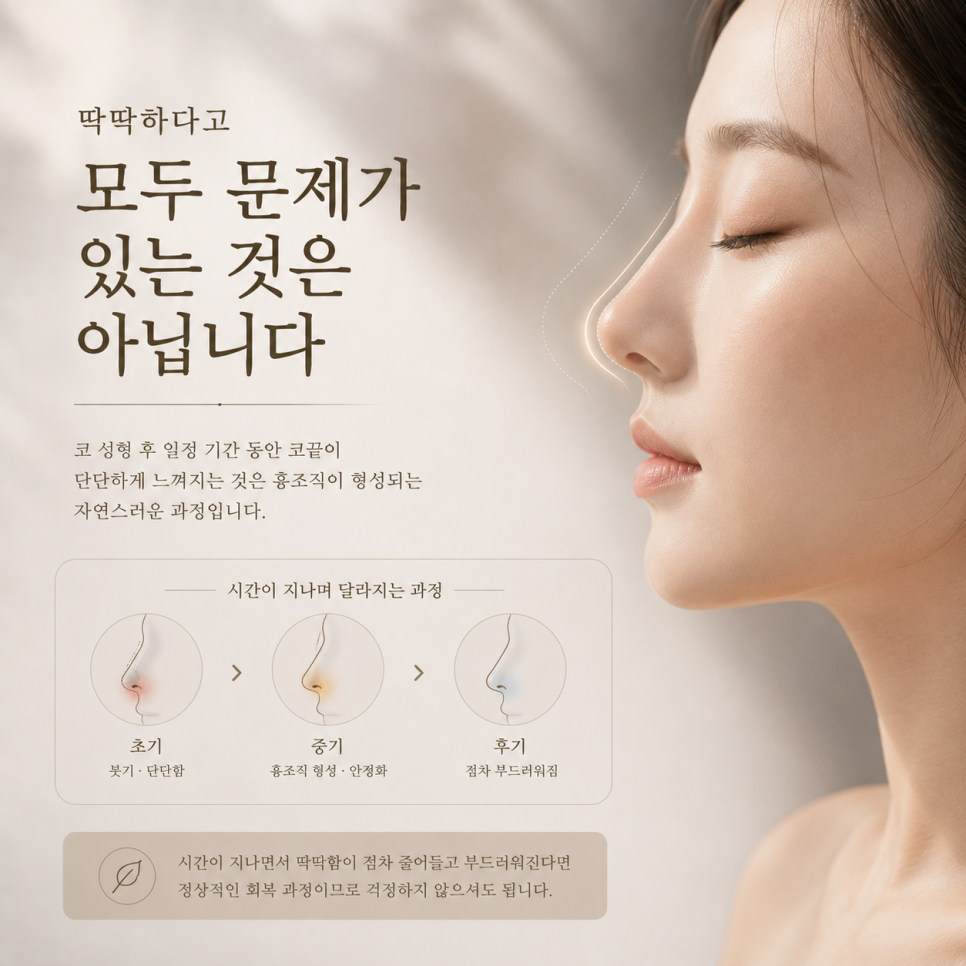
The problem is when the firmness does not decrease
and instead becomes more severe.
When the skin at the tip of the nose is examined by touch in the
consultation room, the texture of firmness during normal recovery
is different from the firmness associated with progressing
contraction.
Normal firmness still allows some give when pressed,
but when contraction is progressing, you may feel taut resistance
that pushes back as soon as you press, along with a sensation that
something beneath the skin is pulling.
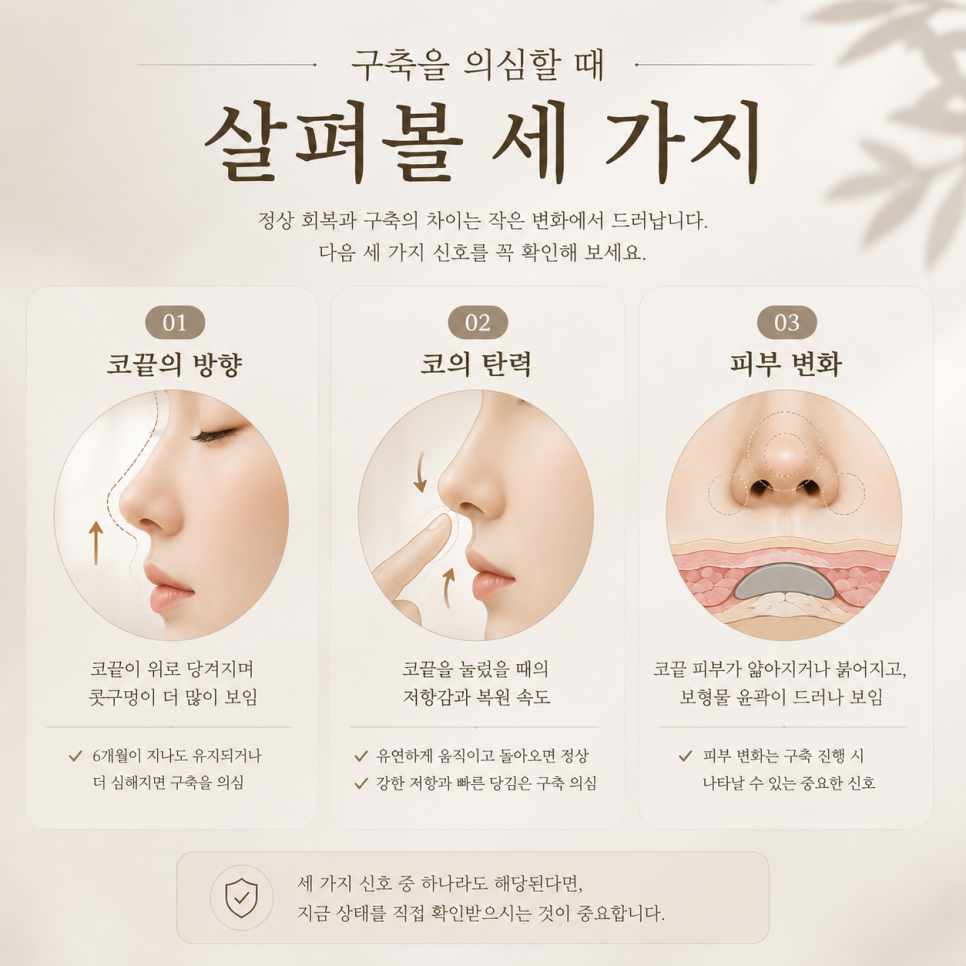
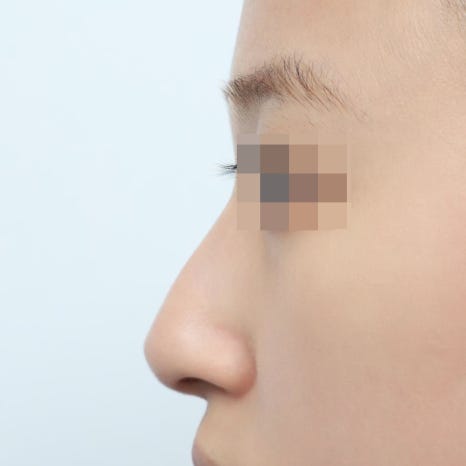
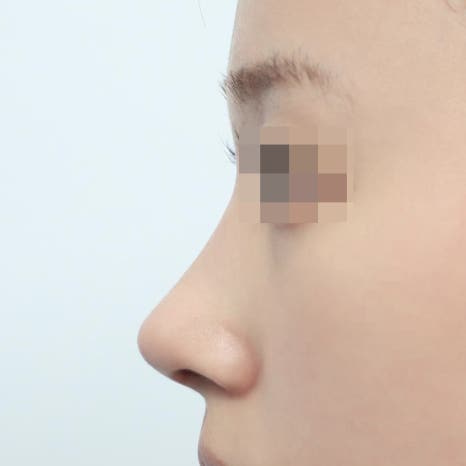
The first sign to check is the direction of the nasal tip.
As the tip of the nose is gradually pulled upward after surgery,
the nostrils become more visible from the front.
If this direction remains unchanged or becomes more pronounced
even after six months, it is time to consider the possibility of
contraction.
Conversely, if the tip of the nose is naturally moving downward,
that is a sign that normal recovery is progressing.
The second sign is the elasticity of the nose.
Gently press the tip of the nose downward and then release it,
and check the resistance and how quickly it returns to position.
If it moves flexibly and returns naturally,
there is no need to worry about its current condition.
When contraction is progressing, the resistance is strong,
and you may feel it being pulled back quickly as soon as you release it.
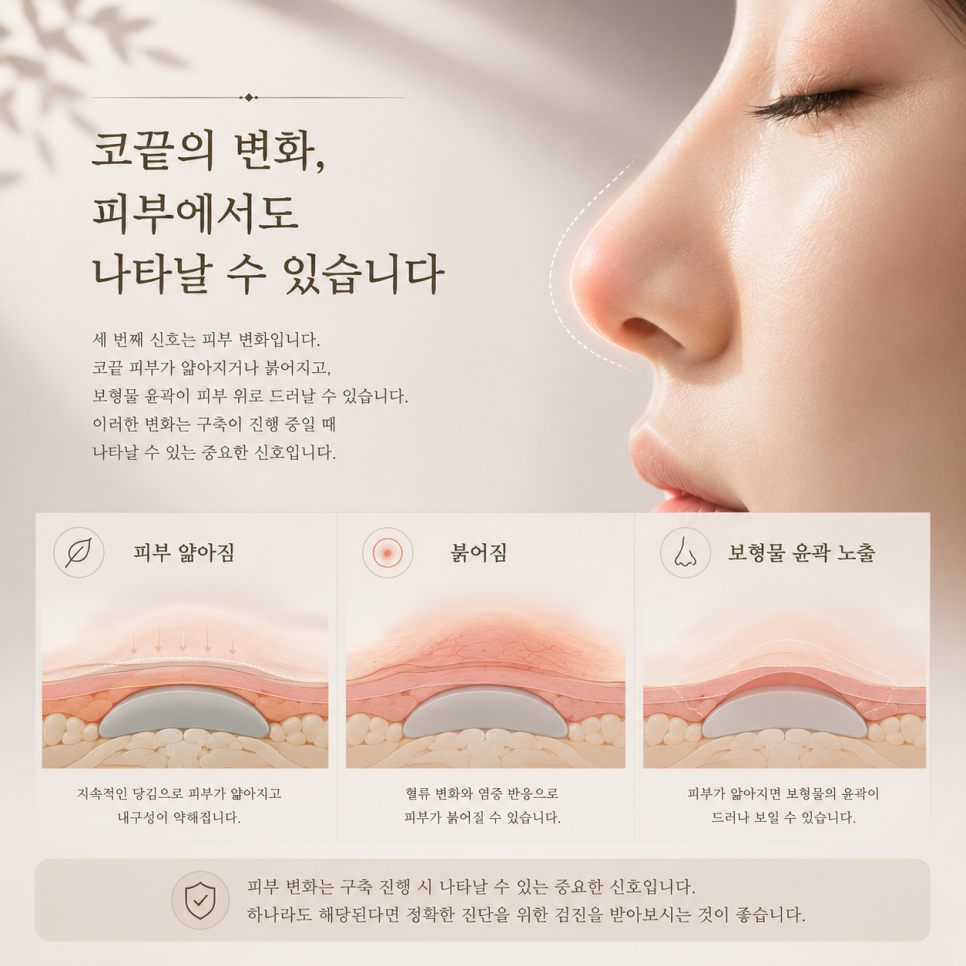
The third sign is a change in the skin.
The skin at the tip of the nose may become thinner or redder,
and the outline of the implant may become visible beneath the skin.
These changes can also occur when contraction is progressing.
If you are currently experiencing even one of these three signs,
it is important to have your current condition examined in person.
“If it is contraction, do I need to have surgery right away?”
Contracted Nose Surgery
Whenever we receive this question,
there is something we explain first.
There is a proper timing for correcting the condition of the nose.
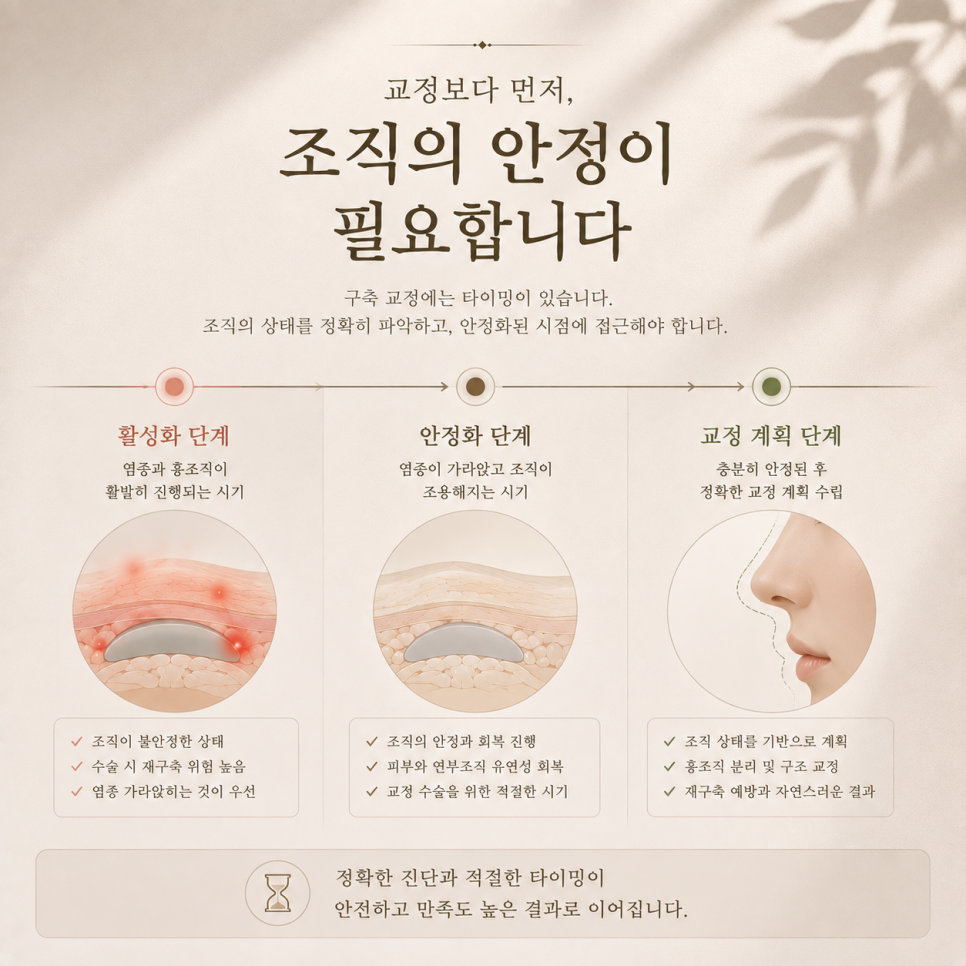
During the active stage, when contraction is progressing,
calming the inflammation takes priority over surgery.
Making an incision during this period means operating on tissue
that has not yet stabilized, which increases the possibility of
recurrent contraction afterward.
At 글로비성형외과의원, even when we fully understand the desire
to resolve the problem immediately, we do not recommend surgery
if the tissue is still in the active stage.
This is a decision made to prevent premature correction from
leading to recurrent contraction.
A typical revision surgery involves replacing the implant
or adding cartilage.
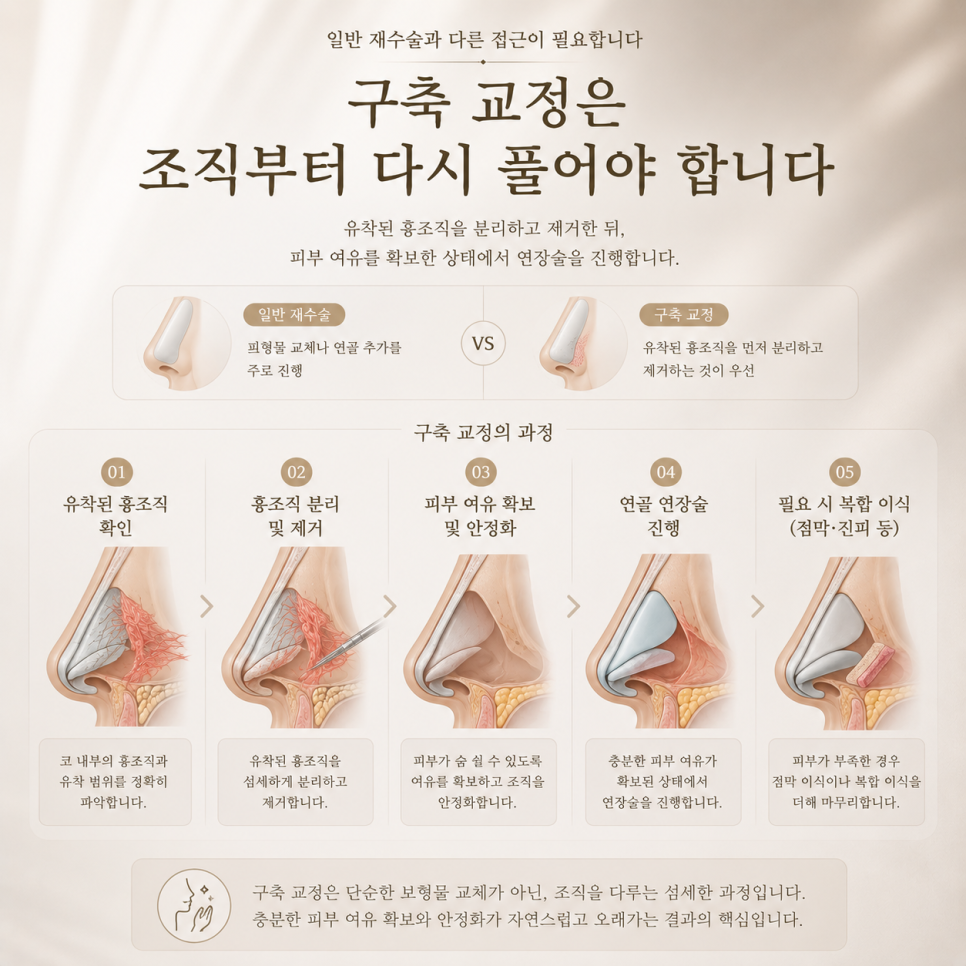
In contrast, correction of contraction requires first separating
and removing the adhered scar tissue, then performing an extension
procedure after securing sufficient skin laxity.
Because the skin has contracted, there may not be enough skin to
cover the nose even after cartilage is placed. In such cases,
mucosal grafting or composite grafting may also be added.
One case remains particularly memorable.
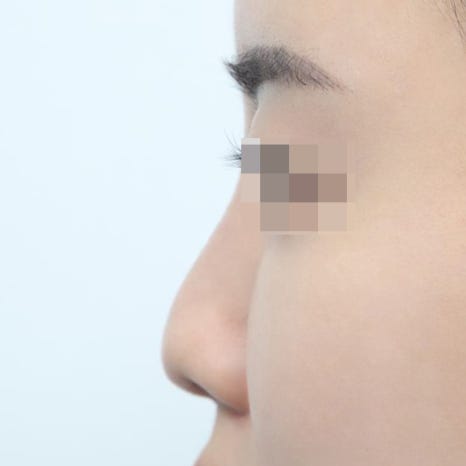
A patient visited us one year after their first rhinoplasty,
saying that the tip of the nose was gradually turning upward
and that the nostrils were becoming visible.
When we pressed the skin at the tip of the nose during the
consultation, it had almost no elasticity. When pushed downward,
the resistance from the rapid pulling-back sensation was
quite strong.
The patient wanted to proceed immediately, but we honestly
explained that because the tissue was still active, making an
incision at that point would make it difficult to achieve the
desired result.
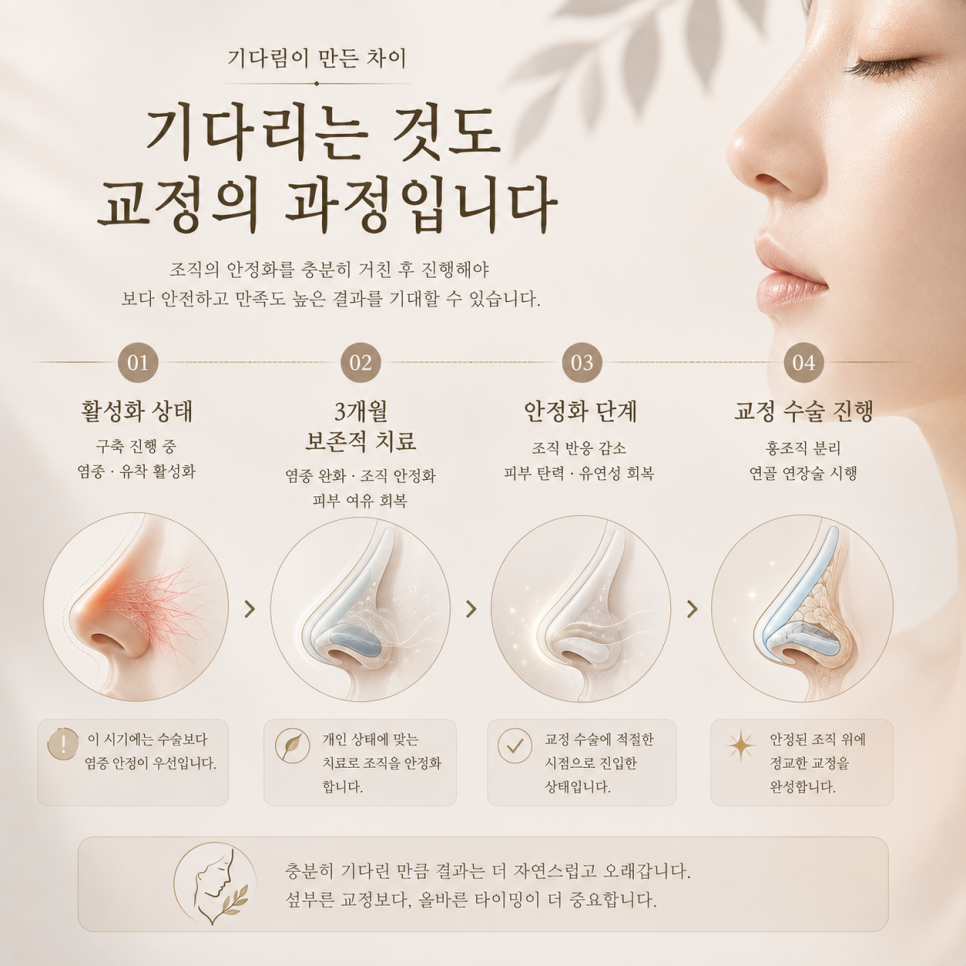
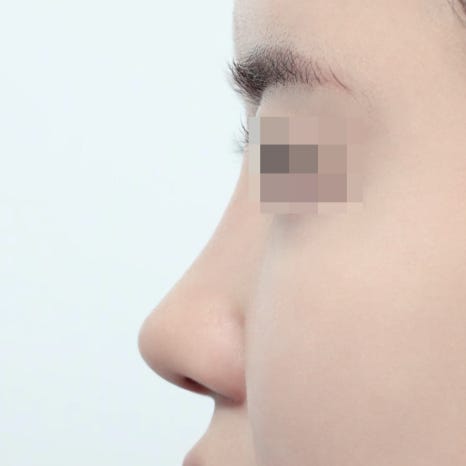
After conservative treatment for three months, surgery was
performed once the condition had stabilized. Scar tissue separation
and cartilage extension were carried out together.
Although waiting at the time was difficult, proceeding after the
stabilization period made the process much easier, and the result
was also clearly different.
Postoperative care also needs to be more meticulous than after
standard rhinoplasty.
The primary goal is to prevent recurrent contraction.
Scar ointment should be applied consistently from the early stage,
and you should avoid strongly pressing or touching the area around
the nose for two weeks after surgery.
When washing your face, rinse gently and absorb moisture by
patting rather than rubbing.
It is advisable to refrain from alcohol and smoking because they
can stimulate inflammatory responses and increase the risk of
recurrent contraction.
The side effects we most often explain in practice are asymmetry,
decreased sensation, and recurrent contraction. Final results can
usually be assessed after six months.
It is natural to find it difficult to determine for yourself
whether the changes you are feeling indicate contraction.
What matters is distinguishing between a situation where it is
fine to wait and one that needs to be checked now.
The earlier contraction is identified, the more options are available;
once it has progressed significantly, correction becomes more complex.
At 글로비성형외과의원, our principle is to transparently share
when contracted nose surgery is needed and what condition warrants it.
Please first check exactly what changes are occurring in your nose,
including the timing and direction of those changes.
※ All plastic surgery procedures and treatments may involve side
effects such as inflammation, bleeding, nerve damage, asymmetry,
and scarring depending on the individual, so careful attention is required.
| 글로비성형외과의원 |
|---|
| Thank you for reading this lengthy post. When making a reservation or requesting a consultation, please simply mention, “I’m contacting you because I saw your blog.” We will be delighted to assist you with even greater care and attention to detail! |
< Other Articles You May Find Helpful >
글로비성형외과의원
is located one minute on foot from Exit 4 of Apgujeong Station
on Subway Line 3, at 5th and 6th Floors, EGI Building,
843 Nonhyeon-ro, Gangnam-gu, Seoul.
Consultation reservations are available on both weekdays and weekends.
All consultations are conducted privately on a one-to-one basis.
For detailed inquiries and reservations, please leave a message
through the channel below.

Contracted Nose Surgery