Reviews of Fat Transfer Breast Augmentation,
It’s Not the Amount of Fat That Determines the Outcome
Hello,
This is Glovi Plastic Surgery Clinic.
Reviews of Fat Transfer Breast Augmentation
| A Clinic That Upholds the Principles of Plastic Surgery, Glovi Plastic Surgery Clinic |
|---|
| Upholding the fundamentals is the most important part of plastic surgery. Procedures should be designed with the patient’s entire lifetime in mind. Both the process and the outcome must be safe. At Glovi, our patients always come first. |
| Consultation is an important step that leads to surgery. To help you be satisfied with your surgical results, we promise personalized consultations with experienced medical professionals. |
| Postoperative care can also be considered an extension of surgery. We provide personalized care programs to help our patients recover quickly. |
Among those who inquire about fat transfer breast augmentation in the consultation room,
many tend to focus first on “how much fat will be injected.”
Of course, the amount transferred is also important,
but the key factor that actually determines the outcome lies elsewhere.
How much of the fat survives—
in other words, the fat survival rate—is what truly determines success or failure.
Looking at fat transfer breast augmentation reviews online,
many focus only on volume measurements.
In this article, we will explain plainly the mechanisms that improve the fat survival rate,
as well as pre- and postoperative care methods that affect the actual outcome.
Why Can the Fat Survival Rate Vary So Much?
Reviews of Fat Transfer Breast Augmentation
Does all of the transferred fat survive?
It has been a month, but it seems to have decreased compared with the beginning.
Quite a few people return for another visit with these concerns.
Their anxiety is entirely understandable,
because in fat transfer breast surgery, the process of helping the fat endure
is far more important than the moment when the fat is injected.
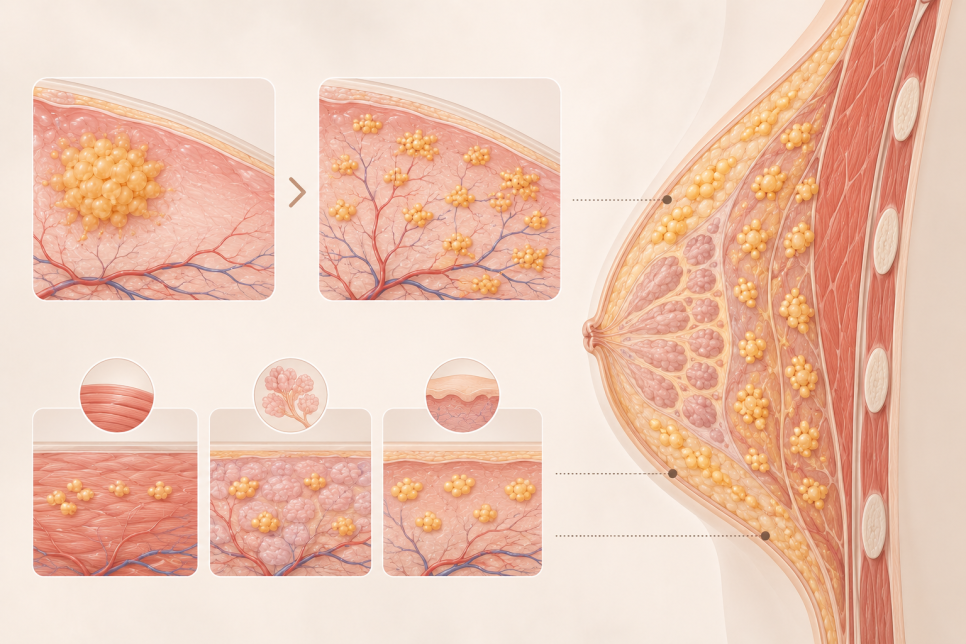
Transferred fat cells must receive nutrients from the surrounding blood vessels
in order to survive in their new location.
According to published studies, fat survival rates vary widely between individuals,
ranging from 15% to 75%.
Clinically, approximately 50% of the transferred volume
is generally considered a standard reference, but the reason this figure
varies significantly from patient to patient is not simply a matter of individual constitution.
Surgical technique and postoperative care are also factors
that determine the outcome.
To improve the fat survival rate, Glovi applies a three-layer fat survival technique.
When fat is concentrated in one place, the cells in the center
may undergo necrosis because blood vessels cannot reach them.
It is similar to planting seeds in a garden bed: if they are all placed in one hole,
not even half may survive.
Small amounts must be distributed across multiple layers,
such as beneath the muscle, beneath the mammary tissue, and beneath the skin,
so that newly formed blood vessels can deliver nutrients evenly to each cell.
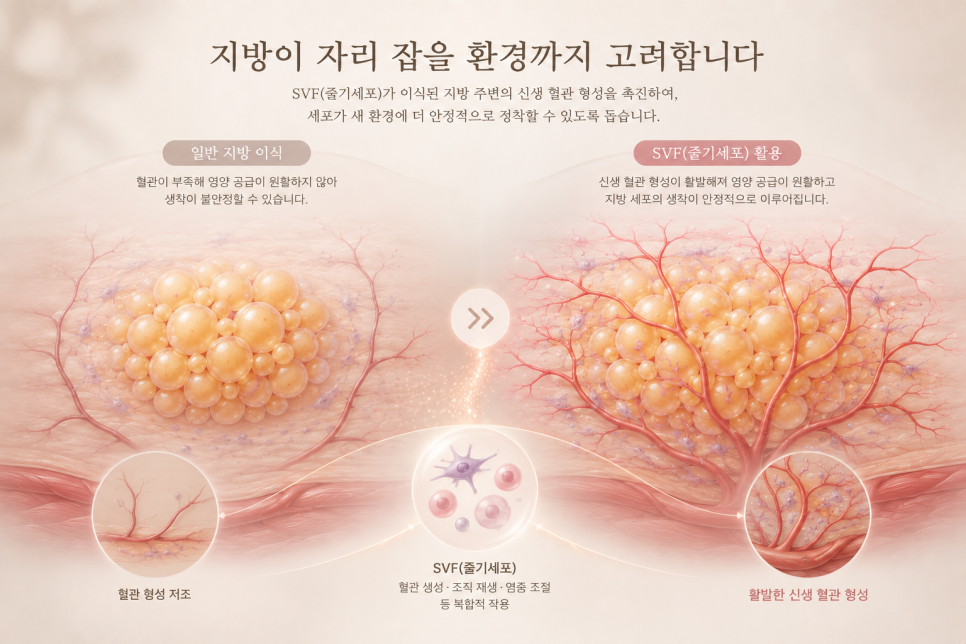
In addition, we actively use SVF (stem cells).
SVF (stem cells) promotes the formation of new blood vessels
around the transferred cells, improving the fat survival environment itself
so that the cells can settle more stably in their new surroundings.
We have repeatedly observed in practice
that this can provide more stable retention than fat transfer alone.
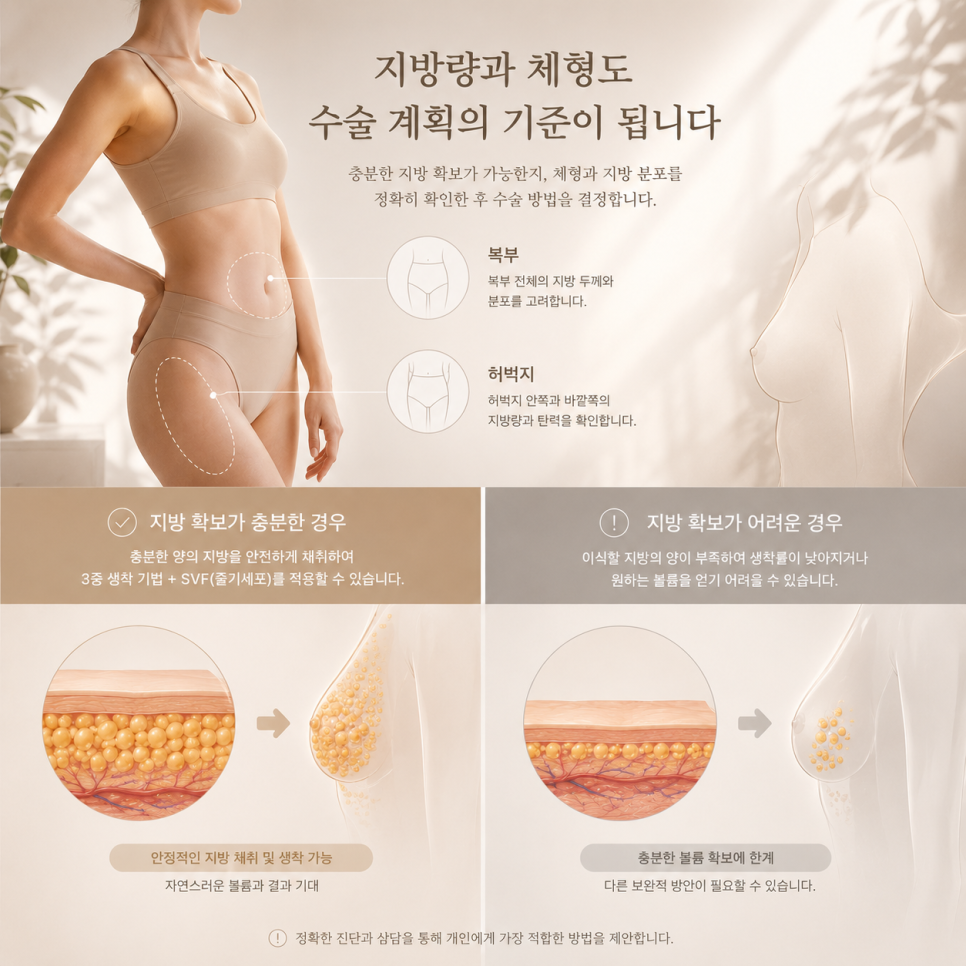
However, we would like to point out in advance that this method
may not be suitable for people with very little body fat
who have difficulty obtaining a sufficient amount from the thighs or abdomen.
Postoperative Care,
Protecting the Outcome Is Also a Matter of Skill
Reviews of Fat Transfer Breast Augmentation
Isn’t it over once the surgery is done well?
Why do I need to be so careful about things at home?
Whenever we hear these questions, there is one answer we always give.
If the surgeon’s technique is the act of planting the seed,
postoperative care is the process that allows the seed to put down roots.
It takes approximately two to three months for the transferred fat
to settle completely, and how this period is spent
determines half of the final outcome.
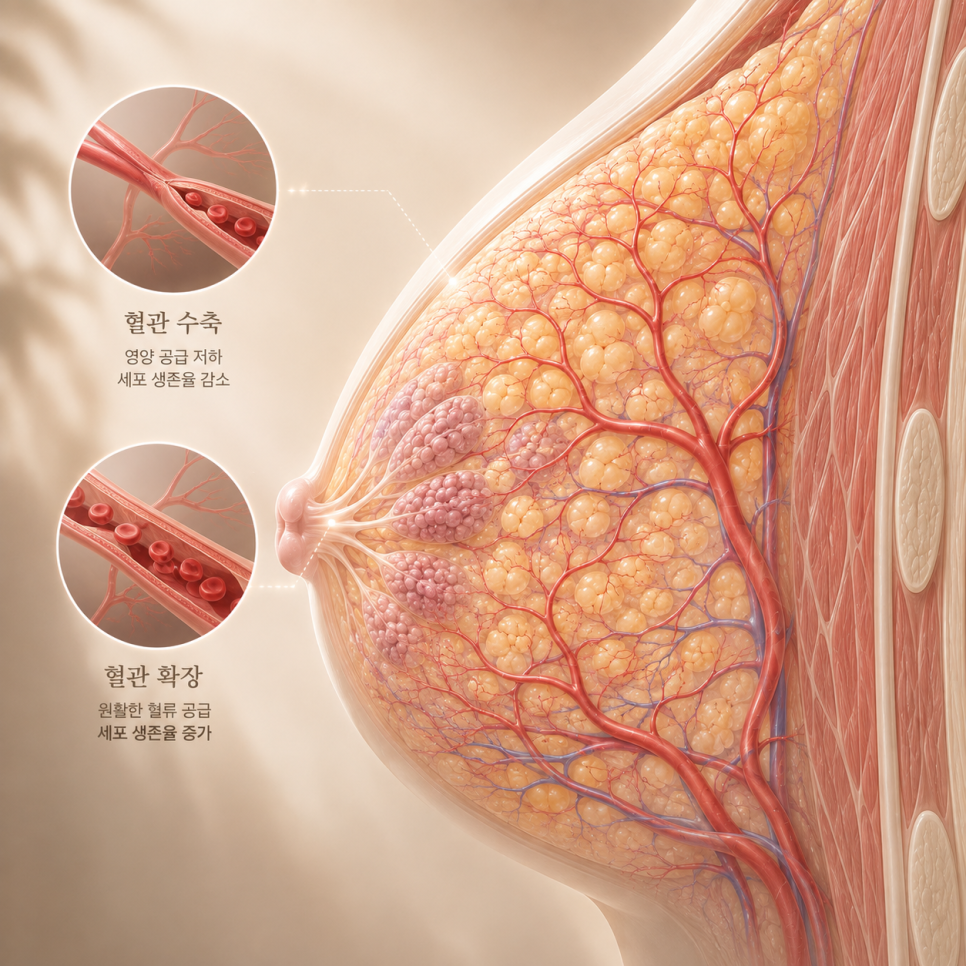
What we emphasize most in practice is blood circulation.
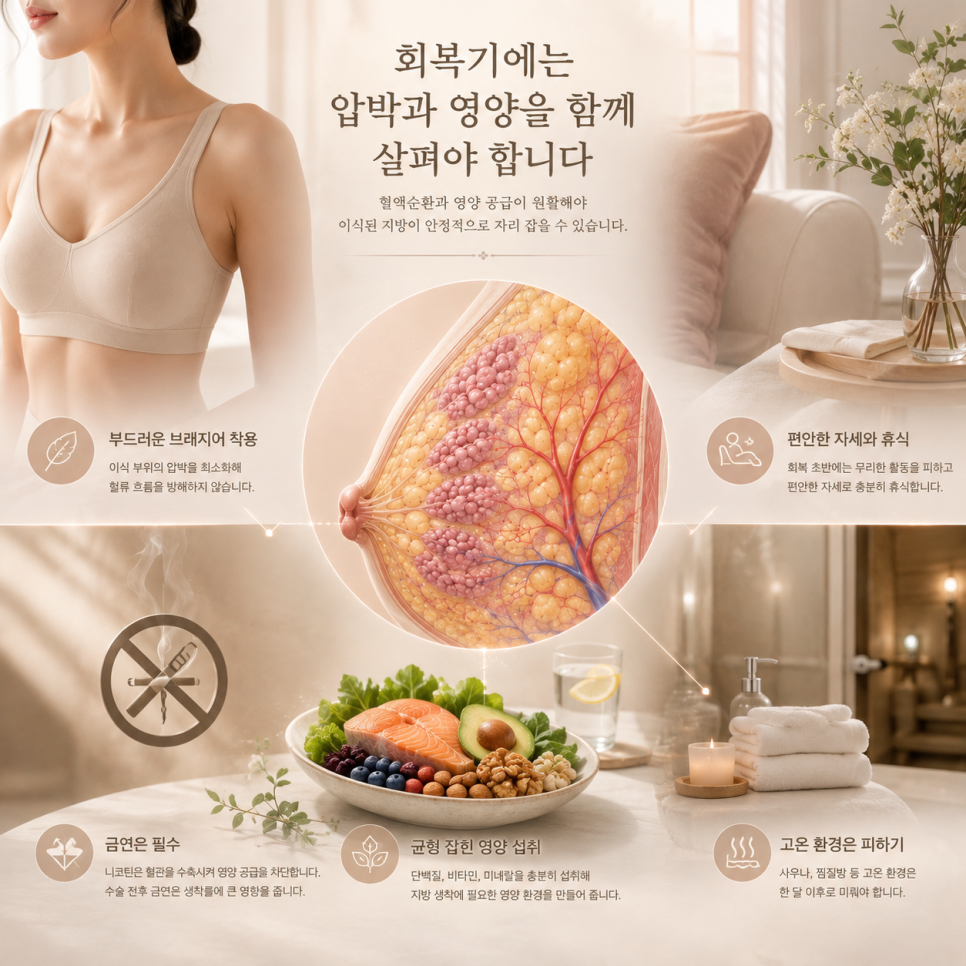
Smoking causes nicotine to constrict blood vessels
and block the supply of nutrients to the transferred cells.
Secondhand smoke is no exception.
Because we have often seen small problems develop into larger ones
when surgery is performed while a person is smoking,
abstaining from smoking before and after surgery
is not optional—it is essential.
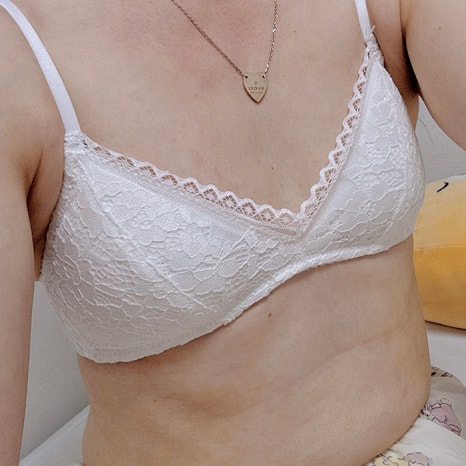
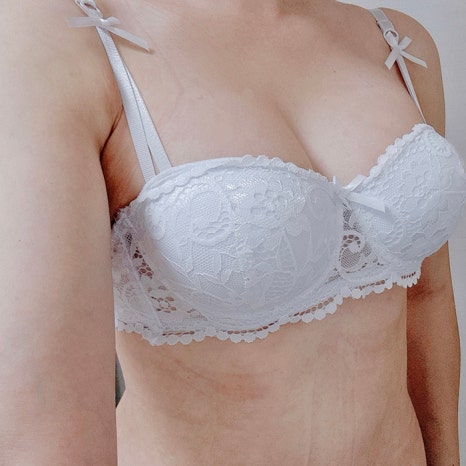
Underwear with stiff underwires or thick padding
can also continuously compress the treated area and interfere with blood flow.
During the early recovery period, you should wear a bra made of soft material.
Showering is possible from the third day,
but please postpone exposure to high-temperature environments
such as saunas and Korean-style bathhouses until at least one month later.
Diet must not be overlooked either.
One person we met in the consultation room
started dieting just three weeks after surgery
and experienced a greater-than-expected decrease in fat survival.
Because transferred fat cells are directly affected by overall nutritional status,
it is important to eat adequately and maintain good nutrition
until the fat has finished settling, which takes two to three months.
Swelling and bruising become most severe around days two to four
and gradually subside over the course of a month.
Please do not mistake the changes during this period
for the final outcome.
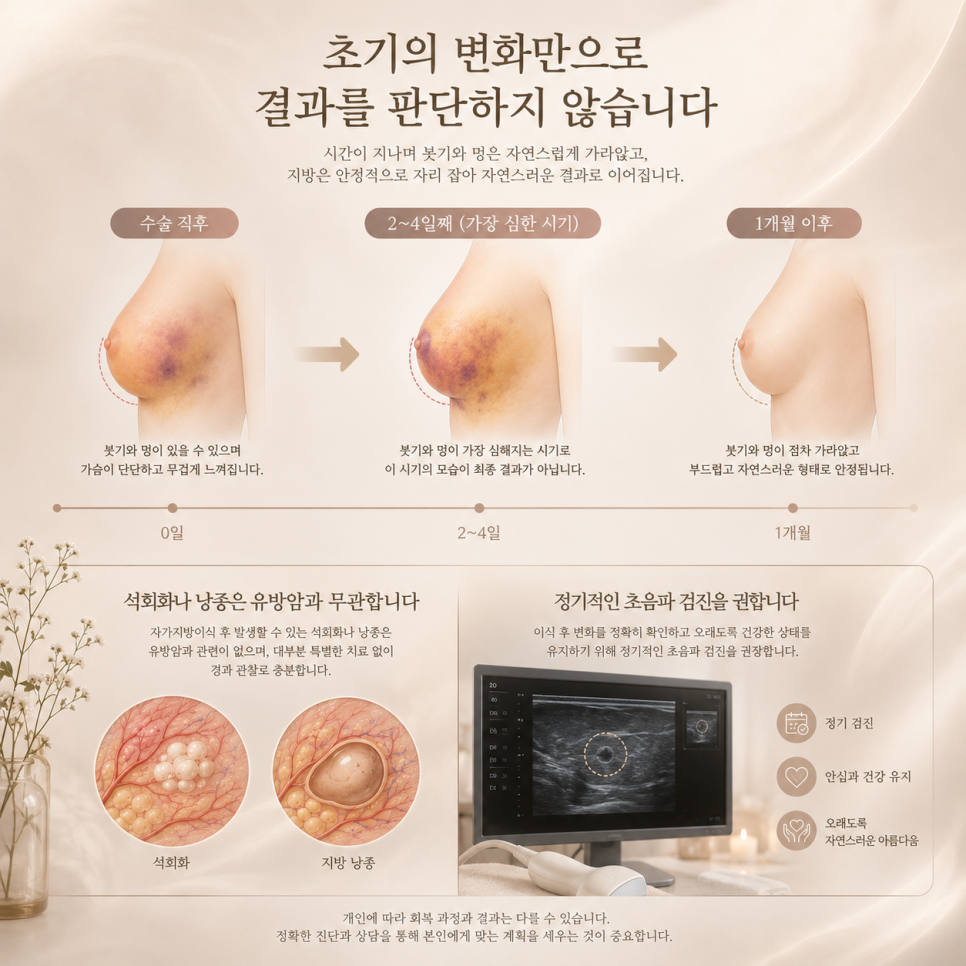
Calcifications and cysts are unrelated to breast cancer,
and unlike in the face, they rarely need to be removed in the breast.
However, we recommend continuing to undergo regular ultrasound examinations.
Informing patients about possible side effects and limitations exactly as they are—
that is the principle Glovi has upheld.
For people with too little body fat to obtain a sufficient amount for harvesting,
or those expecting a major change comparable to implants,
we recommend other options instead of this method.
Rather than starting with unrealistic expectations and being left disappointed,
it is much wiser to first confirm an accurate plan suited to your individual circumstances.
Please discuss through a consultation which method is most suitable for you at this time.
※ Results may vary depending on an individual’s constitution, amount of body fat, and postoperative care,
and side effects such as inflammation, calcification, or cysts may occur.
Please be sure to proceed only after consulting with a specialist.
| Glovi Plastic Surgery Clinic |
|---|
| Thank you for reading this lengthy post. When making a reservation or consultation, please simply mention, “I’m contacting you because I saw your blog.” We will be delighted to help you with even greater care and attention to detail! |
< Other Articles You May Enjoy >
Glovi Plastic Surgery Clinic
is located one minute on foot from Exit 4 of Apgujeong Station on Subway Line 3,
at 5th and 6th Floors, EGI Building, 843 Nonhyeon-ro, Gangnam-gu, Seoul.
Consultation reservations are available on both weekdays and weekends.
All consultations are conducted privately on a one-on-one basis.
For detailed inquiries and reservations, please leave a message through the channel below.


Reviews of Fat Transfer Breast Augmentation