Hello,
This is Glovi Plastic Surgery Clinic.

Breast Fat Grafting Scars
| A Clinic That Upholds the Principles of Plastic Surgery, Glovi Plastic Surgery Clinic |
|---|
| The most important thing in plastic surgery is adhering to the basics. Procedures should be designed with the client’s entire life in mind. Both the process and the results must be safe. Glovi always puts its clients first. |
| Consultation is an important step that leads to surgery. To help you be satisfied with your surgical results, we promise personalized consultations with medical professionals who have extensive clinical experience. |
| Postoperative care can also be considered an extension of the surgery. We provide customized care programs to help our patients recover quickly. |
During consultations for breast fat grafting, we often meet people who ask,
“Does it leave almost no scars compared with implant surgery?”
To give you the conclusion first, the marks are small,
but it would not be accurate to say that there will be no marks at all.
However, where they remain, how much they remain, and what they look like
are entirely different matters.
This procedure does not require the large incisions used for implants,
but if you are concerned about scarring,
there is definitely information you should know in advance.
In this post, we will organize the actual locations and sizes of breast fat grafting scars,
how they change over time, and how to care for them,
based on what we have observed in practice.
Where Do Scars Appear, and How Large Are They?
Breast Fat Grafting Scars
Isn’t fat grafting supposed to leave fewer scars
than implants?
That is why I am even more concerned.
Whenever we hear this question,
we prefer to answer honestly first.
It is true that the size and visibility of the marks are
much smaller than those from implant surgery,
but it would not be accurate to say that there will be no marks at all.
The incisions are made in two main areas:
the donor sites where the fat is harvested
and the grafting sites where the fat is placed in the breasts.
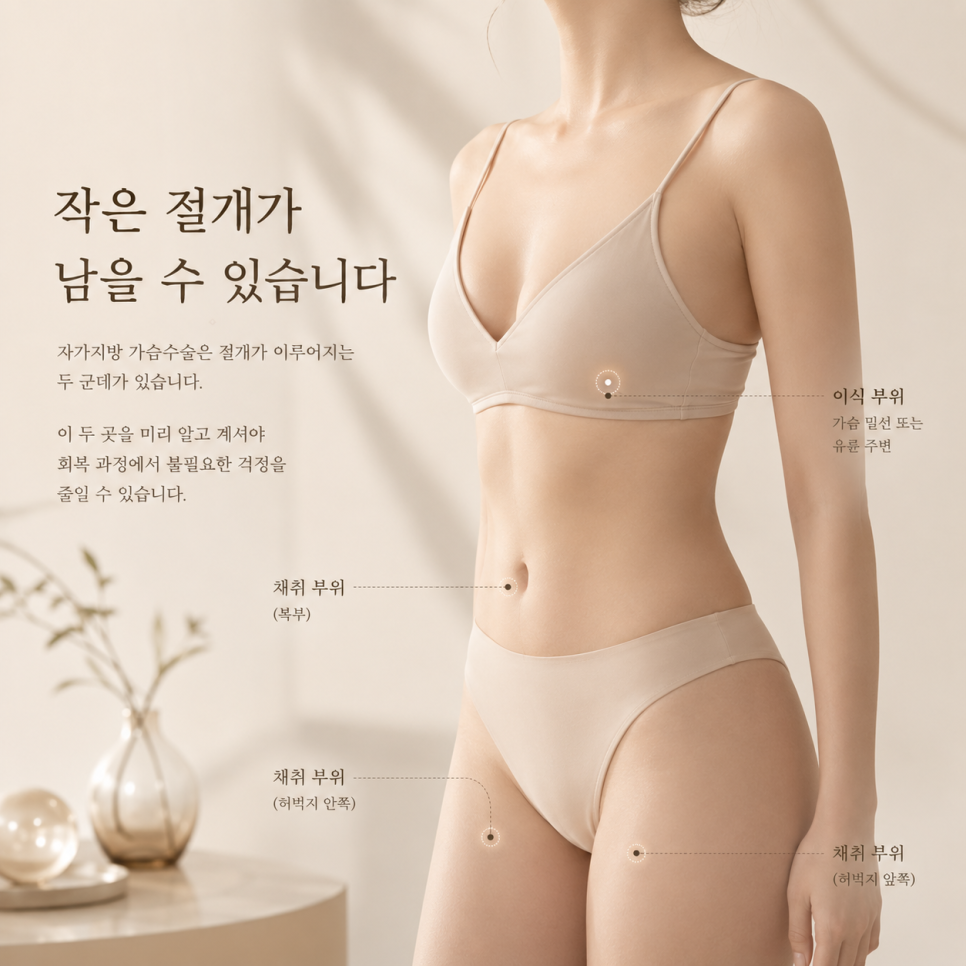
Knowing these two areas in advance can help reduce
unnecessary concerns during the recovery process.
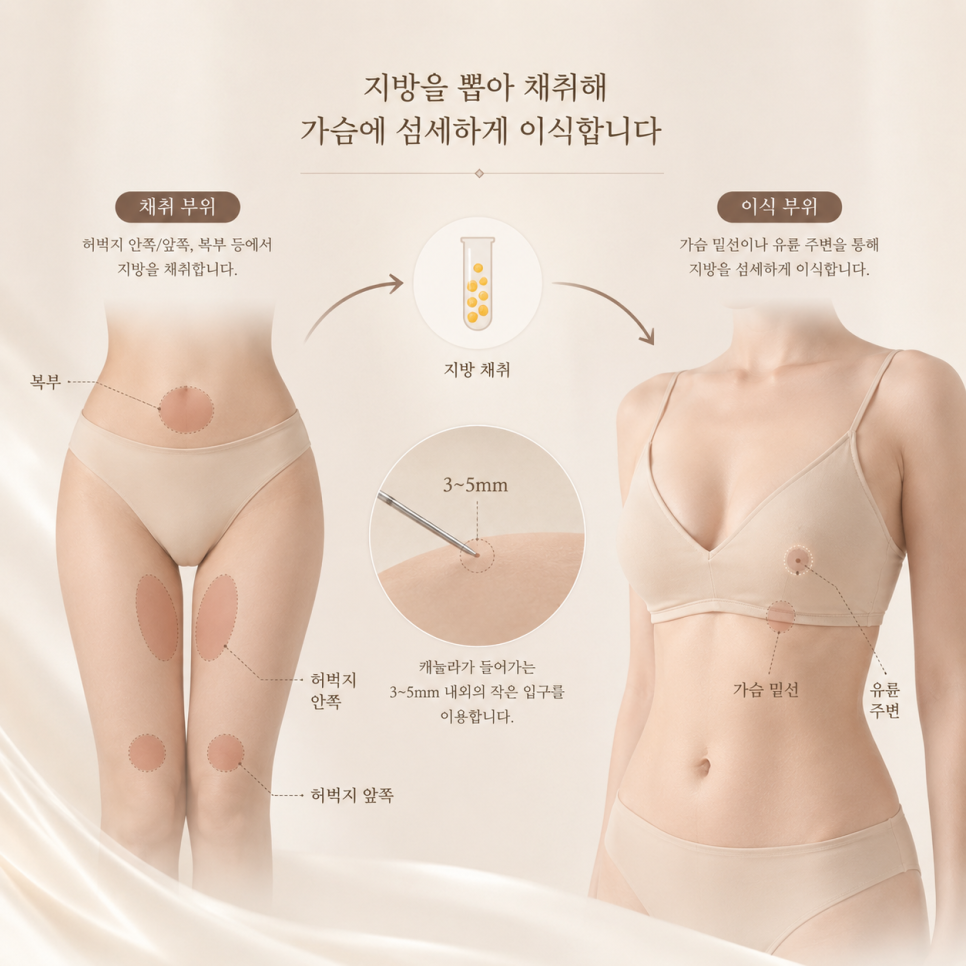
Fat is usually harvested from the inner or front thighs,
or from the abdomen.
These are small openings, approximately 3–5 mm in size,
where a thin tube called a cannula is inserted.
Because they are placed in areas naturally covered by underwear or clothing,
they are unlikely to be exposed in everyday life.
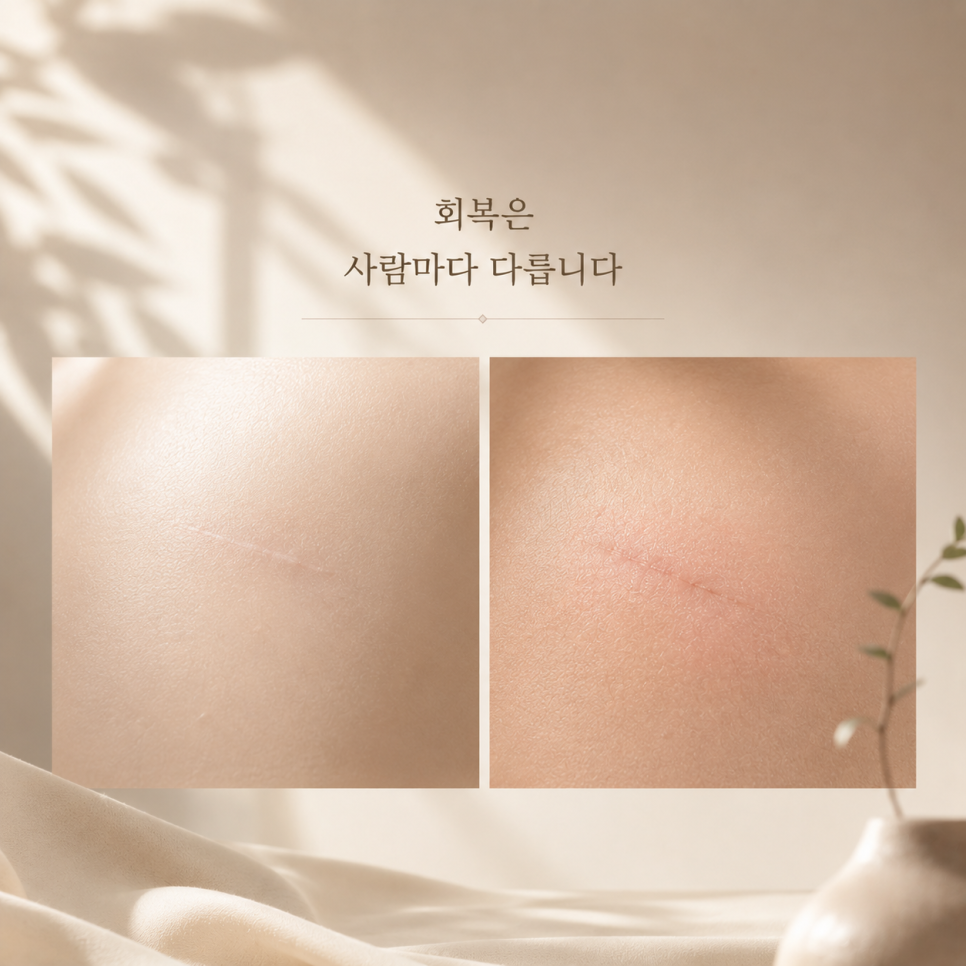
When we directly examine skin thickness and elasticity during a consultation,
we often see that skin reactions can differ even among people with the same body type.
For people who are prone to scarring,
marks may remain longer and more visibly even after the same procedure,
so we make sure to discuss this point during the consultation.
If even small wounds tend to leave noticeable marks on your skin,
it is best to tell us honestly without hesitation.
A small opening is also needed on the breast, where the fat is grafted,
but it is placed in a naturally concealed area,
such as along the inframammary fold or near the areola.
As a result, the mark is usually barely noticeable as it heals.
How Proper Care Can Make Scars Much Less Noticeable
Breast Fat Grafting Scars
What should I do after the stitches are removed?
I feel completely lost.
It is understandable to ask this.
Many people feel uncertain about how the marks will change
and what they should do from the moment the stitches are removed.
The stitches are removed at a visit seven days after surgery,
and this marks the beginning of focused scar care.
From immediately after removal, you must use
scar tape and scar ointment together.
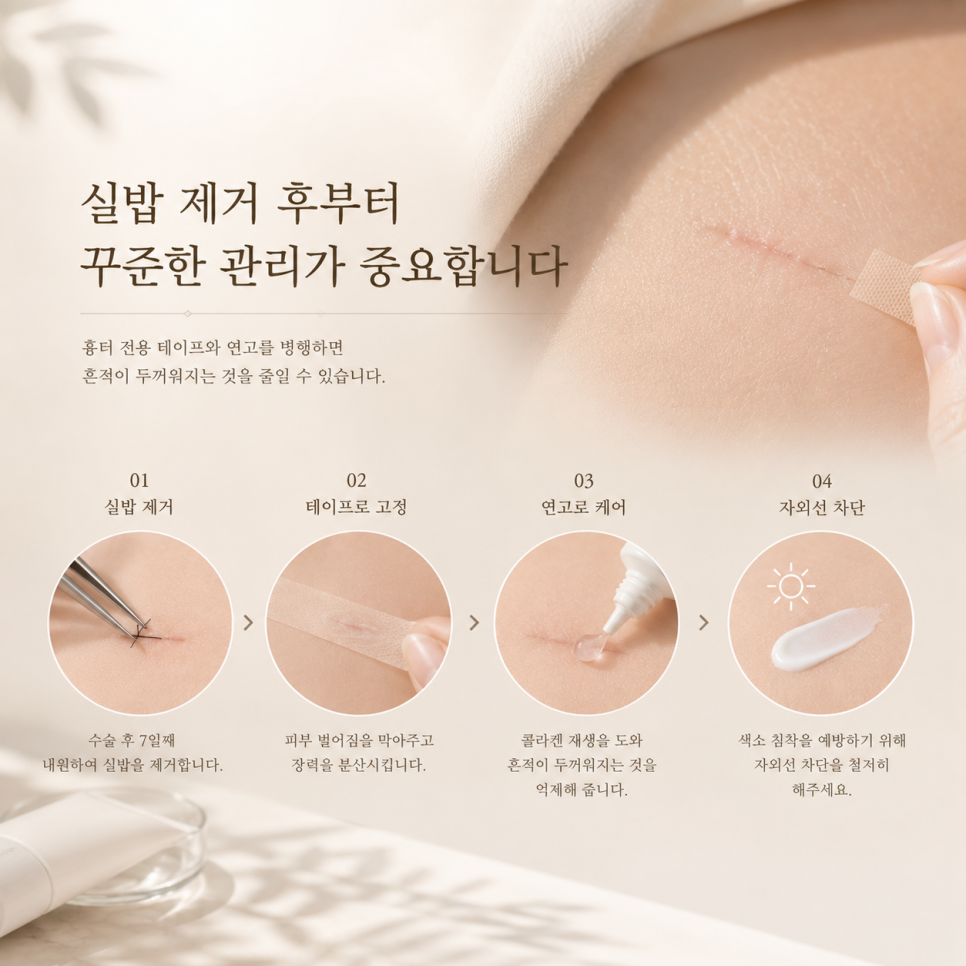
The tape helps distribute the tension that can cause the skin to separate,
and the ointment helps support collagen regeneration
and prevent the mark from becoming thicker.
There is one point we often emphasize in practice:
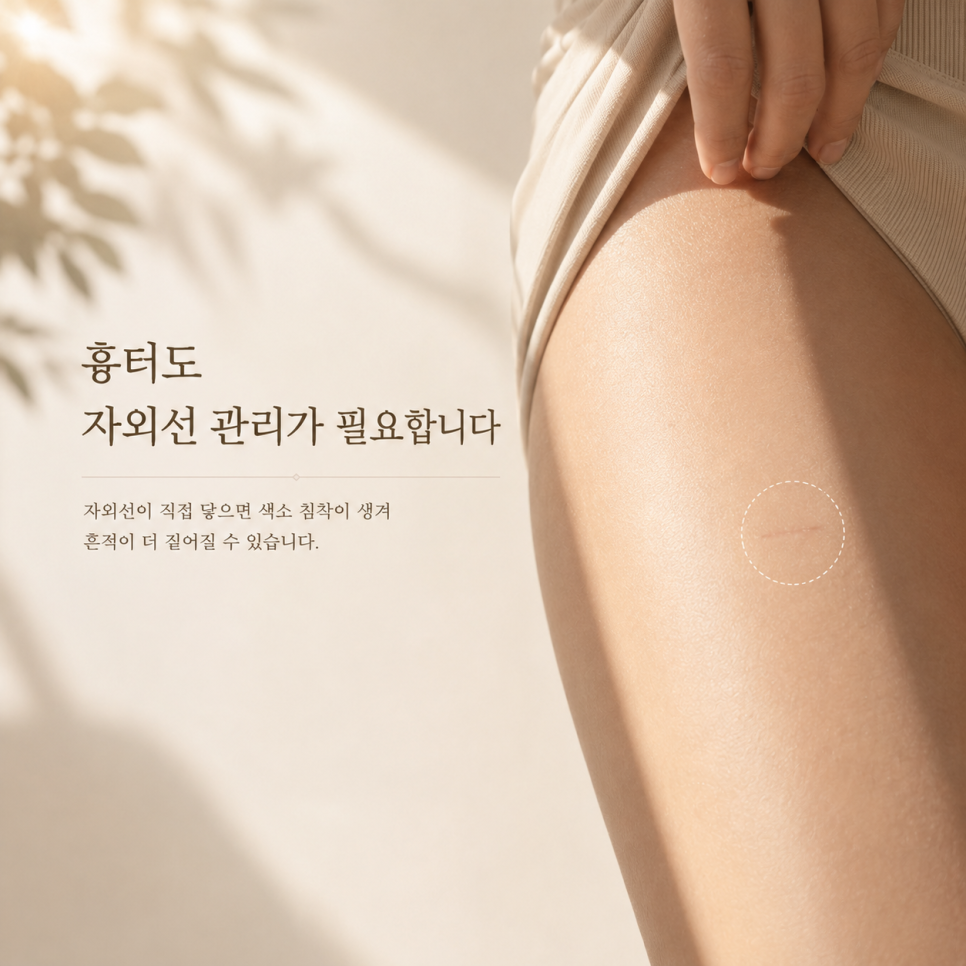
if the healing area is directly exposed to UV rays,
hyperpigmentation may occur and the mark may become darker instead.
If your thighs or abdomen are exposed during a particular season,
we strongly recommend applying sunscreen carefully to those areas.
One person we met during a consultation
missed several days of care after having the stitches removed
and experienced slight thickening around the incision line.
Fortunately, after restarting the ointment and tape,
the area had recovered three months later
to the point where it was almost impossible to see with the naked eye.
Through this person’s experience,
we were able to see firsthand that consistency produces results,
even if care begins a little late.
Bruising and pain at the donor site
usually subside within two to three weeks,
while it is realistic to allow three to six months
for the skin tone to return completely.

If the mark remains more noticeable than expected,
laser treatment may help support recovery.
If you notice any unusual changes,
please visit the clinic without delay.
Being honest from the outset that scars may remain
is a principle Glovi always upholds at the beginning of a consultation.
For people who are prone to keloids,
have significantly reduced skin-healing ability,
or have too little harvestable fat,
we first explain that this procedure may not be suitable.
Rather than proceeding with lingering concerns,
a much better starting point is to accurately determine
what results can be expected based on your individual circumstances.
Please use a consultation to discuss together
which method is most suitable for you at this time.
※ Results may vary depending on an individual’s constitution, skin condition, and postoperative care.
Side effects such as hyperpigmentation, infection, and hypertrophic scarring may occur.
Please proceed only after consulting with a specialist.
| Glovi Plastic Surgery Clinic |
|---|
| Thank you for reading this long post. When making a reservation or consultation inquiry, please simply mention, “I’m contacting you after seeing your blog.” We will be happy to assist you with even greater care and attention! |
< Other Posts You May Enjoy >
Glovi Plastic Surgery Clinic
is located one minute on foot from Exit 4 of Apgujeong Station on Subway Line 3,
at 5th and 6th floors of the EGI Building,
843 Nonhyeon-ro, Gangnam-gu, Seoul.
Consultation reservations are available on both weekdays and weekends.
All consultations are conducted privately on a one-on-one basis.
For detailed inquiries and reservations, please leave a message through the channel below.

Breast Fat Grafting Scars