Hello, I’m Dr. Sohyunsoo from Jaejulgoun Dental Clinic.
Today, I’d like to talk about how to treat a gap between the front teeth with resin.
You may have noticed it while looking in the mirror or taking a photo.
A small gap between the two upper front teeth.
Maybe you did not pay much attention to it before,
but one day it started catching your eye again and again,
and now you find yourself slightly covering your mouth every time you smile.
You might have opened a search window thinking, “Can this be fixed?”
Orthodontics, laminate veneers, resin…
There are many terms, but it is hard to know which one fits your situation.
That is probably why you opened this post today.
I see people like this in my clinic every week.
The size of the gap and the size of the concern are different for everyone, but there is one thing they have in common.
Almost everyone asks,
“Do I need to shave down the teeth?”
Let me start by easing that worry.
Why does a gap between the front teeth form?
A gap between the two front teeth is called a midline diastema in dentistry.
There are many causes.
The most common is when the teeth themselves are not wide enough sideways.
In other words, the teeth are small enough to create a gap.
Other causes include a labial frenum that is too thick
or positioned too far forward,
a tongue-thrusting habit,
post-orthodontic relapse,
or changes in tooth position due to periodontal problems.
Because the treatment approach changes depending on the cause,
it cannot simply be said that “you can just fill it with resin,”
and it also cannot be said that orthodontic treatment must always come first.
You need to look at the case.
Is same-day treatment with resin really possible?
To begin with, yes, it is possible in quite a few cases.
Before it hardens, resin can be shaped freely like clay.
The dentist places it directly onto the tooth by hand, shapes it, and then hardens it with a special light.
Unlike laminate veneers, which are sent to a lab to make a mold
(treatment that attaches a thin porcelain shell),
the treatment can be completed on the same day.
I often compare this process to painting directly on a blank canvas.
Instead of outsourcing it to a lab,
I work directly on the tooth while adjusting the color and shape with my own eyes.
That is why resin has an advantage in recreating the color variation of natural teeth
and their translucent appearance.
However, this is a treatment where the dentist’s manual skill
is extremely important.
Dentists who can do aesthetic resin restorations on front teeth well
are more rare than you might think.
I feel I should be honest about that.
When filling a front-tooth gap with resin, do the teeth need to be shaved?
No, they do not. That is the biggest advantage of resin.
When I treat a gap between the front teeth with resin,
I do not use a drill at all.
That means I do not use any tool to shave down the teeth.
Resin is applied by putting adhesive on the tooth surface
and attaching the material on top of it,
so healthy tooth structure does not need to be damaged.
It is not like laminate veneers or crowns,
where the tooth is reduced and a shell is fitted over it.
There is one exception.
If the front teeth protrude more than the other teeth,
then adding resin would make them stick out even more,
making it difficult to achieve a natural result.
In such cases, a small amount of surface adjustment may be needed,
or it may be better to choose another method from the beginning instead of resin.
How natural does it look after filling the gap with resin?
Honestly,
the result varies a lot depending on the case and the skill of the clinician.
A well-done resin restoration
can look so natural that it is hard to tell which tooth was treated.
That is because resin can reproduce things like
color gradation,
the slightly translucent look near the tooth edge,
and surface texture.
This is done by layering multiple shades of resin
(layering technique).
On the other hand, if a less experienced clinician
simply fills the gap with a single shade of resin,
the color may stand out or the shape may look awkward.
From the patient’s perspective, that can feel like,
“I got treatment, but it looks even more unnatural.”
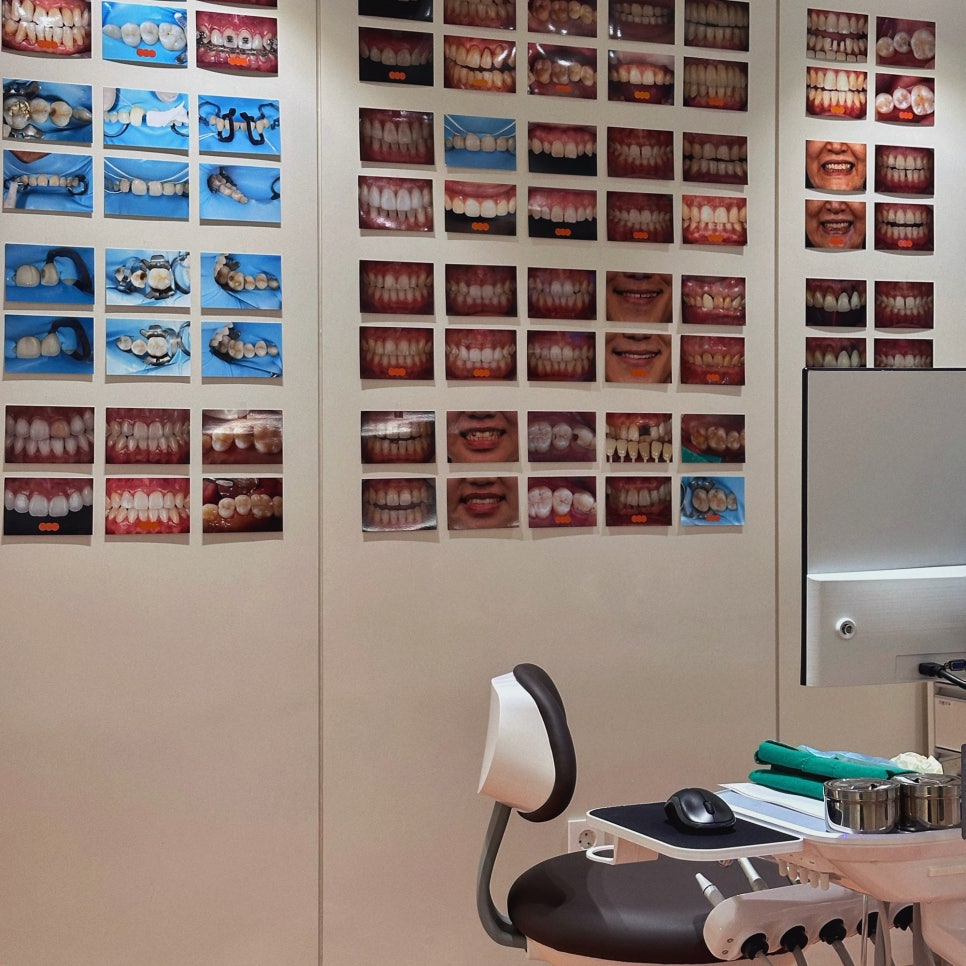
When you consult, it is a good idea to ask to see before-and-after case photos.
That is the quickest way to check whether the clinic has extensive experience with aesthetic resin restorations.
How should resin be managed after treatment?
Resin is more prone to discoloration than ceramic.
I should be honest about that.
If you often drink coffee, black tea, wine, or eat curry,
the boundary between the resin and the tooth may become slightly stained over time.
However, one easy-to-overlook point is that
laminate veneers are also bonded to the tooth with resin.
So if the conditions are such that resin becomes discolored,
laminate veneers become discolored too.
If the conditions are such that laminate veneers do not discolor,
resin does not discolor either.
Even though resin has drawbacks such as being weaker than ceramic
and more prone to discoloration,
well-treated resin that has been properly bonded
is often used without problems for an average of 7 years.
Of course, this varies depending on personal habits and care.
After treatment, it is important to avoid biting hard foods
or cracking ice with your front teeth.
Because resin is attached to your tooth,
it is vulnerable to twisting forces or sudden impact.
Just like a screw embedded in a wall can withstand downward force
but may come loose if twisted or hit sideways.

Are there cases where orthodontic treatment should come first instead of resin?
Yes, there are. This part is important.
If the gap between the front teeth is related to a problem with the bite
(how the upper and lower teeth meet),
or if it was caused by a tongue-thrusting habit or a frenum problem,
then even if the gap is filled with resin, it may open again over time.
In such cases, putting resin on the gap without first addressing the cause
is like putting tape over a leaking pipe.
You need to look at the cause of the gap,
the size of the gap,
and the overall balance of the dental arch.
If the gap is 3 mm or less,
resin restoration alone is often sufficient.
If it is larger than that or there is also an imbalance in the dental alignment,
it may be necessary to consider combining it with orthodontic treatment.
There are limits to explaining everything in writing.
An accurate judgment is only possible after directly checking dental photos or X-rays.
What you should know before the consultation
Before a dental consultation, it will be much easier if you think about the following three things in advance.
First, check whether the gap has been there for a long time
or whether it appeared recently.
If it has been there for a long time, the likelihood of post-orthodontic relapse or periodontal problems is lower,
and in many cases it can be approached directly with resin restoration.
On the other hand, if it suddenly feels like the gap has opened recently,
you should first check for gum or bite problems.
Second, be sure to ask, “Can this be treated without shaving the teeth?”
If it is a case that can be treated with resin on the same day,
it can proceed without removing tooth structure.
You can clarify this before treatment.
Third, ask to see before-and-after photos
of front-tooth resin restorations.
The results of aesthetic resin restoration can vary greatly depending on the clinician’s skill.
Checking example images during consultation
is an important way to make a reasonable choice.
In closing
The content of today’s post was written in compliance with the Medical Service Act and the Ministry of Health and Welfare’s medical advertising guidelines. It is valuable material prepared to help patients understand and provide accurate information, so specific treatment plans or diagnoses should be decided after 충분한 consultation with the attending medical staff. Because the appropriate treatment for a gap between the front teeth varies depending on the cause and size, it is important to judge only after directly checking the condition of the teeth rather than relying on outside information that simply says “resin is better” or “orthodontics is better.” Rather than deciding based on internet information or other people’s cases, we recommend finding the optimal method for your own situation through a careful diagnosis.
In addition, while there have recently been many issues related to medical law and some people have experienced confusion, we plan to take legal action with our advisory attorney regarding false reports or baseless complaints. We will continue doing our best to provide trustworthy information.
Today’s summary
One-line summary: A gap between the front teeth can vary depending on the cause and size, but in many cases it can be treated with resin on the same day without shaving the teeth.
| Item | Details |
|---|
| Do the teeth need to be shaved? | Resin restoration is, in principle, performed without shaving the teeth |
| Is same-day treatment possible? | In most cases, yes. It can be completed on the spot without outsourcing to a lab |
| Can resin be used instead of orthodontics? | If the cause of the gap is not a structural problem, resin alone is often sufficient |
| How long does resin last? | It varies depending on care, but in many cases it is used for an average of 7 years or more |
| What should I prepare before the consultation? | Check when the gap appeared, ask whether treatment can be done without shaving, and request before-and-after case photos |