Hello, I’m Dr. So Hyun-soo, director of Jaejujoeun Dental Clinic.
Today, I’d like to talk to those who are considering retreatment because they are not satisfied with resin work they previously received.
Many of those who search for “incisor resin retreatment” are probably in a situation like this.
At some point in the past, an incisor fractured and was restored with resin, but over time, something began to feel off.
The color may be subtly different from the adjacent tooth, or the boundary may be clearly visible,
or perhaps it looked somewhat flat and lacking in depth from the beginning, making you conscious of it every time you looked in the mirror.
I understand how you feel. I meet many people like this in the dental office.
“I’m worried it will turn out the same way even if I have it redone,”
or, “I was told I need a crown, but I don’t want to have my tooth filed down.”
I think those concerns are entirely understandable.
Why does the resin that was previously placed look unnatural?
To put it simply, it is difficult to achieve a natural result by filling an incisor with a single shade of resin.
Natural teeth are not simple, solid masses.
On the inside, they contain dentin, which determines the tooth’s basic color and brightness. On the outside, there is translucent, glossy enamel, while the incisal edge contains a transparent layer through which light can pass. These layers form a complex structure.
This structure is precisely why natural teeth look so vivid and deep when they receive light.
But what happens when the tooth is covered with a single resin? Like a thick coat of white paint, it only reflects light instead of allowing it to pass through.
It may look similar from a distance, but up close, it can inevitably give the impression that “it’s resin.”
This is not a problem with the material. It is a problem with the approach.
So how should retreatment be done differently?
The existing resin is removed, and the tooth structure is recreated from the beginning. This approach is called the Natural Layering technique. As the name suggests, resin is built up layer by layer to imitate the internal structure of a tooth.
Specifically, it works like this.
A foundation is first created with translucent resin, starting from the innermost area on the palate-facing side of the tooth.
Without this layer, the incisor will inevitably look like “stuffy plastic.”
Next, dentin resin is used to establish the tooth’s basic color and brightness.
It is no exaggeration to say that the thickness and shade selection of this layer determine 70% of the overall result.
Finally, the surface is finished with enamel resin.
If this layer is too thick, the tooth may look gray; if it is too thin, the underlying color may show through too strongly.
This is why the thickness must be adjusted with great precision.
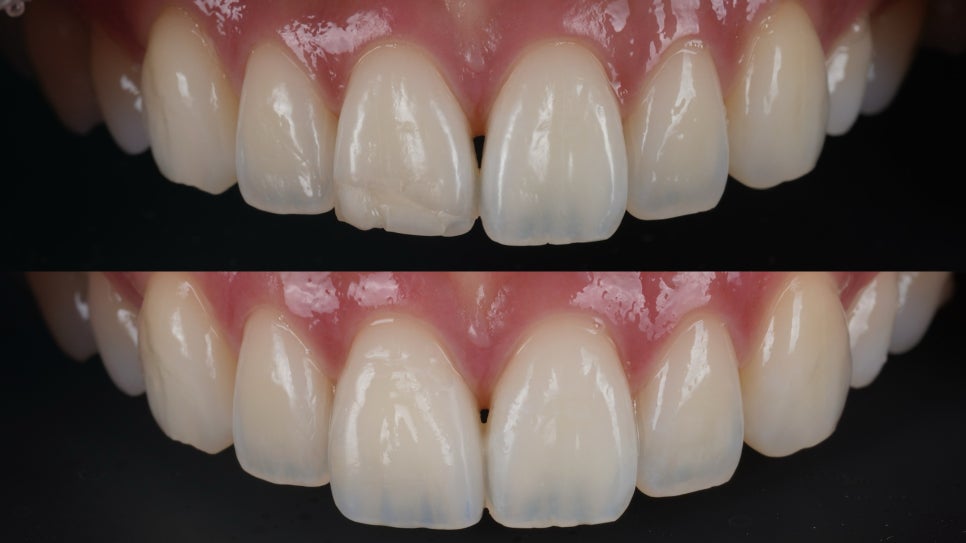
Does all of the existing resin have to be removed during retreatment?
In most cases, yes.
The key is to precisely remove only the problematic areas while preserving as much of the remaining healthy tooth structure as possible.
This is the biggest difference from a crown, a treatment in which the entire tooth is reduced and covered like a cap. With a crown, healthy tooth tissue must also be removed, whereas resin retreatment involves cleaning up only the necessary areas and preserving the remaining tooth.
I am often asked, “The tooth has already received resin treatment. Won’t using resin again make it weaker?”
The opposite is actually true.
The most important factor during retreatment is establishing proper bonding conditions. If enough of the tooth itself remains, resin retreatment is a much more conservative option than a crown.
What is most important for successful retreatment?
There are two things I would like to mention first.
The first is moisture control, using a rubber dam.
Resin bonding is, in a word, “a battle against moisture.” The moment saliva, blood, or moisture in the mouth reaches the bonding surface, even the best resin becomes ineffective. It is like trying to apply Scotch tape with wet hands—the tape will not adhere.
Precisely placing a rubber dam, a rubber-like material that isolates the tooth from the rest of the mouth, is a prerequisite for everything else. No matter how good the treatment technique is, the result will not last if moisture is not properly controlled.
The second is the ability to analyze color.
Teeth are not a single color. Everything differs, including the thickness and distribution of the dentin, the extent of the translucent layer, the translucency of the incisal edge, the thickness of the enamel, and the surface texture. These features must be carefully observed and planned before treatment to achieve a natural result.
You can see this when you take a photograph: in the post-treatment photo of this case, it is difficult to find the treated area. I believe that is the standard for a well-executed resin restoration.
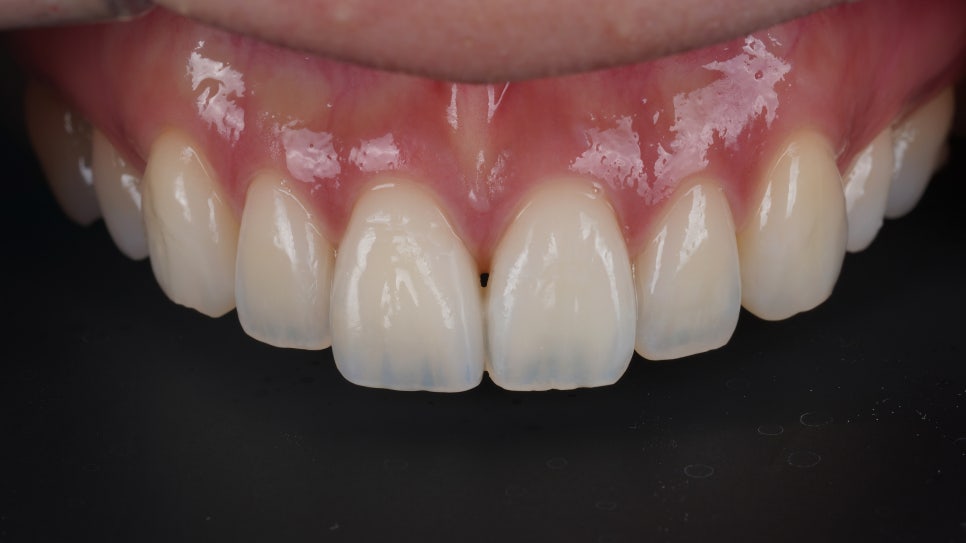
In cases like this, should a crown be chosen instead of resin retreatment?
That is not always the right answer.
A crown may be more appropriate than resin retreatment in situations such as these:
- The resin repeatedly fractures or comes off, especially when severe tooth grinding is present.
- The tooth itself is extensively damaged, leaving too little tooth structure.
- There is a major problem with the bite, meaning the way the upper and lower teeth come together.
If none of these conditions apply—in other words, if enough tooth structure remains and you want retreatment for aesthetic reasons—resin retreatment should be considered first. There is no reason to unnecessarily file down a healthy tooth.
However, this cannot be determined from written information alone. It can only be assessed through a direct examination.
How long will the result last after retreatment?
I’ll answer honestly.
Resin is more vulnerable to discoloration than ceramic. However, resin placed under proper moisture control and with an appropriate bonding protocol can have a lifespan that is not significantly different from that of a ceramic laminate veneer.
This is because veneers are ultimately bonded to the tooth with resin as well. In some cases, restoring a tooth with resin under rubber-dam isolation may provide a more stable long-term result than placing a laminate veneer without proper moisture control.
What affects longevity is not the material so much as the principles followed during the treatment process.
In Closing
Today’s post is not a medical advertisement. Nevertheless, it was written in compliance with the Medical Service Act and the Ministry of Health and Welfare’s guidelines for medical advertising. This material has been prepared to help dental professionals understand the subject and to provide accurate information. Please decide on a specific treatment plan or diagnosis only after having a thorough consultation with your healthcare provider. The approach to incisor resin retreatment may differ depending on the condition of the remaining tooth, the bite, and the extent of the fracture, so a direct examination is essential. Rather than making a decision based solely on online information or other people’s cases, we recommend receiving a careful diagnosis to find the best method for your individual situation.
In addition, although recent issues related to medical law have caused confusion in some cases, we intend to pursue legal action together with our advisory attorneys against false reports or baseless complaints. We will continue to do our best to provide reliable information.
Summary of Today’s Content
One-line summary: The quality of incisor resin retreatment is determined not by the material, but by three principles: moisture control, color analysis, and the layering technique.
| Item | Details |
|---|
| Why does the existing resin look unnatural? | Because a single shade of resin cannot reproduce the tooth’s translucency and depth. |
| What is Natural Layering? | A technique in which resin is built up layer by layer to imitate the internal structure of a tooth in the order of dentin → translucent layer → enamel. |
| Does all of the existing resin have to be removed during retreatment? | Only the problematic areas are precisely cleaned up, while the remaining tooth structure is preserved as much as possible. |
| How is the choice between resin and a crown made? | If enough tooth structure remains and there is no problem with the bite, resin retreatment should be considered first. A crown may be considered in cases of severe grinding or extensive tooth damage. |
| What is the standard for successful resin retreatment? | The color, shape, and translucency should be so natural that the treated area is difficult to distinguish from the natural tooth in a photograph. |