From front teeth to molars, I am Dr. So Hyun-soo of Jaejoo Good Dental Clinic, and I am committed to preserving natural teeth.
Today, I would like to discuss a somewhat challenging case that many fellow dentists may have encountered at least once in the treatment room.
It was a molar whose root canal treatment had been started at another dental clinic and was completed at our clinic.
The patient came to us with the root canal orifices left completely open.
Normally, for a tooth like this, it is only natural to proceed by saying, “The root canal treatment is finished, so you can now have a crown placed.”
However, this time, we completed the treatment without a crown, using a resin overlay—a restoration that covers the occlusal surface with resin as well.
You may wonder, “Why use resin for a tooth that has already undergone root canal treatment?”
That question is the starting point of today’s post.
How should we approach the completion of treatment for a tooth that has undergone root canal treatment at another dental clinic?
This situation is more common than you might think. The canal preparation has somehow been completed, but:
The patient is already exhausted,
an increasing amount of tooth structure has been removed,
and the remaining tooth structure has become as thin as a shell.
This is where a choice must be made.
One option is the familiar route: reduce the tooth all the way around and place a crown.
It is quick, predictable, and associated with fewer complaints.
The other option requires more time and effort.
It involves preserving as much of the remaining tooth structure as possible, distributing stress through bonding, and covering the tooth with a resin overlay.
I chose the latter.
The reason is simple: that was what the patient wanted.
A crown is a standard treatment method.
However, it does require removing a considerable amount of tooth structure.
Can a resin restoration withstand occlusal forces?
Yes, it can.
Of course, because it is weaker than a crown, it may wear or fracture sooner.
However, when a problem does occur, there are often no major problems with the tooth itself.
On the other hand, when a tooth is treated with a crown and a problem develops,
it is fairly common for the problem to affect the tooth rather than the crown itself.
This can include secondary caries or the pattern of fracture.
I also explain and provide crown treatment in most cases.
However, if the patient’s priority is to preserve the tooth for as long as possible,
I believe that completing the treatment with resin is also an option.
Why use a rubber dam when completing root canal treatment?
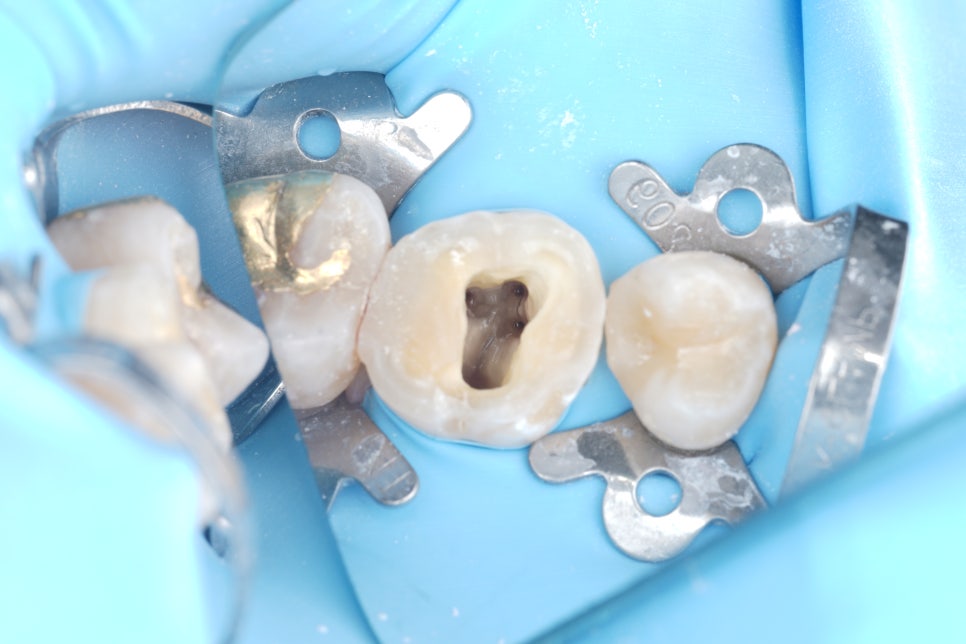
The key to this case is not an elaborate shape, but the invisible process of moisture control.
Bonding is, in a word, a “battle against moisture.”
Think of painting.
Even the best paint will lift and peel if moisture remains on the wall.
Tooth bonding works the same way. The moment saliva, blood, or gingival crevicular fluid touches the bonding surface, that interface is already tilted toward failure.
This is especially true for a root-treated tooth with open canal orifices.
The area deep inside must be sealed and built up with a core,
but if moisture gets in, pathways for microleakage and marginal leakage remain.
Even after root canal treatment has been performed well, cases in which the tooth becomes reinfected through coronal leakage—the leakage of bacteria through a gap on the restoration side—are something most dentists have encountered at least once.
That is why I complete the root canal treatment and restoration as one continuous process under rubber dam isolation.
The moment the root canal is sealed is handled in the cleanest, most completely isolated environment possible within the oral cavity.
This is precisely the essence of “sealing,” which is emphasized in biomimetic dentistry.
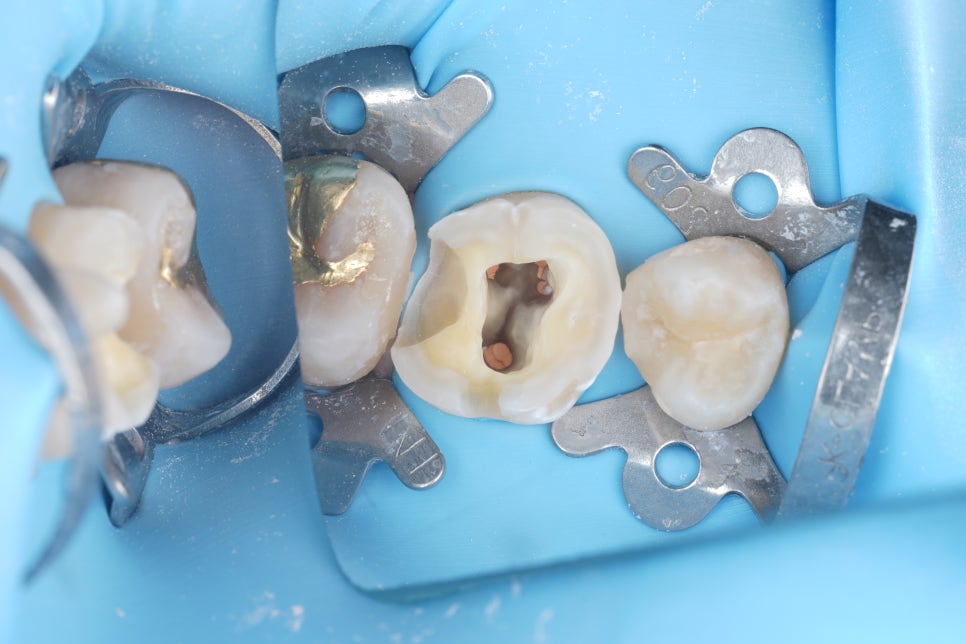
Why fill the core inside the root canal access opening with SFRC resin?
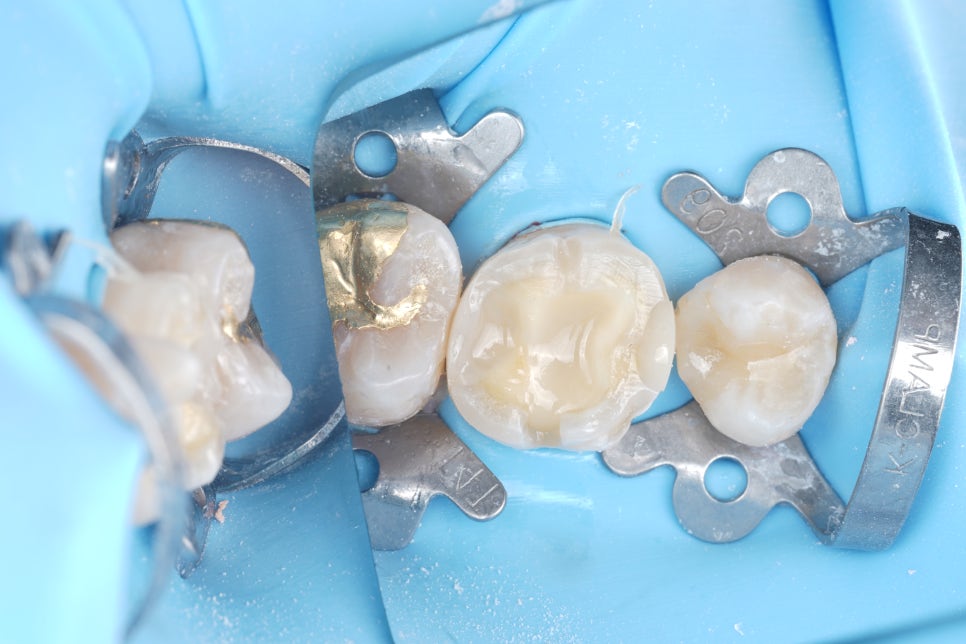
When filling the canal orifices and the bottom of a deep cavity, I use not ordinary resin but
SFRC resin—short fiber-reinforced composite, a resin containing short fibers.
The reason is stress distribution.
Think of the difference between a column made only by pouring concrete and one made by placing reinforcing steel inside before pouring the concrete.
Although they may look the same on the outside, the way they withstand force is completely different.
The fibers in SFRC resin serve the same role as the reinforcing steel.
Because a root-treated tooth is hollow inside, occlusal forces can easily become concentrated at specific points.
If left that way, it may one day split suddenly all the way to the root, resulting in an untreatable fracture—a catastrophic failure.
When a core is built up with SFRC, the force is distributed rather than concentrated at a single point.
Even if a problem occurs, the pattern of fracture can change into one that may allow the tooth to be saved again.
The fact that the pattern at the time of retreatment can be different
is a point repeatedly emphasized in biomimetic dentistry,
and it is an approach aimed at preserving the tooth for a long time rather than merely preserving the restoration.
How are occlusal resin and UHMWPE fiber used?
The inside is filled with SFRC, but the occlusal surface that actually contacts food while chewing has a different role.
Because this area receives wear and impact directly, it must be finished with resin containing a high filler content.
This creates an outer shell that is hard and wear-resistant, like the enamel of a natural tooth.
In summary, this means reproducing the layered structure of a natural tooth.
Between these layers, on top of the bonding layer at the cavity floor, I place one layer of UHMWPE fiber—ultra-high-molecular-weight polyethylene fiber.
This acts like a “safety net” that protects the bonding layer.
The fiber absorbs and disperses the impact so that polymerization shrinkage stress and occlusal forces do not strike the bonding interface directly.
You can think of it as similar to placing a mat on the floor.
Whether or not this single layer of fiber is present can make a fairly significant difference in marginal microleakage and the likelihood of restoration loss several years later.
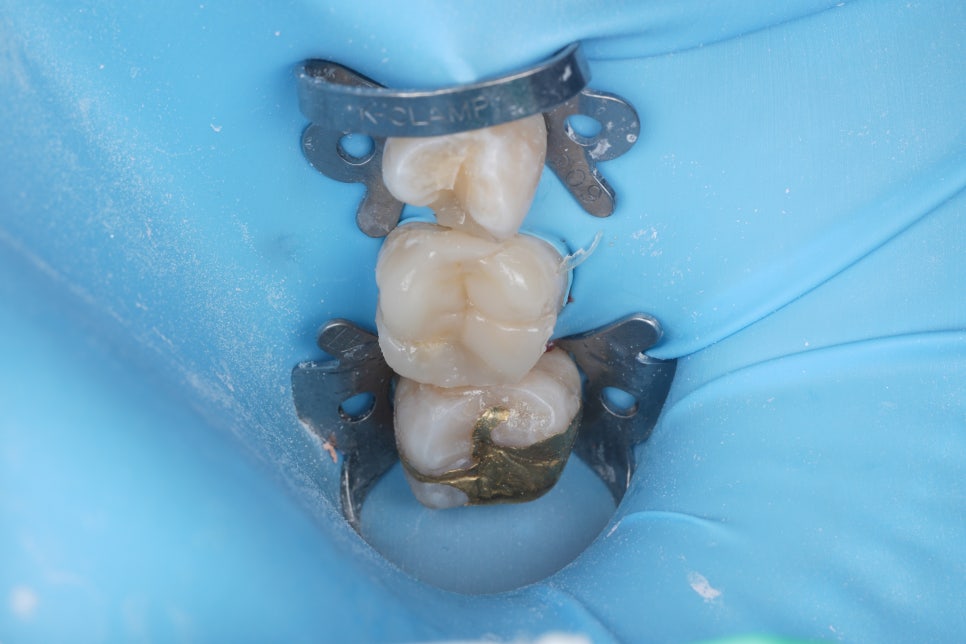
Is it reasonable for treatment to be expensive when this much work is involved?
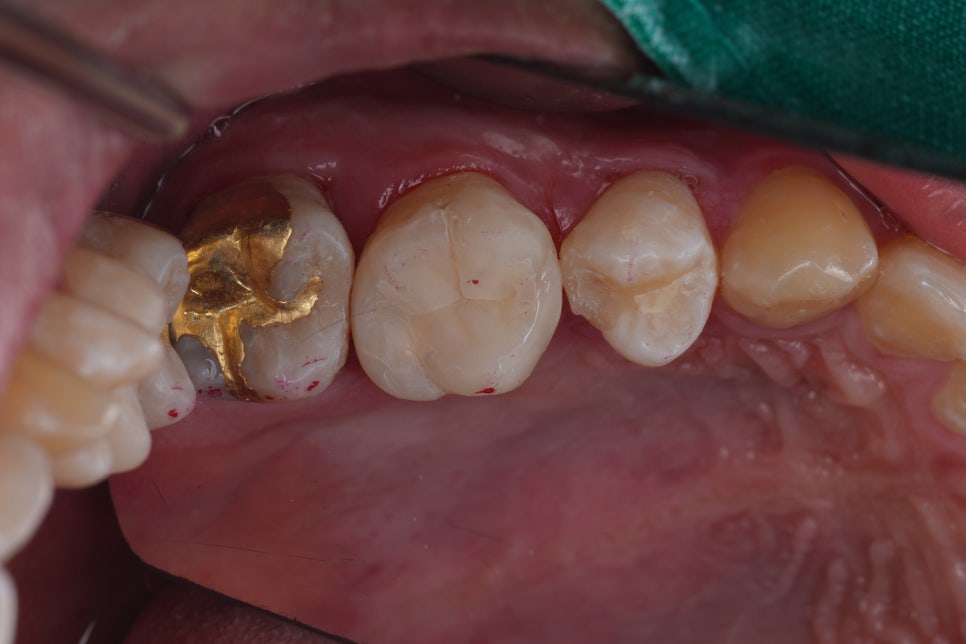
(The red dots indicate the marks from checking the occlusal contacts.)
I will be honest. This procedure is difficult, and it takes a great deal of time.
With a crown, the tooth is prepared, an impression is taken, and the procedure is complete.
By contrast, this resin overlay involves rubber dam isolation, canal sealing, SFRC core buildup, fiber placement, layering of the occlusal surface, and occlusal adjustment.
Each step requires careful attention.
Because the result can be compromised if even one step fails, the operator cannot afford to lose concentration from beginning to end.
Therefore, because I invest more time and care in cases like this,
a higher treatment fee is justified, in my view.
When I hear, “Why is it expensive when it is the same resin?” I honestly feel a little disappointed.
Even with the same material, understanding the structure of a natural tooth and rebuilding it layer by layer is fundamentally different from simply filling it like a lump of dough.
More than anything, the greatest value of this tooth is that it preserves a “next opportunity.”
If a large amount of tooth structure is removed at once for a crown, there may be little tooth structure left to work with if a problem develops later.
But if the tooth is completed conservatively,
there may still be room to approach it again and save it if a problem occurs in the future.
I believe that preserving this “room” for the patient is worth more than the cost itself.
What I would like to recommend to fellow dentists
If you encounter a similar case, I recommend checking just three things before proceeding with a crown.
First, confirm whether enough remaining tooth structure is present to support bonding.
The key is whether a sound enamel margin—a sealing zone, not a ferrule—can be secured around the circumference.
Second, do not begin this procedure if moisture control cannot be achieved.
If rubber dam isolation is not possible in that location, it is better to choose another method.
Third, plan in advance whether the core, occlusal surface, and bonding-layer protection can each be designed using different materials.
This is fundamentally different from filling the entire tooth with a single type of resin.
However, there are significant limits to conveying all of this in writing. Case selection is ultimately something that can only be judged after placing the rubber dam, removing all the caries, and visually confirming the remaining tooth structure. It is difficult to definitively say “this will work” or “this will not work” based only on photographs and explanations.
Closing remarks
Today’s post is not medical advertising. Nevertheless, it was written in compliance with the Medical Service Act and the Ministry of Health and Welfare’s medical advertising guidelines. This valuable material has been prepared to help dental directors understand the subject and to provide accurate information. Please determine any specific treatment plan or diagnosis only after sufficient consultation with your treating medical professional. Because the remaining tooth structure and occlusal condition vary from tooth to tooth, the choice of restoration method after root canal treatment must be preceded by an individualized diagnosis rather than applied uniformly. Rather than making a decision based only on internet information or examples from people around you, we recommend finding the best method for your situation through a thorough diagnosis.
In addition, although recent issues related to the Medical Service Act have caused confusion in some cases, we plan to take legal action together with our consulting attorney regarding false reports or baseless complaints. We will continue to do our best to provide reliable information.
Summary of today’s content
One-line summary: Even after root canal treatment, a resin overlay restoration can be performed by designing an SFRC core, fiber, and occlusal resin in layers under rubber dam isolation, thereby reconstructing the structure of a natural tooth while preserving as much tooth structure as possible.
| Item | Details |
|---|
| How should root canal treatment started at another dental clinic be completed? | Perform canal sealing and restoration as one continuous process under rubber dam isolation to minimize the risk of leakage. |
| Why use a rubber dam during root canal treatment? | Bonding is a battle against moisture, and isolation at the moment the canal orifices are sealed is key to preventing reinfection. |
| Why use SFRC resin for the core? | Like reinforcing steel in concrete, the fibers distribute stress and help prevent untreatable fractures. |
| What are the roles of occlusal resin and fiber? | High-filler-content resin creates a wear-resistant layer like enamel, while UHMWPE fiber acts as a safety net protecting the bonding layer. |
| Why is the treatment expensive? | It is a technically demanding procedure requiring concentration at every stage, and it preserves the value of a “next treatment opportunity” by conserving tooth structure. |