
What Is the Principle Behind Inverted Nipple Correction?

Although the nipple is small, it is a part that occupies a meaningful place in the body’s structure and affects not only overall balance but also care and function. For this reason, interest in inverted nipples, where the nipple is drawn inward, has been gradually increasing, and it is necessary to view them not as a simple difference in shape but as a feature connected to internal structure.
In this context, inverted nipple correction can be understood as a process of structurally examining the condition of the nipple and looking at the principle by which correction is performed. In this article, I will organize the overall flow of what features inverted nipples have and how correction proceeds.

Structural reasons inverted nipples form
Inverted nipples often result not from a visible skin problem but from the arrangement and tension of the tissues located beneath the nipple. The nipple is connected to the milk ducts, connective tissue, fibrous structures, and more, and when some of these are relatively short or firm, the nipple is pulled inward rather than projecting outward.
This structure may be present from birth, may gradually become more apparent as the body changes during growth, and may also vary in degree depending on each person’s anatomical characteristics. Therefore, inverted nipple correction can be explained not as an approach that simply changes appearance, but as a method that begins by understanding the internal structure supporting the nipple.
The core direction the procedure aims for
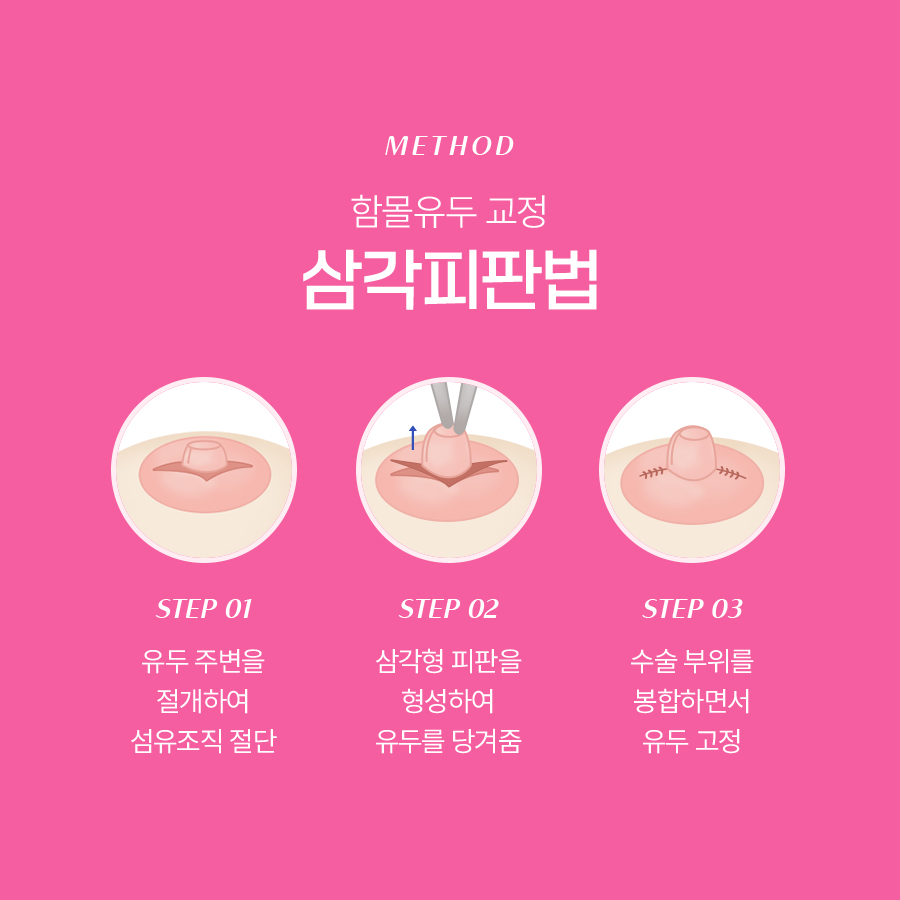
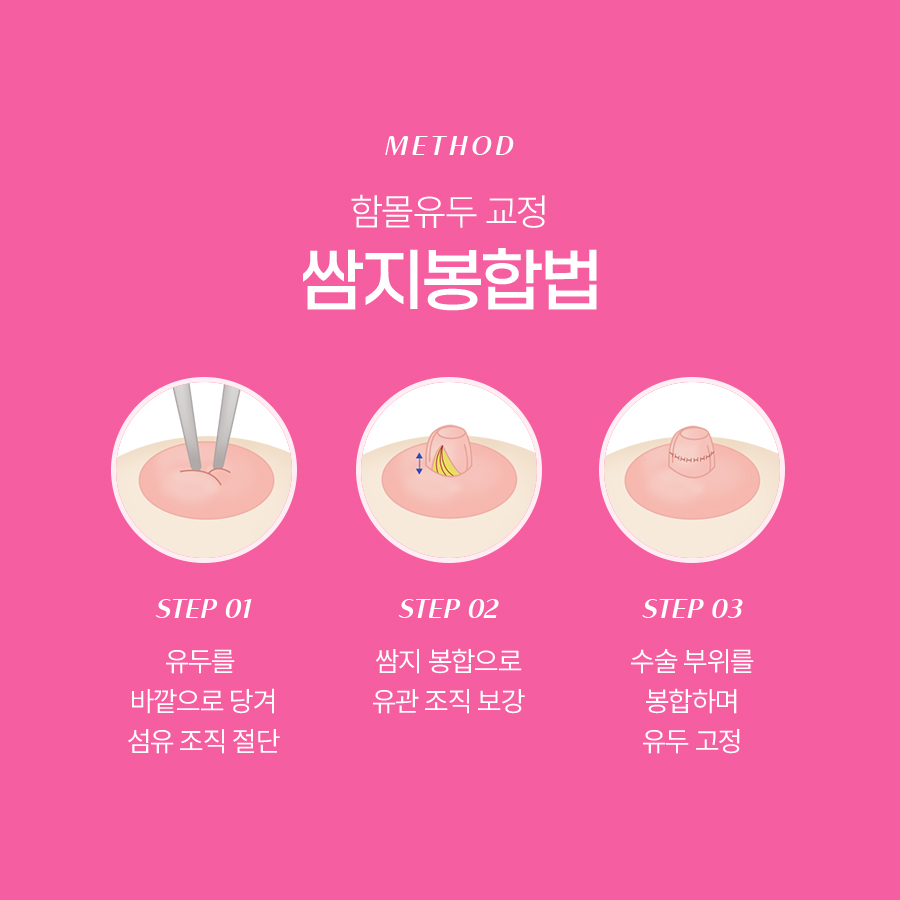
Rather than focusing on pulling the nipple outward, inverted nipple correction surgery aims to organize the causes that draw the nipple inward and help establish a stable position. It can be seen as a process of reconstructing the internal environment so that the structural tension that had been acting continuously beneath the nipple is relieved and the outward position can be maintained.
This approach is also why inverted nipple correction is described as structural adjustment rather than a simple change in shape. Recently, methods that minimize the incision range and design the suturing process in detail so that the contour and texture of the nipple blend naturally have been used. Although the detailed method may vary depending on the individual’s condition, the overall direction is focused on considering the nipple’s stability and harmony.
Classification criteria by degree of inversion
Inverted nipples can be examined in several stages depending on how far the nipple is drawn inward and how responsive it is. In relatively mild cases, the nipple appears without much difficulty when stimulated by hand, and the structural pulling is not very strong. In more advanced cases, even if there is a momentary response to external stimulation, it returns inward over time.
On the other hand, in deep inversion, almost no change in shape appears even with stimulation, so the arrangement of the tissues beneath the nipple must be considered more carefully. Because the degree of inversion differs from person to person, accurately identifying the current condition is the basic starting point when planning inverted nipple correction.

Situations that lead people to consider correction
People often become interested in inverted nipple correction surgery not so much because of a change in appearance, but because of discomfort in daily life. Correction may come to mind when the nipple is drawn inward and feels difficult to manage, or when the structure repeatedly inverts even without special stimulation. In addition, if there is a noticeable difference in the shape or position of the left and right nipples and balance becomes a concern, people often continue searching for related information.
In particular, when the inverted state has been maintained for a long time and it feels difficult for the change to improve naturally, some people consider whether a structural approach through inverted nipple correction is possible. Recently, more and more people are reviewing correction procedures from the perspective of considering not only appearance but also functional and hygienic aspects.
Inverted nipple correction surgery can be understood as a method that helps create a more stable condition by organizing the structure where the nipple is located. Although it is a relatively small area, it is a process that requires a careful approach that takes each person’s anatomical characteristics and balance into account.
Rather than viewing an inverted nipple only as a problem of outward appearance, understanding it as a feature connected to internal structure can be helpful in grasping the meaning of inverted nipple correction. I hope this article serves as informational material that helps you look at the overall flow and direction of inverted nipple correction surgery.