Triple-Plane Breast Surgery: A Three-Dimensional Approach Beyond the Dual-Plane Technique

Breast augmentation is no longer a procedure in which results are judged only by the position of the implant. It has expanded into the realm of three-dimensional planning that also takes into account the structure of the breast tissue and muscles, the elasticity of the skin, and everyday movement. In this shift, the technique drawing attention is the triple-plane method, which is characterized by a more refined approach than conventional surgical concepts, dividing the space where the implant sits into multiple anatomical layers for planning.
In particular, it focuses on the fact that the upper, middle, and lower portions of the breast each play different roles. Considering the flow of volume, the feel, and the formation of a natural line at the same time is the core of triple-plane breast surgery. Rather than simply being a change in technique, it can be seen as an evolved planning method that emerged from the trend toward structurally understanding breast augmentation.

The core of the “triple-plane” concept
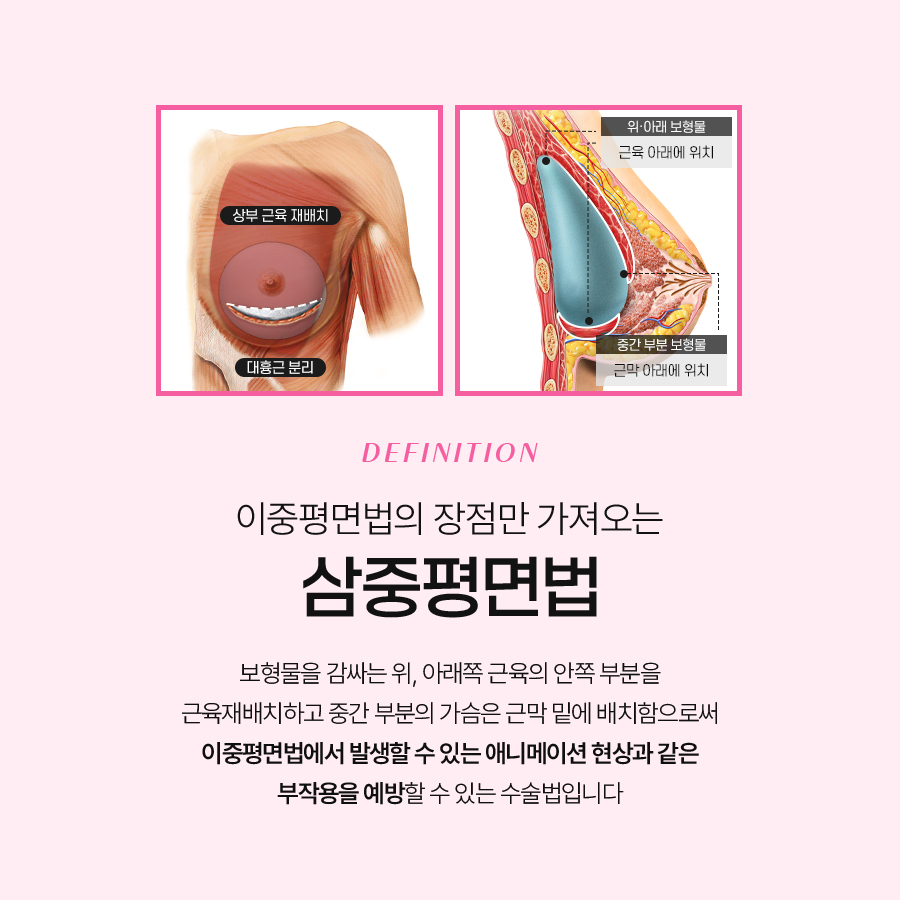
Unlike conventional methods in which the implant is placed in a single space, triple-plane breast surgery is designed by dividing the breast into three sections—upper, middle, and lower—and making use of the characteristics of each tissue layer. The upper section is centered on the lower pectoralis major muscle area, providing stable support and soft volume. The middle section uses the complex structure where the pectoralis major muscle and glandular tissue overlap to create a natural transition. The lower section is designed to complete a stable yet delicate line through fine adjustments in the space below the glandular tissue.
This layer-by-layer approach is based on the fact that the upper, middle, and lower portions of the breast each perform different roles. By maximizing the strengths of each space, it can be said to be the core principle for creating a more three-dimensional and natural breast line.
The breast line that triple-plane surgery aims for
Triple-plane breast surgery does not view the breast as one simple mass. Its core is customized, area-specific volume design, planning the upper, middle, and lower portions according to their respective roles and characteristics. The upper breast uses the strength and thickness of the pectoralis major muscle to form a natural, soft curve, providing stable volume without making the top of the breast appear excessively bulging.
The central breast is designed by using the intermediate layer between muscle and glandular tissue so that the upper and lower volumes connect smoothly. This creates a natural three-dimensional impression not only from the front but also when viewed from the side. The lower breast uses the space below the glandular tissue to secure both sufficient volume and stability, helping the overall contour of the breast finish in a full yet balanced way.
This approach, which optimizes and connects the three sections individually, differs from a surgery that simply inserts an implant. It can be described as a distinctive philosophy of triple-plane surgery, in that it involves delicate planning tailored to anatomical structure and body type.
Why did it need to be “triple”?
Traditional breast augmentation methods were largely limited to a binary structure, mainly placing the implant either under the muscle or under the glandular tissue, or simply combining those two layers. In reality, however, the breast is not a fixed shape; it changes in three dimensions during various movements such as lying down, turning to the side, or raising and lowering the arms. There is a limit to explaining these dynamic characteristics with only two layers, and triple-plane breast surgery was developed to address that point.
By dividing the upper, middle, and lower portions into different layers and planning each one separately, triple-plane surgery more precisely reflects the changes and volume flow that occur as the breast moves, helping to create a more natural and three-dimensional line. In other words, the core of triple-plane surgery is a planning philosophy that takes into account the movement and dimensionality of the breast, which cannot be captured in a single plane.

A new standard for natural-looking results
For many people, a natural-looking breast does not simply mean “not looking obvious.” In triple-plane breast surgery, naturalness means maintaining harmonious volume and curves when standing, moving, wearing clothes, and being viewed from different angles. To achieve this, triple-plane surgery does not see the breast as a fixed mass; it views it as a structure whose volume and lines respond naturally to the situation and movement.
The philosophy of naturalness unique to triple-plane surgery is to help the breast maintain a three-dimensional, balanced shape in various postures and movements by carefully designing the upper, middle, and lower portions as separate layers.
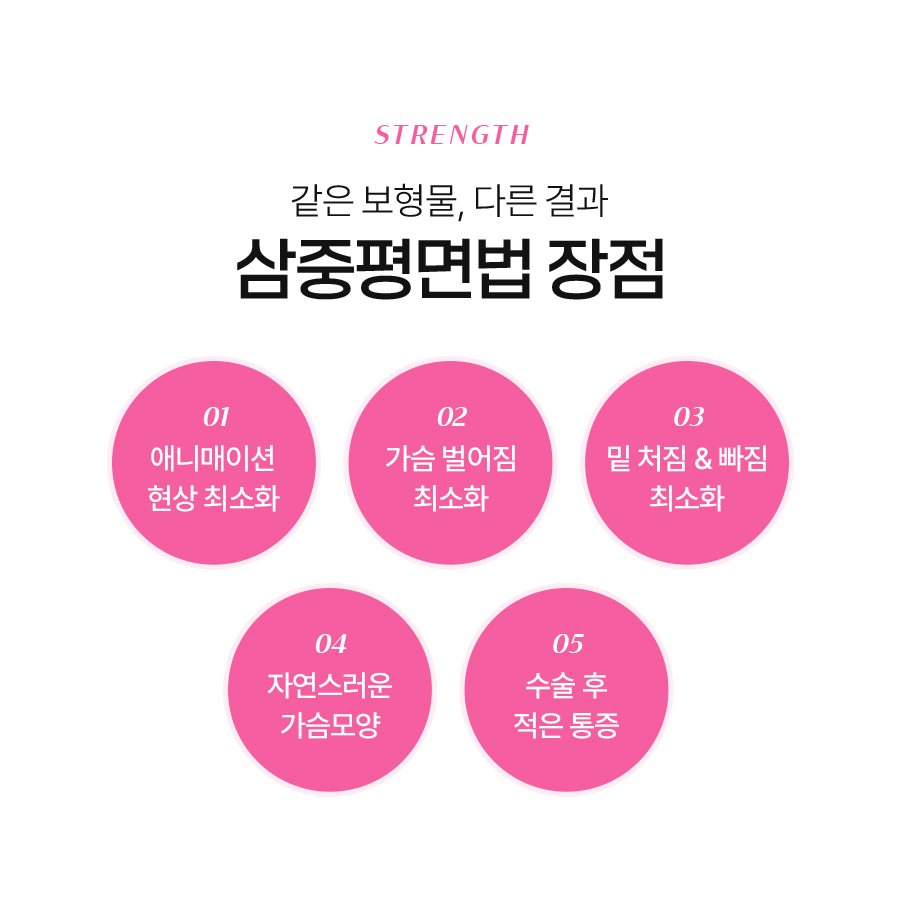
Triple-plane breast surgery is not merely a variation of the dual-plane method; it is an approach that expands breast augmentation into the realm of anatomical and three-dimensional design. By dividing the space where the implant is placed into three detailed planes—upper, middle, and lower—it allows for more precise adjustment of breast volume, feel, movement, and contour, leading to a more natural result that harmonizes with each individual’s body type.
Therefore, when considering breast augmentation, if you focus not only on how much larger it should be but also on how it should be structured, triple-plane surgery is a method worth understanding and considering.