The Secret to Natural-Looking Hybrid Breast Surgery

Recent breast augmentation trends have shifted away from simply increasing size and toward achieving more refined results. In the past, volume itself was the most important factor, but now the focus is on natural curves that harmonize with the body type, a soft feel with movement, and a careful balance between the upper and lower portions.
Within this trend, one method often mentioned as an alternative is hybrid breast surgery, which combines implants and autologous fat grafting to design both three-dimensional volume and natural-looking softness at the same time. In this article, we will systematically organize the key information, from the basic concept of the procedure to the process, suitable candidates, design considerations, and recovery stages, to help with understanding.
The Combination of Implants and Fat Grafting
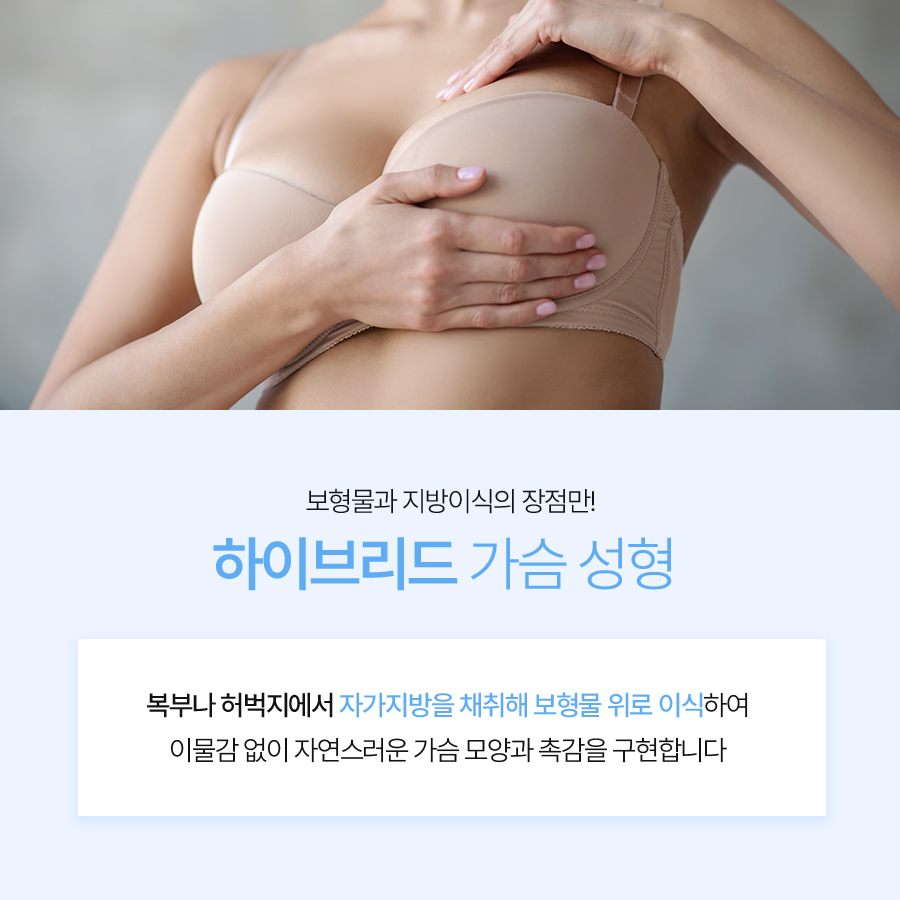
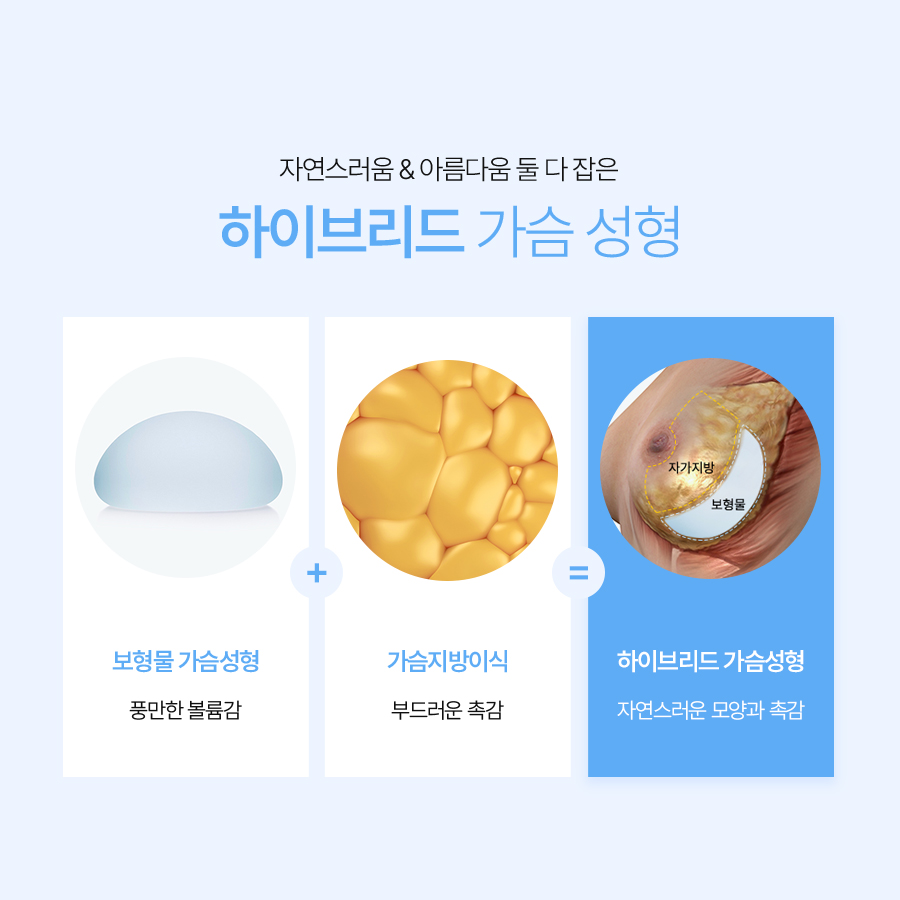
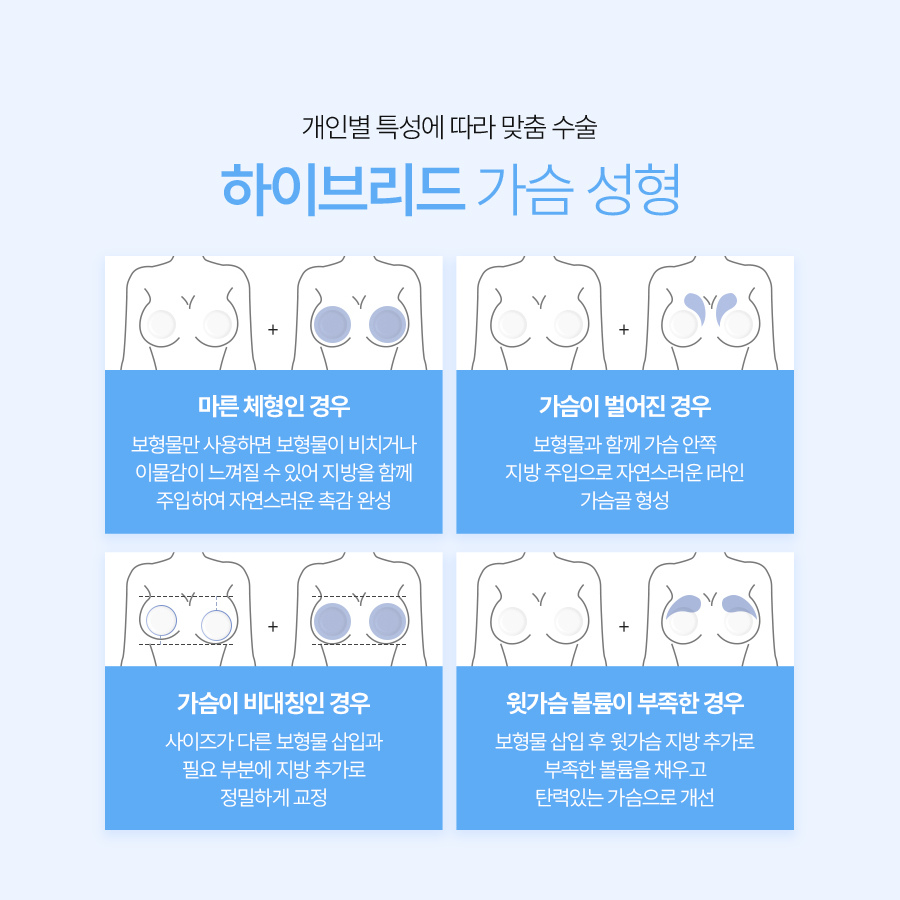
Hybrid breast surgery is a combined procedure that first secures the basic size and projection of the breasts with implants, then adds autologous fat grafting to soften and refine the contours. If the implant forms the central structure and establishes the overall height and volume, the fat is delicately grafted to the edges, upper area, or central area of the implant to reduce visible boundaries and make the texture feel more natural.
In other words, this is less about simply increasing size and more about a design approach that considers the three-dimensional curves of the breasts and how they harmonize with the body type. In particular, depending on skin thickness and the amount of existing breast tissue, hybrid breast surgery can finely refine lines that would be difficult to express with implants alone using fat, making it a surgical concept that pursues both volume and completeness.
Key Features of Hybrid Breast Surgery
The biggest feature of hybrid breast surgery is that it designs not only the visible volume but also the texture when touched and the overall proportions of the upper body. In cases where the skin is thin or the fat layer is insufficient, the edges of the implant may stand out. At that time, dividing fat into multiple layers above and around the implant can make the feel much softer and connect the appearance more naturally. In addition, for body types where the upper chest below the collarbone looks flat or hollow, carefully distributing small amounts of fat can create subtle upper volume without being excessive, gently improving the overall impression.
Because the procedure also comprehensively analyzes factors such as breast width, the degree of chest wall protrusion, and the proportions of the shoulders and waist, it can be seen as an approach that completes harmony across the entire upper-body silhouette rather than simply increasing size. In that sense, hybrid breast surgery is a method that pursues both delicate balance and naturalness.

Cases to Consider This Option
For those who are concerned that implant contours may stand out because their body type is slender, or for those who value texture and natural movement more than size, a more delicate approach is needed. In particular, when the upper chest below the collarbone is flat and the upper body looks underdeveloped, or when there is insufficient volume in the center of the breasts and cleavage is less defined, simple enlargement alone may make it difficult to achieve the desired image.
Also, even in situations where someone is considering revision surgery after a previous implant procedure because they want to soften the lines further, it is important to address the thickness of the tissue and the condition of the skin. In this way, if the breast tissue is thin or if you want to improve the overall completeness of the curves, hybrid breast surgery that uses both implants and fat grafting can be considered a method for adjusting volume and texture at the same time.
A Three-Dimensional Design Strategy That Determines the Final Result
In breast design, the important factor is not just size but the three-dimensional effect that looks different depending on the angle. First, upper volume below the collarbone can create an unnatural impression if it is filled too much, so the key is to create a gentle downward slope. Using fat at this point can produce a softer transition line. The central cleavage area also requires a different approach depending on each person’s chest width and projection. By carefully placing fat while considering the space between tissues, it is possible to encourage natural cleavage without being excessive.
In addition, not only the front view but also the flow of the curve seen from the side is important; the side line should not break abruptly but should be designed to connect organically with the upper-body line, which raises the overall quality of the result. The process of coordinating these three elements together is the core design stage of hybrid breast surgery.
Hybrid breast surgery combines the stable volume provided by implants with the natural texture created by autologous fat grafting, making it possible to complete a three-dimensional design that harmonizes with the body type rather than simply increasing size. Because it allows multiple factors to be considered at the same time, such as natural feel, detailed body-type correction, soft contour formation, and a three-dimensional silhouette, it is especially suitable for those looking for a personalized procedure that fits them.
Ultimately, breast augmentation is not just a simple enlargement procedure but a form of “design,” and setting the most suitable direction for each individual through sufficient consultation and body-type analysis can be said to be the most important step in achieving a satisfying result.