Understanding the Causes of Breast Capsular Contracture Is Essential for Safe Revision Surgery

As time passes after breast surgery, many people consider revision surgery because the breasts gradually feel firmer or seem to have changed shape. These changes may not be simple swelling or a temporary phenomenon, but may be related to the tissue response surrounding the implant. Among these, a key point often discussed is understanding the causes of breast capsular contracture. The human body forms a capsule to protect the inserted implant, and if this capsule becomes excessively thick or contracts, it can cause discomfort along with changes in appearance.
Therefore, it is important to systematically examine how symptoms begin, how they progress, and how revision surgery to improve them is planned. In this article, we will organize information on the background of capsular contracture, its stage-by-stage characteristics, and the key factors to consider during revision surgery.
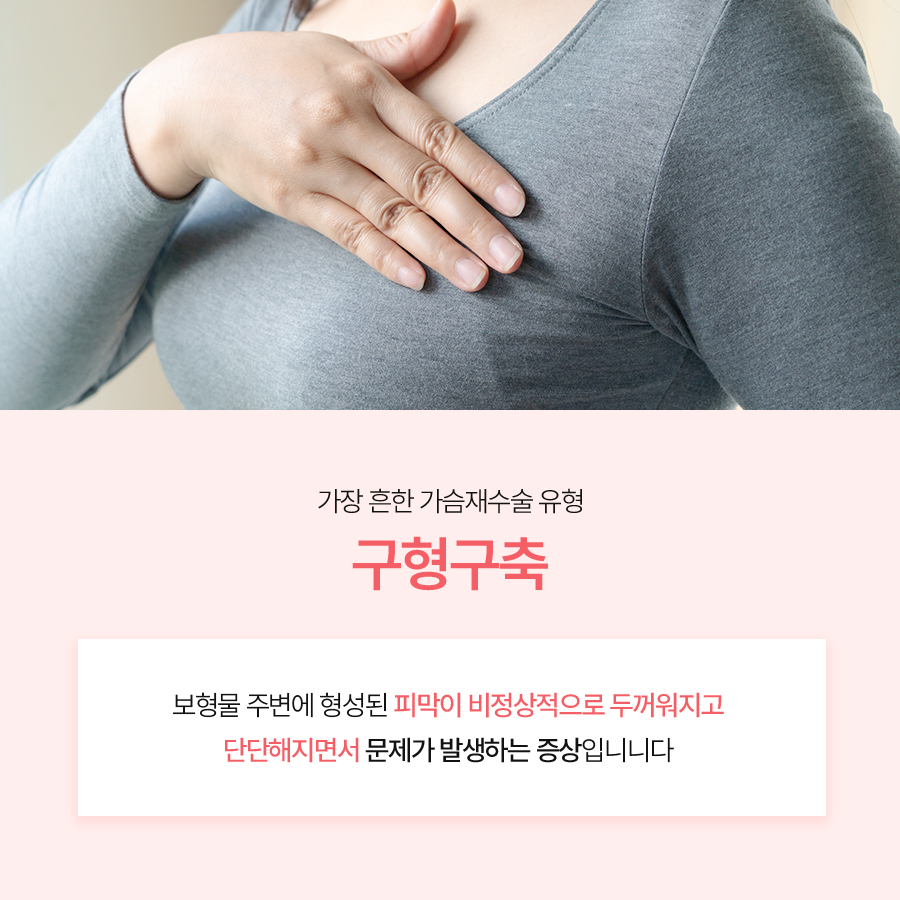
Concept of capsular contracture and how it forms
After breast surgery using implants, the body naturally forms a thin fibrous membrane to protect the inserted implant, and this is called a capsule. This is part of a normal immune response, and in most cases it remains soft and flexible. However, due to various causes of breast capsular contracture, if this capsule tissue becomes abnormally thick or contracts, it can tightly compress the implant.
When the capsule tightens in this way, the feel gradually becomes stiffer, and the breast may gather into a round, ball-like shape or appear to be lifted upward, creating changes in shape. Beyond simply feeling “hard,” the balance of the appearance may change and differences between the left and right sides may develop, which can also lead to psychological distress. Depending on the degree of progression, pain or a foreign-body sensation may also be felt. Therefore, it is important to understand capsular contracture not as a simple change in texture, but as a medical phenomenon in which the tissue response around the implant has progressed excessively.

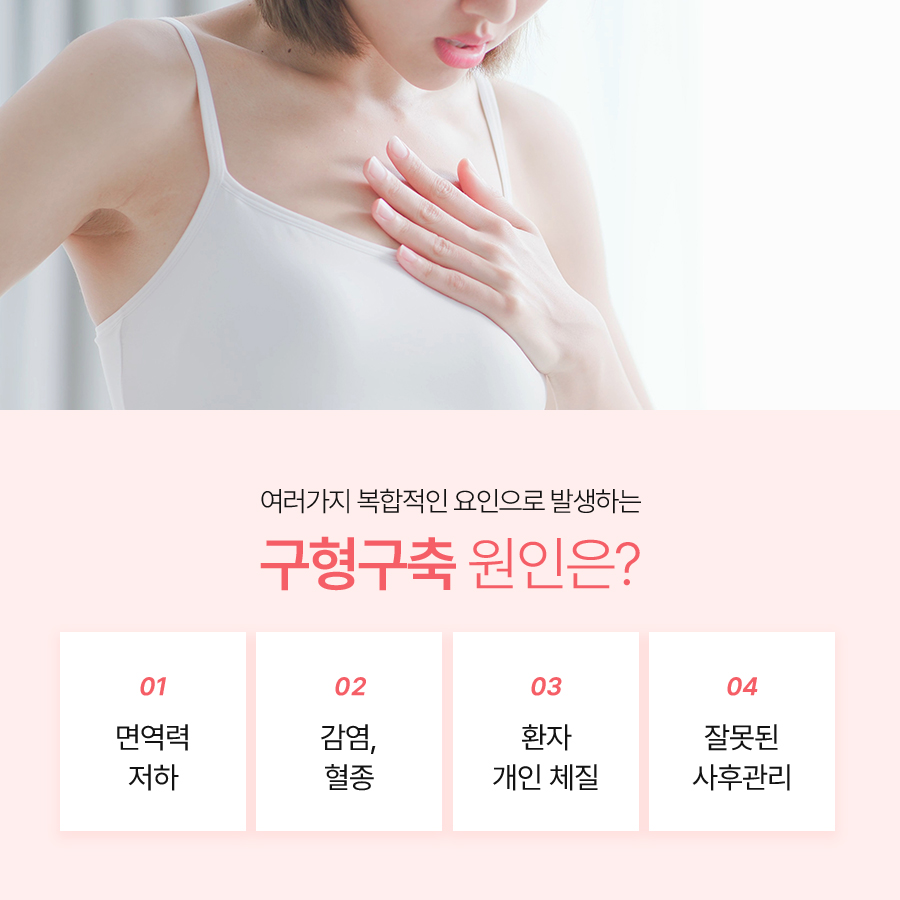
Complex factors that trigger capsular contracture
Capsular contracture often does not arise from a single cause, but from several overlapping conditions. Minor bleeding or hematoma that can occur immediately after surgery, as well as bacterial growth that is not easily visible, can stimulate an inflammatory response in the body and create an environment in which the capsule thickens. If this process continues, the tissue surrounding the implant is more likely to gradually harden.
In addition, factors such as which layer the implant is placed in and how much tissue damage was minimized during surgery can also act as important causes of breast capsular contracture. If dissection is excessive or hemostasis is insufficient, capsule formation may become more pronounced. Individual constitutional traits also play a role. In people who tend to form thick scars or who have sensitive inflammatory responses, the tissue reaction may become excessive even under the same surgical conditions.
Finally, care during the recovery period is also a variable. Excessive pressure, external impact, or strenuous upper-body exercise can interfere with tissue stabilization and promote capsule contraction. Ultimately, capsular contracture should be understood as a phenomenon formed through the interaction of the surgical environment, the body’s response, and post-operative care.
How capsular contracture changes by stage
Capsular contracture does not suddenly become severe; rather, it tends to progress step by step as changes accumulate gradually. In the early stage, there may be no major visible difference, and the feel may remain relatively natural, so many people do not notice significant inconvenience in daily life. However, as the tension of the capsule gradually increases over time, the breast may start to feel firmer than before. Later, even if the appearance seems to be maintained, internal pressure increases, elasticity decreases, and shape changes such as a more prominent upper portion or an overall rounded gathering may appear.
As it progresses further, the hardness becomes more pronounced, left-right asymmetry or positional changes may be observed, and in severe cases pain or pressure may accompany it. This flow is closely connected to the causes of breast capsular contracture, and as the tissue response continues, differences in appearance and texture become more evident. Therefore, even if no obvious deformity is visible, if a change in feel is detected, it is important to check the condition early and receive an accurate diagnosis.

The actual process of revision surgery for capsular contracture
Revision surgery for capsular contracture is not simply a matter of replacing the implant with a new one; it is closer to a process of comprehensively reorganizing the tissue environment that has already formed. The surgery begins with the safe removal of the currently inserted implant, during which the thickness and elasticity of the internal capsule and any damage to the surrounding tissue are carefully checked. The severely contracted capsule is then partially incised or removed as needed to relieve internal pressure, and this decision is made by comprehensively considering the causes of breast capsular contracture and the degree of progression.
In the next step, the space for the implant is redesigned. It is important to determine whether to keep the existing position or change to a different layer in order to create a more stable support structure. Finally, taking into account the patient’s body shape, tissue thickness, and previous surgical history, an appropriate implant is selected or its size and shape are adjusted. Recently, various materials and surface characteristics have made it possible to create individualized plans. In this way, revision surgery for capsular contracture can be seen as a high-level corrective procedure that requires precise judgment at each stage.
Capsular contracture can occur in anyone after breast surgery, but if you understand its course and characteristics accurately and respond appropriately, it is a problem that can be improved. In particular, the process of identifying the causes of breast capsular contracture should come first so that the direction of treatment and the revision surgery plan can be set more clearly. Revision surgery is not simply a matter of replacing the implant; it is a corrective process that stabilizes the already formed capsule and tissue environment again, so careful diagnosis and planning are especially important.
Therefore, it is advisable to have the current breast condition objectively evaluated and establish a customized strategy that takes into account your body type, tissue conditions, and previous surgical history. Understanding the surgical process and recovery care through sufficient consultation, and then making a careful decision, can be the first step toward a satisfying result.