Breast Revision Surgery Timing: Why Is Everyone Looking for the Triple-Plane Technique?

When planning breast surgery, the point that most patients think about most deeply is achieving soft texture and dynamic movement without an artificial look. But for those who already had unsatisfactory results from their first surgery and are now adjusting the timing of breast revision surgery, resolving the complex relationship between the implant and the muscle will be the top priority.
In the past, breast augmentation was limited to a simple planar approach of placing the implant either above or below the muscle. Recently, however, the triple-plane technique has been introduced, in which the upper, middle, and lower parts of the implant are three-dimensionally repositioned to match the body structure, dramatically reducing the foreign-body sensation. It has drawn attention as a unique alternative that goes beyond the limitations of the conventional dual-plane technique and naturally achieves spreadability when lying down.

Advanced Three-Dimensional Design: The Anatomical Principles of the Triple-Plane Technique
Unlike the conventional method of simply inserting the implant into the space in front of or behind the muscle, the triple-plane technique is a high-level design approach that separates the anatomical origin of the pectoralis major from multiple angles and reconstructs the points where the implant interacts with body tissue into three independent planes. In particular, for those who are considering the right timing for breast revision surgery due to implant rupture or capsular contracture, this technique is effective because it can distribute the muscle load differently by area according to each patient’s chest wall curvature and soft tissue thickness.
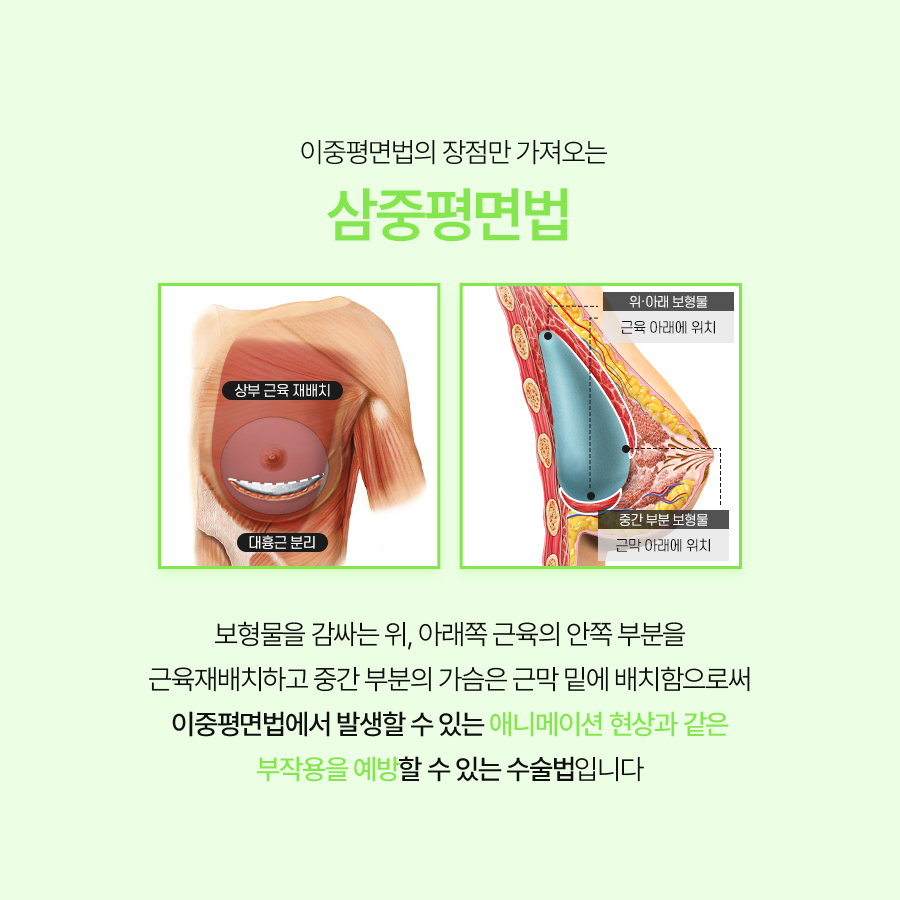
This means that the upper part of the implant is securely covered by the muscle, while toward the lower part the tissue tension is flexibly released. Beyond simply adding volume, it forms a customized pocket optimized for each person’s skin elasticity, fundamentally resolving the sense that the implant is floating separately from the body.
Why 'Triple'? The Role of Each Layer
The essence of the triple-plane technique lies in a mechanical design that differentiates the tension of the tissue surrounding the implant by area, bringing physical conflict with the body close to zero. First, in the upper plane, the pectoralis major firmly supports the implant to prevent edge visibility and rippling. In the middle transition zone, the muscle fibers are delicately separated so that the implant settles in harmony with the glandular tissue and forms the central axis of volume.
Especially when considering breast revision surgery timing due to side effects from a previous surgery, it is essential to fully release muscle pressure in the lower plane and reconstruct the space so that the implant can spread naturally in the direction of gravity. Through this detailed layer-by-layer design, where upper fixation and lower flexibility coexist, a dynamic mechanism similar to a real breast is completed—maintaining a teardrop silhouette when standing and flowing softly to the side when lying down.

The Distinct Advantages of the Triple-Plane Technique
The unique value of the triple-plane technique lies in the fact that the implant does not merely remain inside the body, but becomes perfectly synchronized with muscle movement to create a sense of unity. When raising the arms or flexing the chest muscles, animated deformation that makes the implant move awkwardly is fundamentally blocked through muscle-preserving surgery, and the rippling phenomenon in which the outer shell is felt through thin skin is also smoothly compensated for by strategically distributing tissue thickness by area.
If you are carefully reviewing the timing of breast revision surgery due to implant displacement or lower tissue deformity, the triple-plane technique exerts fixation power that reconstructs the collapsed inframammary fold structure from multiple angles and lifts sagging tissue, precisely correcting even the ‘double bulge’ phenomenon in which the nipple and the center of volume do not align.
As a result, the natural silhouette that follows gravity and the seamless feel during physical activity provide the highest level of aesthetic satisfaction for those whose elasticity has declined after pregnancy and childbirth or who want to overcome the limitations of a slim body type.
Who Is It Best Suited For?
The triple-plane technique is not applied uniformly to all cases; rather, its true value is even more pronounced in cases with challenging physical conditions or those requiring advanced correction. For people with a narrow chest width and tight soft tissue, where strong pressure is easily applied to the implant, or for slim body types with extremely little glandular tissue where the implant outline tends to stand out, this technique, which carefully distributes tissue by layer, is essential.
In particular, for those who want to identify the proper timing for breast revision surgery and achieve fundamental structural improvement due to asymmetry or shape distortion from a previous surgery, it becomes the optimal alternative for rebuilding the disordered plane structure in three dimensions, achieving symmetry, and restoring a natural silhouette.
In addition, fitness enthusiasts with high pectoral muscle activity and those who enjoy an active lifestyle can also enjoy both the comfort and aesthetic satisfaction of breasts that feel like their own in daily life through this technique, which minimizes the pressure and foreign sensation of the implant during muscle contraction.
In the end, the essence of breast surgery is not simply filling in missing volume, but a delicate process of three-dimensionally redesigning the internal structure to match each person’s unique anatomical curves. Especially if you are carefully adjusting the timing of breast revision surgery to overcome previous dissatisfaction with shape or limitations in touch, the triple-plane technique—which simultaneously achieves visual refinement and the flexibility of real skin—will serve as an excellent guide.
However, because the precision of dissection determines 80 percent of the result in the triple-plane technique, it must be supported by the skill of an experienced specialist who can closely identify nerves and blood vessels through advanced HD endoscopic equipment. Therefore, the surest key to completing a perfect silhouette without a second failure is to thoroughly analyze your chest wall skeleton and soft tissue density based on data and have an in-depth discussion with the specialist about the optimal layer-by-layer design ratio accordingly.